Cargo Nov 2, 2026
Cabotage Crackdown, Lower Border Tolls and Walmart’s $400M Investment Reshape U.S.-Mexico Logistics
Stricter U.S. enforcement of cabotage regulations threatens Mexican truck driver availability, while Nuevo León cuts commercial truck tolls by half and Walmart prepares a major distribution center in Texas expected to generate 425 jobs.
U.S. Cabotage Enforcement Raises New Concerns Over Cross-Border Trucking Capacity
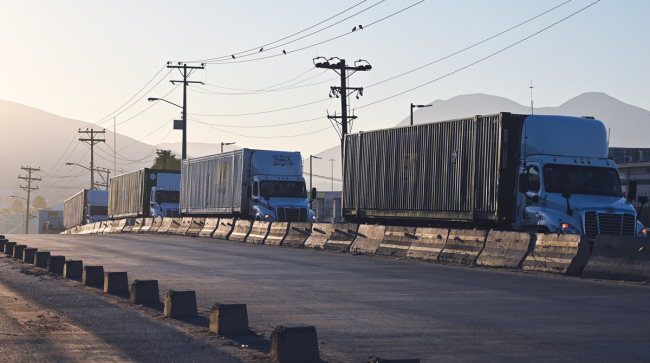
JACKSONVILLE, Fla. - Increased enforcement of U.S. cabotage regulations is creating additional uncertainty for Mexican truck drivers operating across the U.S.-Mexico border. Knight-Swift Transportation CEO Adam Miller believes the stricter measures could further constrain trucking capacity and complicate the movement of international freight.
Speaking to FreightWaves on Tuesday during the second annual WEX OTR Summit in Jacksonville, Florida, Miller explained that U.S. authorities have intensified their scrutiny of Mexican drivers, including investigations into potential cabotage violations involving previous employers.
“We’re seeing the enforcement really ramp up on cabotage,” Miller said.
Cabotage refers to domestic transportation between two locations within the same country by a foreign carrier. Under U.S. legislation, this type of activity is subject to specific restrictions designed to regulate the participation of foreign trucking companies in the domestic freight market.
Miller highlighted a particular concern for Mexican drivers whose employment history could expose them to enforcement actions. According to the executive, some drivers have lost their visas over alleged violations committed while working for other carriers, even when those incidents had no connection to Knight-Swift's own operations.
“I’ve seen them take visas away from drivers from really a previous carrier, not even cabotage with our trucks, with our company,” he explained.
Knight-Swift (NYSE: KNX), one of the largest full truckload transportation companies in the United States, operates a fleet exceeding 26,000 tractors and 96,000 trailers, supported by approximately 28,000 employees.
Its Mexican subsidiary, TransMex, headquartered in Nogales, operates more than 1,100 tractor-trailers and over 3,000 trailers, providing transportation services across the border.
Miller said the company applies strict compliance procedures to its cross-border activities. Nevertheless, he warned that the growing pressure from U.S. authorities could discourage Mexican drivers from continuing to operate in the American market.
As enforcement expands, the availability of qualified drivers could become increasingly limited.
“I do feel like that type of capacity is going to get a little bit tighter as enforcement ramps up,” Miller said.
Nearshoring offers long-term growth opportunities despite trade uncertainty
The enforcement developments come at a time when Mexican trucking companies are increasingly concerned about visa restrictions and the potential loss of drivers authorized to transport international freight.
Despite these difficulties, Miller remains positive about the long-term outlook for U.S.-Mexico trade. He believes Mexico will become an increasingly important part of North American supply chains as companies continue relocating manufacturing operations closer to the U.S. market.
“I think long term I think Mexico is going to play a bigger role,” he said. “I think you’ll see more opportunities because of the nearshoring.”
However, the executive also pointed to tariffs and changing trade policies as significant sources of uncertainty for transportation companies and their customers.
“Tariffs are a big unknown,” Miller said.
Knight-Swift has considerable exposure to cross-border automotive freight. According to Miller, some of the company's customers have already begun modifying their transportation strategies as tariff developments reshape their supply chain decisions.
“Our customer strategies are changing as the tariff situation develops,” he added.
The combination of stricter driver enforcement and unpredictable trade policies could therefore create additional pressure on freight capacity, even as nearshoring continues to support demand for transportation between the two countries.
Nuevo León Slashes Toll on Colombia Bridge by 50% to Increase Cross-Border Freight
The Mexican state of Nuevo Leon is offering a 50% reduction in additional toll charges for commercial trucks that use the Colombia-Solidarity International Bridge to make the crossing more attractive to freight operators and boost exports to the United States.
The measure focuses on a state-imposed fee levied about 500 meters before the current bridge tollbooth on the Mexican side of the border.
The additional charge was first applied on April 14, 2025, under the administration of Nuevo León’s Governor Samuel García.
This week’s announcement is for a new cut in this state toll alone. It does not impact the individual tolls collected by the City of Laredo, Texas.
The initiative is designed to improve the competitiveness of the Colombia-Solidarity route by lowering the cost of access crossing and to motivate logistics companies to divert more commercial truck traffic through the port of entry.
Lower transportation costs may encourage carriers and exporters to explore other routes for shipments between Mexico and the United States.
“There are major economic benefits in coordinating our efforts to reduce border-related expenses,” Treviño said.
"By collaborating to reduce tolls and fees, we can help reduce transportation costs, aid businesses and bolster the flow of goods through our region," Treviño said, the Laredo Morning Times reported.
The Colombia-Solidarity International Bridge connects Nuevo Leon with the Laredo area and is an alternate crossing for commercial shipments moving between the two countries.
The toll cut aims to strengthen its role in the regional logistics network by reducing the cost of cross-border trucking operations.
Walmart Presses Ahead With $400M Distribution Center Project Near San Antonio
Walmart is making a major bet in Texas, with plans for a $400 million distribution center in Cibolo, northeast of San Antonio. The development is expected to enhance the retailer’s logistics infrastructure and create at least 425 full-time jobs.
The San Antonio Express-News reported the proposed project, code-named “Project Theo,” would be located on about 126 acres at 3641 S. Santa Clara Road.
Documentation filed with the Texas Department of Licensing and Regulation describes a 712,500-square-foot warehouse and a 31,933-square-foot office building next door.
Construction is due to commence in February 2027 and the facility is scheduled to be completed by August 2029.
425 jobs and key local economic incentives
In addition to its logistics capacity, the project is expected to add significant employment opportunities to the Cibolo area.
Walmart expects to generate at least 425 full-time positions paying above the median wage in the San Antonio metropolitan area.
Cibolo officials had earlier approved an incentive package totaling some $32.5 million to land the investment.
The deal calls for a 10-year, 75% property tax abatement, a significant financial incentive for the development.
Local officials have praised the proposed site as a state-of-the-art distribution center, blending advanced technology with on-the-ground human know-how.
The warehouse will have robotics, advanced warehouse equipment and employees to manage and support automated processes.
Improving Walmart’s distribution in Texas
If approved, the proposed development would further extend Walmart’s distribution footprint along the Interstate 35 and Interstate 10 corridors.
These highways are major freight arteries connecting San Antonio, Austin and other important Texas markets, making the location strategically important for regional distribution activities.”
The investment underscores the ongoing importance of logistics infrastructure in enabling retail distribution as operators ramp up the use of automation and sophisticated equipment in warehouse operations.
Why These Developments Matter for the Logistics Industry
The three developments suggest different forces at work in freight transportation between Mexico and the United States today.
Tighter cabotage enforcement could mean fewer Mexican drivers available for cross-border runs, potentially adding capacity constraints to supply chains that are already facing uncertainty over tariffs.
Meanwhile, Nuevo León’s decision to cut the toll charges on the Colombia-Solidarity International Bridge in half indicates that regional authorities are trying to attract freight traffic with reduced transportation costs.
Meanwhile, Walmart’s planned $400 million distribution center is a major expansion of logistics infrastructure in Texas, combining automation, job creation and enhanced distribution capabilities.
All these developments underscore the increasing strategic importance of the U.S.-Mexico logistics corridor, where regulatory changes, transportation costs, nearshoring and investment in modern distribution facilities will continue to influence freight flows and supply chain decisions.
END OF REPORT