



Motive has secured more than $1.3 billion in growth financing from General Catalyst, giving the fleet technology company substantial new capital to accelerate its artificial intelligence strategy while allowing it to remain private for the time being.
The San Francisco-based company announced Thursday that it had withdrawn its previously filed S-1 registration statement. The decision comes as Motive reports record financial momentum, with annual recurring revenue (ARR) surpassing $600 million during its strongest quarter to date.
Overall ARR growth accelerated to 30% year over year. The performance was even stronger among Motive’s largest customers. ARR generated by customers spending more than $100,000 annually increased by nearly 60% from a year earlier, while net revenue retention for that group exceeded 120%.
As part of the transaction, Pranav Singhvi, a managing director at General Catalyst, has joined Motive’s board of directors.
Growth capital aimed at AI and commercial expansion
Motive plans to use the new financing to increase investment in AI throughout its platform while expanding its sales, support and service organizations.
The funding is therefore intended not only to support the development of new AI models and products, but also to put more people in the field and strengthen the company’s commercial reach.
Earlier this year, Motive appointed Thomas Hansen as its first president of go-to-market. Hansen previously held roles at Amplitude, UiPath, Dropbox and Microsoft, bringing extensive experience from several major technology companies.
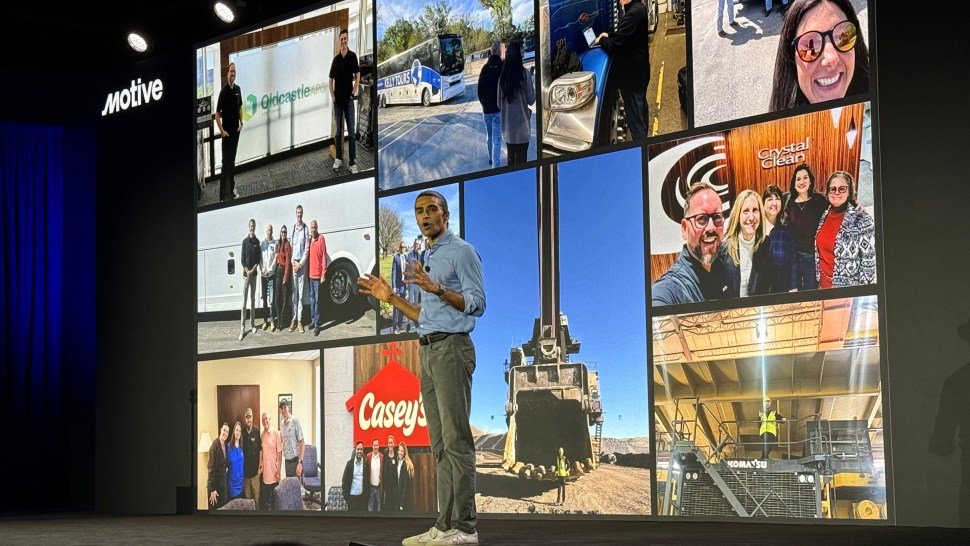
Motive currently serves nearly 100,000 customers, ranging from small fleets to Fortune 500 companies. Its customer base spans trucking, construction, energy, field services, manufacturing, agriculture and other industries that rely on physical operations.
Public listing remains a future possibility
The new financing also changes the immediate trajectory of Motive’s plans for the public markets.
Makani said the company decided to withdraw its S-1 because the new capital provides enough financial flexibility to continue operating privately while making significant investments in the business.
“With this financing, we’re very well capitalized. We withdrew our previously filed S-1,” Motive Co-founder and CEO Shoaib Makani told FreightWaves.
He emphasized, however, that the decision does not rule out a future IPO.
“But we remain very well positioned for the public markets in the future. Motive has the operational capacity and the growth profile, to be a public company. With this financing we can continue to operate privately, but with the resources to invest aggressively.”
Motive’s technology is already deployed across more than 1 million commercial vehicles, according to Makani. He estimates the North American commercial vehicle market at approximately 30 million vehicles, giving the company a current penetration rate of roughly 3%.
That leaves what Makani sees as considerable room for expansion.
“The TAM here is hundreds of billions of dollars, and we’re just scratching the surface,” he said.
Motive CFO Chirag Shah also linked the financing directly to the company’s product development plans and efforts to build a larger sales organization.
“From our earliest conversations, it was clear that General Catalyst shares our long-term vision for building Motive into a generational business,” Shah said.
“Our momentum has never been stronger, and this financing will allow us to compound that for years to come through continued cutting-edge product innovation and scaling our go-to-market engine.”
AI moves from detection to action
Motive’s AI strategy builds on technology it has been developing for years. The company has been deploying AI-powered cameras since 2017 to identify potentially dangerous behaviors such as phone use, driver fatigue and inadequate following distances.
Makani estimates that fewer than 20% of commercial vehicles currently use such cameras, despite his view that the technology can generate returns several times greater than the cost of the hardware.
The latest financing is expected to help Motive broaden that technology into additional applications, including its newly launched Maintenance and Operations Intelligence platform.
The company’s ambition is also shifting beyond simply identifying problems and notifying users.
“For many years, we’ve been detecting unsafe behavior and alerting drivers. But now we can actually take interventions with agents. It doesn’t just end up in a dashboard somewhere. It actually gets acted on.”
Those AI agents could, for example, remove a driver from the road following a high-risk behavioral pattern, automatically schedule a repair after identifying a vehicle defect, or detect potential fraud involving a fuel card.
The broader objective, Makani said, is to create an AI layer capable of monitoring physical operations and taking action rather than simply producing information for a human operator to review.
“Motive is building the intelligence layer for the physical economy,” Makani said in the company’s announcement.
“AI that can see what’s happening on the road and in the field, understand what matters, and take action. For our customers, that means preventing collisions, avoiding downtime, and eliminating manual work.”
General Catalyst bets on physical and edge AI
For General Catalyst, the investment reflects the growing importance of AI applications operating directly in physical environments.
Singhvi pointed specifically to Motive’s combination of cameras, connected equipment and AI capabilities deployed in the field.
“The physical AI market, and edge AI specifically, represents one of the most compelling long-term opportunities we see today,” Singhvi said.
“Motive is at the forefront of that, with the market-leading platform that puts AI to work in the field, on the road, and on the job site in ways that deliver immediate, tangible ROI to customers.”
He also argued that Motive’s underlying business has continued to strengthen as the company has scaled.
“This has helped Motive become one of the rare businesses we have come across whose fundamentals continue to grow stronger with scale, and we have no doubt the best is yet to come.”
Makani sees physical AI still in its early stages
Despite Motive’s current scale, Makani believes adoption of AI across the physical economy remains at an early stage.
“I think we’re in the very early innings,” he said.
Over the next decade and beyond, he expects companies operating in physical industries to increasingly rely on AI to improve both safety and productivity.
“Over the next decade-plus, you’ll see the physical economy leverage AI to improve safety and improve productivity,” Makani said.
He believes the companies willing to adopt the technology early—and those prepared to move most aggressively will ultimately have an advantage.
“The early adopters and the more aggressive adopters are the ones that are going to run better businesses.”