



Pharmaceutical logistics is enjoying a period of strong growth, but that favourable environment should not be confused with long-term protection from structural change.
A warning is emerging from two industries that share many of the characteristics of pharmaceuticals: chemicals and automotive manufacturing. Both depend on complex supply networks, major R&D investments, specialised engineering skills, substantial energy requirements and tightly connected production processes. Both also rely on ecosystems in which manufacturers, suppliers and logistics providers work closely together.
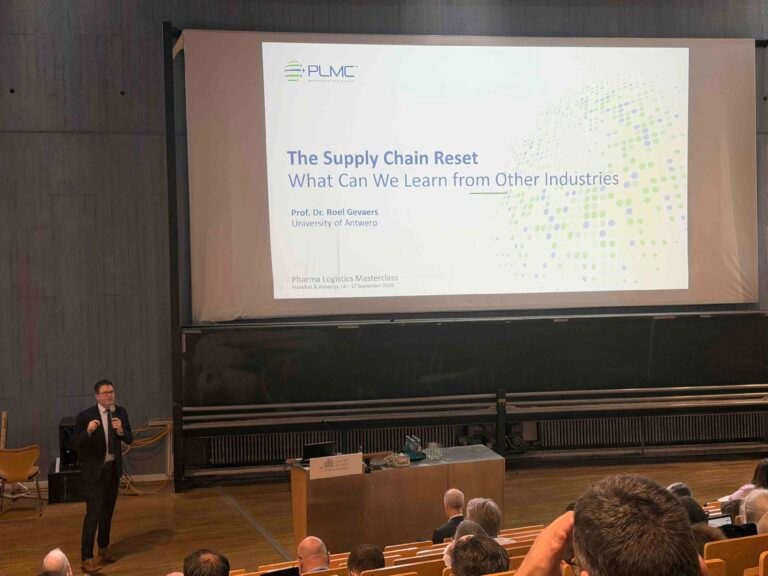
The issue was highlighted by Professor Dr. Roel Gevaers of the University of Antwerp during Day One of the 2026 Pharma.Aero Masterclass at the Frankfurt University of Applied Sciences.
“Why shouldn’t we be worried? Pharmaceutical logistics is a huge sector, quite well doing, with huge growth rates today, so what should be worrying about it?” Gevaers asked. He argued that looking at older industries can provide valuable clues about what may happen next.
The chemical industry’s warning
The European chemical industry offers one of the clearest examples of how an industrial ecosystem can gradually lose strength.
Production has fallen significantly over the past decade, while investment in European chemical industries declined by 80 percent in 2025.
Part of the explanation lies in the long-standing decision by European and US companies to move basic, lower-value manufacturing offshore while keeping more complex and higher-value activities closer to home.
China took a different route.
Rather than treating basic manufacturing as an activity to abandon, Chinese companies increasingly used it as a foundation from which to develop technology, engineering capabilities and broader control of the value chain.
“The chemical industry was heavily relying on what you call ecosystems of clustering,” Gevaers explained. “Europeans and Americans started to say we can offshore the basics, the cheap products, and focus on the high-value, more complex products. China did exactly the opposite.”
The evolution of Chinese chemical companies illustrates this approach. Some began as subcontractors for international manufacturers, then progressively expanded their capabilities, acquired European businesses and moved into increasingly sophisticated products.
The result was a transition from contract manufacturing towards control of a much wider portion of the value chain.
For pharmaceuticals, that development matters because a manufacturing base can accumulate knowledge, technology, engineering expertise and supplier relationships over decades, potentially transforming the competitive landscape.
What automotive manufacturing reveals
The automotive industry provides another powerful example.
Chinese vehicle manufacturers have undergone a dramatic transformation. Many initially entered the sector through partnerships or contract manufacturing before developing their own technologies, brands and supplier ecosystems.
Companies once regarded primarily as low-cost vehicle producers are now competing internationally in electric vehicles and other advanced technologies.
Their competitive advantage is no longer simply about manufacturing costs. It increasingly comes from their ability to bring components, suppliers, technology and production together within a single ecosystem.
“Many of these manufacturers started as subcontractors, or they started from a totally different industry, but then they started to add parts and parts and ecosystems around the whole value chain,” Gevaers said.
“What is interesting is the vertical integration and the ability to integrate everything and build the ecosystem around their own system.”
Electric vehicles make this evolution particularly visible. Battery technology, software, electronics, vehicle manufacturing and charging infrastructure are becoming increasingly interconnected.
BYD is one example. Capabilities developed through battery manufacturing have helped the company establish a broader position across the electric vehicle ecosystem.
Xiaomi offers another example from a different direction. Having started in consumer electronics, the company was able to transfer its expertise in electronic systems into automotive manufacturing, an industry where software and electronics are becoming increasingly central to the vehicle itself.
The broader lesson for pharmaceuticals is significant: industrial boundaries can move faster than companies expect.
A future competitor does not necessarily have to enter through the traditional pharmaceutical route. It may instead bring capabilities from an adjacent industry and use them to construct an entirely new ecosystem.
From outsourcing to integration
At the heart of both examples is a fundamentally different approach to the value chain.
For decades, European and US businesses embraced outsourcing, concentrating on core competencies while breaking larger industrial ecosystems into specialised components.
China has increasingly pursued the opposite strategy: integrating production, suppliers, engineering and technology in order to gain greater control over the complete value chain.
“Instead of breaking value chains and ecosystems into bits and pieces, they do exactly the opposite: integrate everything again, make again the ecosystems,” Gevaers said.
He also warned against assuming that maintaining a focus on R&D and high-end activities will automatically protect Europe and the US from future competition.
“If we believe in Europe and the USA that focusing on R&D and the high-end will be enough because China or maybe India will never be able to make it, that will be wrong.”
This does not mean pharmaceutical companies need to bring every operation in-house.
The more important question is whether companies understand where strategic dependencies are emerging and whether they retain enough capabilities to react if those dependencies eventually become vulnerabilities.
That could also change the role of logistics.
Supply chains built around fragmented production and long-distance transportation may eventually look very different from geographically and operationally integrated industrial ecosystems.
The engineering talent equation
Behind the manufacturing discussion sits another critical factor: engineering capacity.
Figures presented during the session showed that the European Union produces considerably fewer engineering graduates than China. China’s enormous domestic market provides scale, but its ability to train and deploy large numbers of engineers also gives manufacturers significant capacity to develop technologies, production systems and integrated supply chains rapidly.
The challenge therefore goes beyond manufacturing costs.
Industrial competitiveness depends increasingly on the ability to design, operate and continuously improve sophisticated production ecosystems.
“If you look at the engineering graduates, the European Union has a much smaller number, while China has around 1.5 million,” Gevaers said.
“Even if you want to change it now, they will still have huge capacities to keep on investing and integrating.”
For pharmaceutical logistics, this represents a strategic issue as much as an industrial one.
A different supply chain strategy
The pharmaceutical industry has traditionally benefited from concentrating on high-value activities while sourcing less differentiated inputs from elsewhere.
Gevaers’ warning is that this model could become increasingly exposed if competitors adopt the same integration strategy already visible in the chemical and automotive sectors.
China’s development in both industries demonstrates that beginning with lower-value manufacturing does not necessarily mean remaining there.
Subcontracting can provide a route to acquire knowledge, establish supplier relationships, develop engineering capabilities and progressively move into more complex products.
For Europe and the US, the challenge is therefore broader than protecting today’s pharmaceutical production.
The question is whether the industrial ecosystems required to support tomorrow’s production are being built today.
“Many of us were taught that the main way of management was to outsource everything and focus on your core,” Gevaers said.
“That was taught by many universities and colleges over the past 30, 40, even 50 years, but China is not teaching that.”
For pharmaceutical logistics, the implications could be substantial.
The next supply chain reset may not be driven primarily by tariffs, freight rates or individual sourcing decisions. It could instead emerge from a much broader competition over how industrial ecosystems themselves are designed and built.
Companies that continue to optimise individual links in their supply chains could ultimately find themselves competing against businesses that have designed the entire chain around their own capabilities.
The experience of the chemical and automotive industries suggests that once such a transformation is well underway, catching up can be considerably more difficult than anticipating it.
“It’s not only about production and manufacturing; it is highly linked to logistics, R&D and engineering,” Gevaers concluded. “That’s why we should have an idea about what is happening and understand that these changes are not only about tariffs or trade policy, but about how entire ecosystems are being built.”