



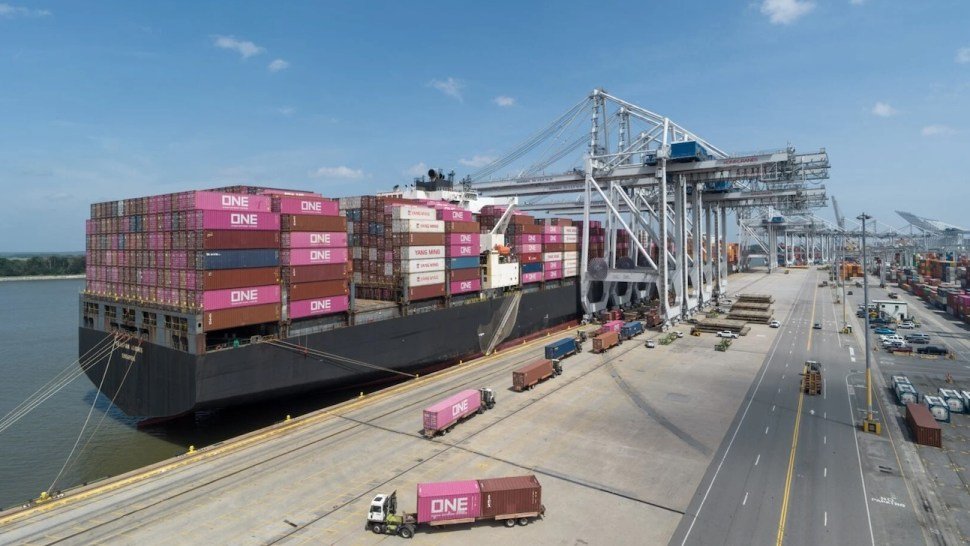
The Port of Savannah moved 529,523 TEUs in August, keeping container traffic essentially in line with the same month last year despite weather-related disruptions in Asia and water-level constraints affecting the Panama Canal.
August throughput was down by less than 1% year over year. Loaded exports provided some positive momentum, increasing 4.2%, or nearly 4,700 TEUs, to 117,242 TEUs. Loaded imports also edged higher, rising 1.5%, or approximately 3,800 TEUs, to 265,859 TEUs.
“Asia weather and Panama Canal water levels are being felt in August supply chains. For September, we are seeing strong numbers on the water and the Suez Canal seems to be picking up,” Georgia Ports Authority Chief Executive Griff Lynch said.
Lynch said underlying customer demand for Savannah remains strong, but noted that typhoons in Asia and El Niño conditions affecting Panama are having an impact on cargo volumes.
Across Georgia Ports Authority facilities, 1.03 million TEUs were handled during July and August, the first two months of the authority’s fiscal year. That figure represents an increase of 22,537 TEUs, or 2.2%, compared with the corresponding period a year earlier.
“We’re off to a strong start, with more than a million TEUs moving through Georgia’s ports in the first two months of the fiscal year,” GPA President Kevin Price said. “At the same time, we’re improving truck efficiency.”
That improvement was reflected at Savannah’s Garden City Terminal, where average truck turn times for dual import-export transactions reached 43 minutes in August. That was 6.5 minutes faster than the terminal’s previous six-month average.
Dual transactions account for nearly 80% of truck activity in Savannah. Garden City Terminal handles approximately 15,000 truck gate transactions every weekday, operating between 4 a.m. and 6 p.m.
Inland Port Rail Volumes Set New Record
The Appalachian Regional Port also recorded a strong month, with August volume increasing 10% compared with August 2025.
For the first two months of the Georgia Ports Authority’s fiscal year, volumes at the inland rail facility were more than 25% higher than during the same period a year earlier.
At the Port of Brunswick, heavy machinery traffic also increased significantly in August. The port handled 4,726 units, an increase of 3,884 units, or nearly 22%, compared with the same month the previous year.
However, total automobile and heavy-machinery volume at Brunswick stood at 60,572 units, down 3,348 units, or 5%, year over year.
According to the Georgia Ports Authority, part of the decline was linked to stronger competition facing luxury vehicle manufacturers from Chinese domestic producers. That competitive pressure has contributed to lower U.S. vehicle exports to China.
Meanwhile, work on a fourth berth at Brunswick’s Colonel’s Island terminal has reached the halfway point.
The $100 million construction project is scheduled to be completed in November 2027. Once operational, the additional berth will enable the port to accommodate vessels carrying more than 7,000 vehicles.
Why It Matters
Savannah remains an important container gateway serving the East and Gulf coasts. Its container throughput provides a useful indication of several areas of the broader supply chain, including import demand, retailer replenishment, manufacturing supply flows and exporters’ access to international markets.