



Tesla is preparing to bring its Semi to European roads, with demonstrations planned for the first half of 2027 and customer deliveries targeted for the end of the year. Dan Priestley, Tesla’s head of Semi, outlined the timetable during a keynote at IAA Transportation 2026, confirming that the first trucks destined for Europe will be built at Tesla’s facility outside Reno, Nevada.
Priestley gave the timeline in response to a question about whether Tesla had already opened a European order book.
“What we’re working on right now is lining up customers that are highly interested in experiencing the truck through demonstrations in the first half of next year, with the opportunity then to take delivery, targeting by the end of next year,” he said.
Homologation changes for the European truck
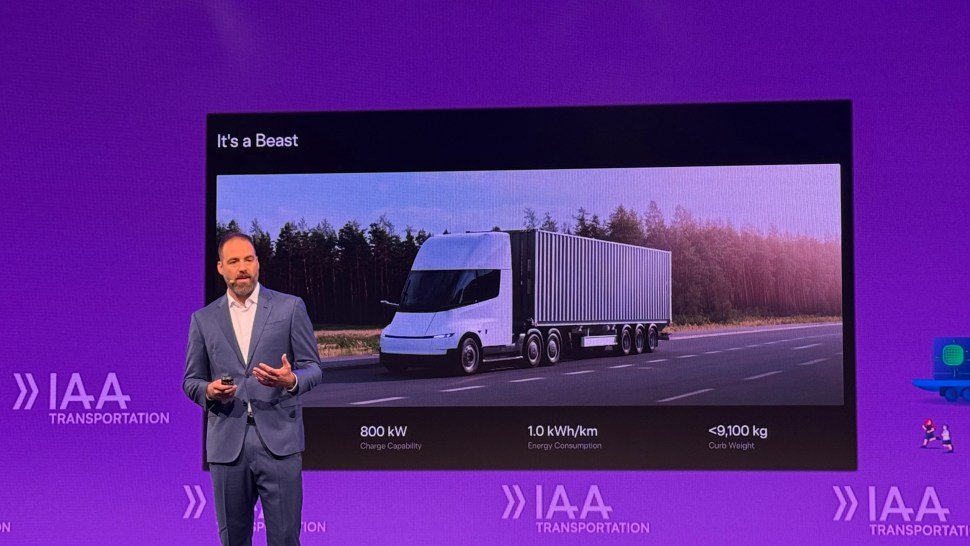
Tesla’s European Semi is rated for 550 kilometers of usable range, or roughly 342 miles, with consumption of 1 kilowatt-hour per kilometer, equivalent to about 1.61 kilowatt-hours per mile.
Both figures are based on a 40-metric-ton gross combination weight, or 88,185 pounds. That is above the 82,000-pound gross combination weight rating used by Tesla for the North American version. The European truck has a curb weight of 9,100 kilograms, or approximately 20,060 pounds.
The Semi can accept up to 800 kilowatts of charging power. Priestley said that allows the truck to recover more than 60% of its range in 30 minutes, representing around 300 kilometers, or 186 miles. Tesla’s published European specification sheet confirms the 60% figure but does not specify the recovered distance in kilometers.
The tractor is also designed to operate at up to 44 metric tons, approximately 97,000 pounds, for drayage and container operations.
Under the European configuration, the truck is essentially Tesla’s North American standard-range Semi, which Priestley said has a 325-mile range. The European rating of 342 miles at a higher operating weight therefore reflects a different testing cycle rather than a larger battery pack. Tesla has not announced a long-range European version.
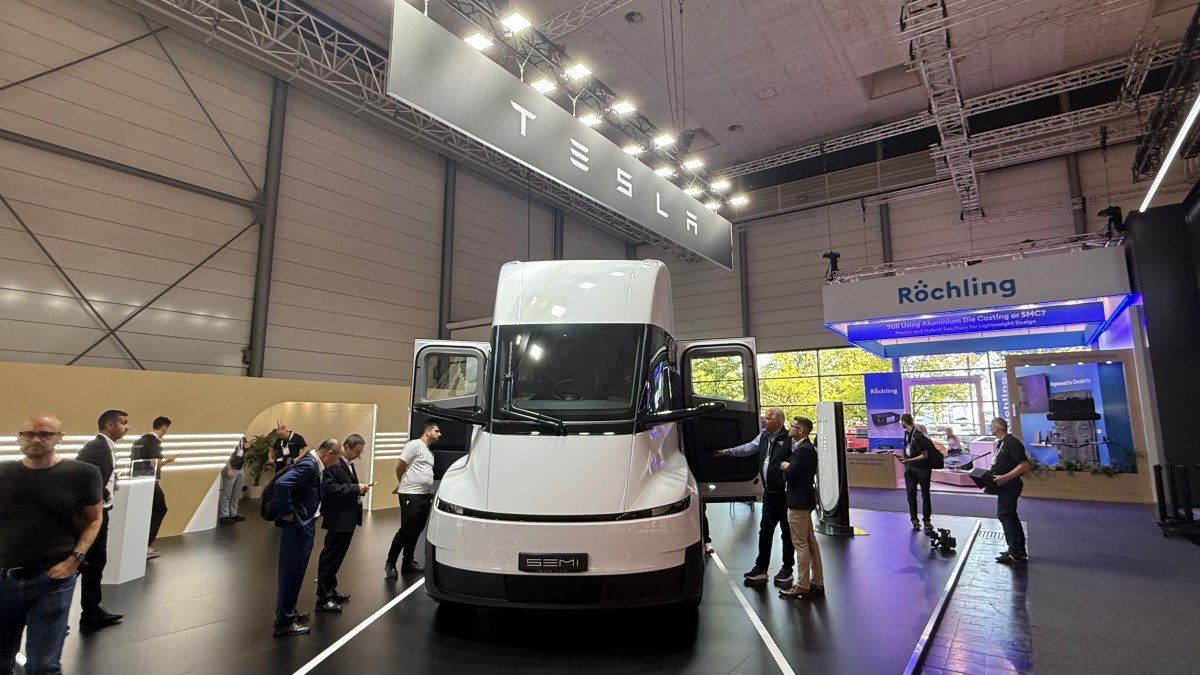
“All the major technology pieces, the frame rails, the chassis, battery pack, drive axles all of them are the same,” Priestley said. “They’re the underpinnings. The exact same vehicle, the same wheelbase.”
The European Semi retains a three-axle configuration, adding a third axle compared with the setup more commonly seen on European trucks. Two of the axles are driven. The rear axle is geared toward highway cruising, while the middle axle provides power and torque. Priestley said the drivetrain automatically shifts work between the two without requiring driver input, helping Tesla reach its consumption target while using the smallest battery possible.
Most of the differences are tied to European homologation requirements. These include lighting rules, the installation of a tachograph, a slightly different trailer interface and splash guards.
One European requirement results in a different approach to visibility. Regulations allow camera-monitor systems to replace conventional mirrors, so cameras mounted on the Semi’s side arms send images to displays positioned on the interior pillars and dashboard. Trucks operating in the U.S. continue to use mirrors.
Inside the cab, the driver sits in a forward center position behind wraparound glass. Priestley said that layout is particularly important when operating in tight urban environments. The three-axle truck also uses independent front suspension, which he said gives it the maneuverability of a two-axle truck.
“And yes, I get a lot of questions: ‘Is your truck too big?’ No, it’s not,” Priestley said. “It fits the turning circle quite nicely, and we’re confident it’ll work in the variety of European environments.”
Megacharger stalls and Basecharger pricing
Tesla plans to begin its European Megacharger rollout next year with more than 100 charging stalls using the Megawatt Charging System. Each stall will be capable of delivering up to 1.2 megawatts.
Transport Topics has reported at least 22 charging locations across Europe. That figure counts sites, while Priestley’s total focuses specifically on charging stalls.
For fleets and depots that do not require high-speed charging, Tesla is also offering its Basecharger. The 120-kilowatt charging post integrates the power electronics directly into the unit, eliminating the need for a separate cabinet.
The Basecharger is currently listed at 17,000 euros, or roughly $19,500. Three units can be daisy-chained and divided to provide 40 kilowatts each.
The chargers are already available for purchase, even as Tesla continues to identify customers for its European demonstration program and has not yet provided a firm date for commercial European Semi sales.
Semi fleet kilometers, uptime and service
Tesla’s Semi fleet has accumulated more than 28 million kilometers, or around 17.4 million miles, according to Priestley.
Customers account for 19 million of those kilometers, approximately 11.8 million miles, covering regional delivery, linehaul operations and duty cycles falling between the two.
That customer mileage also includes 400,000 kilometers, or about 249,000 miles, generated by a demonstration fleet that Tesla makes available to prospective customers for several weeks at a time. The program allows those companies to test the Semi directly against their own operations.
Priestley said Semi uptime has reached 98% this year.
Tesla already operates dedicated Semi service centers in North America and plans to establish the same type of support network in Europe. Priestley linked the approach to more than a decade of training in high-voltage technician capabilities.
The demonstration program is therefore intended to offer more than a driving experience. It also gives prospective operators an opportunity to understand how Tesla’s service infrastructure works before making a commitment.
Driver assistance ahead of full autonomy
Autonomy remains part of Tesla’s longer-term vision for the Semi, but Priestley said the company is currently concentrating on driver assistance and safety.
The company is using human-driven trucks to collect training data that could eventually support fully autonomous operation. However, Priestley did not provide a timetable for full autonomy on the Semi.
He noted that an articulated commercial vehicle presents a different challenge from a passenger car. Tesla is nevertheless carrying over the systems and training architecture developed for the supervised Full Self-Driving software used in its passenger vehicles.
For now, Priestley said the focus is on making the technology predictable and useful for professional drivers, particularly when it comes to the truck’s alerts and assistance systems.
“We weed out false alerts and have something that is really smooth and a good driver and operator experience,” Priestley said. “That includes all the safety features they have come to expect in the industry.”
Nevada capacity and European localization
Tesla’s Nevada facility has been designed to produce 1,000 Semi trucks a week, equivalent to 50,000 units a year, and is already manufacturing trucks intended for customers.
Priestley said Tesla would open the facility to customer visits the following week, with the timing corresponding to a Sept. 24 customer event in Sparks, Nevada.
That available capacity is a major reason Tesla is not currently planning a European manufacturing plant.
“We’re not worried about that at this time. We’re focused on launching in North America right now,” Priestley said. “We’ve got ample capacity to support our initial wave, but whenever it makes sense, we’ll look at various localization efforts to stand up whatever’s needed.”