


• Latest
  • Trending
Truckload Capacity Exodus Deepens as Carriers Face Mounting Pressures

Truckload Capacity Exodus Deepens as Carriers Face Mounting Pressures

September 17, 2026
Mexico Reopens Empty-Truck Crossings After 700 Tractors Stranded at Border

Mexico Reopens Empty-Truck Crossings After 700 Tractors Stranded at Border

September 17, 2026
Norfolk Southern’s New Intermodal Era Targets the Friction Holding Rail Back

Norfolk Southern’s New Intermodal Era Targets the Friction Holding Rail Back

September 17, 2026
ADVERTISEMENT
At Shippers’ Gathering, Analysts Warn of a Fragile Trucking Market

At Shippers’ Gathering, Analysts Warn of a Fragile Trucking Market

September 17, 2026
Carney Says Enhanced EU Partnership Will Face Debate and Vote in Parliament

Carney Says Enhanced EU Partnership Will Face Debate and Vote in Parliament

September 17, 2026
B.C. Supreme Court Clears Way for Vancouver Aquatic Centre Renewal

B.C. Supreme Court Clears Way for Vancouver Aquatic Centre Renewal

September 17, 2026
North End Wastewater Treatment Plant Upgrade Reaches Major Milestone

North End Wastewater Treatment Plant Upgrade Reaches Major Milestone

September 17, 2026
B.C. home sales fall again in August as market recovery remains gradual

B.C. home sales fall again in August as market recovery remains gradual

September 17, 2026
From investment momentum to construction: Canada’s major projects still face major hurdles

From investment momentum to construction: Canada’s major projects still face major hurdles

September 17, 2026
Steelworkers union president urges Canada and U.S. to stand together amid trade war

Steelworkers union president urges Canada and U.S. to stand together amid trade war

September 17, 2026
San Pedro Bay ports propose incentives to accelerate zero-emission truck adoption

San Pedro Bay ports propose incentives to accelerate zero-emission truck adoption

September 17, 2026
SC Ports and Norfolk Southern expand intermodal reach across the Southeast

SC Ports and Norfolk Southern expand intermodal reach across the Southeast

September 17, 2026
BermudAir to become second Embraer E-Freighter operator

BermudAir to become second Embraer E-Freighter operator

September 17, 2026
  • Home
  • About Us
  • Press Room
  • Podcasts
  • Media Kit
  • Contact Us
  • Careers
Thursday, September 17, 2026
  • Login
  • Register
The Logistic News
  • Logistic
  • Air
  • Maritime
  • Land
  • World
  • Business
  • Tech
  • Events
  • Advertise
No Result
View All Result
  • Logistic
  • Air
  • Maritime
  • Land
  • World
  • Business
  • Tech
  • Events
  • Advertise
No Result
View All Result
The Logistic News
No Result
View All Result
Home Business

Truckload Capacity Exodus Deepens as Carriers Face Mounting Pressures

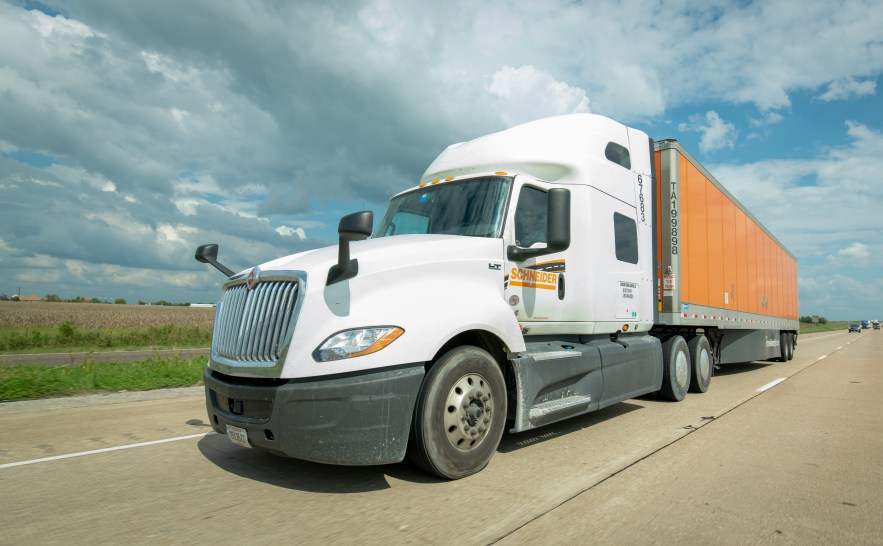
Schneider National CEO says shrinking capacity, rather than demand, is becoming the biggest barrier to growth

The Logistic News by The Logistic News
September 17, 2026
in Business, Cargo, Land, Logistic, World
Reading Time: 4 mins read
0
Truckload Capacity Exodus Deepens as Carriers Face Mounting Pressures
ADVERTISEMENT

The correction in the truckload market is still in its early stages, according to carrier executives who spoke at an investor conference this week, with the industry continuing to lose capacity amid regulatory pressure, weak economic conditions and rising operating costs.

A regulatory crackdown that began about a year ago has accelerated a contraction that was already underway. Prolonged economic weakness had pushed many small and midsize fleets out of the market, while the latest jump in diesel prices has added another burden for smaller operators, particularly those without mechanisms to recover higher fuel costs.

The U.S. Supreme Court’s broker liability ruling has added another layer of pressure. Both brokers and shippers are now being forced to take a closer look at the carriers they select, further narrowing the pool of available transportation providers.

ADVERTISEMENT

“There was no standard for entry-level driver training,” said Jim Filter, president and CEO of Schneider National (NYSE: SNDR), during Morgan Stanley’s Annual Laguna Conference.

Filter pointed to the thousands of drivers who entered trucking during the previous upcycle. According to him, many obtained operating authority unlawfully and did not receive adequate training. The closure of sham driver schools has since narrowed that entry point.

At the same time, capacity entering the market is facing greater scrutiny. Shippers and brokers are increasingly reluctant to tender freight to new motor carriers that do not have established safety ratings. Strict oversight of electronic logging device (ELD) providers is also making it harder for drivers to circumvent hours-of-service requirements.

These measures continue to eliminate drivers who, as Filter put it, “were not playing by the same rules as everybody else.”

Executives at Werner Enterprises (NASDAQ: WERN) described a similar shift in how carriers are being selected. They believe the current capacity crunch could still be only in the second or third inning, with the market tightening further after the Supreme Court’s broker liability, or Montgomery, ruling.

Werner’s management team also highlighted a recent Texas Supreme Court decision involving Home Depot (NYSE: HD). The retailer was dismissed from a liability lawsuit stemming from a fatal accident that occurred while Werner was hauling Home Depot cargo. The court ultimately determined that Home Depot had fulfilled its legal obligation by hiring a reputable carrier.

At Schneider, the brokerage operation has sharply reduced its approved carrier base. Filter said the list now contains about 14,000 carriers, down from 60,000 at its peak. The company began removing operators several years ago, initially as part of efforts to combat cargo theft.

“I can tell you that there aren’t 100,000 carriers out there that I think any of us would be able to look at and say, 100,000 carriers are safe and should be out there on the road,” Filter said.

The full consequences of the Montgomery decision are still emerging, but Filter expects a significant number of carriers to struggle to qualify for liability insurance. For others, insurance costs could become prohibitively expensive.

Werner also sees a potential opportunity in the disruption. As owning and operating private fleets becomes more difficult, the company believes some private fleets could be converted into dedicated customers.

Driver availability has once again become an issue. Private fleets often lack dedicated teams focused on recruiting and training drivers, while many expanded substantially during the pandemic and are now approaching their largest-ever equipment replacement cycle.

That replacement cycle comes at a time when equipment costs remain high. Private fleets are also dealing with continued increases in insurance costs and are increasingly being forced to consider self-insurance as a way to manage liability exposure.

Capacity, rather than demand, is becoming the bigger growth constraint

For Schneider, demand remains relatively stable, with certain areas showing strength. Minibid activity continues as shippers seek to protect transportation coverage ahead of their most important season.

But according to Schneider, demand itself is no longer the main obstacle to expansion. The bigger issue is whether sufficient capacity is available.

“Well, with the amount of supply that has exited, it has created enough demand for our services,” Filter said. “We don’t necessarily need more demand.”

Werner reported that demand among its predominantly discount-retail and food-and-beverage customers remained steady between the second and third quarters. The company is seeing increased minibid activity in its one-way business, while demand for dedicated services has also risen sharply.

For the third quarter, Werner expects one-way rates per total mile to increase between 10% and 13% year over year. The metric was already 10% higher year over year in the second quarter, while fleet utilization improved by 16%.

Its dedicated fleet, which represents 80% of Werner’s truckload network, is expected to generate a 3% to 5% year-over-year increase in revenue per truck per week for full-year 2026.

Revenue per truck per week increased 5% year over year in the second quarter, or 8% when FirstFleet is excluded. Werner acquired FirstFleet in January. The dedicated segment has also delivered low- to mid-single-digit contractual rate increases in recent months.

Werner expects the upcoming 2027 bid season could bring “strong” contract rate increases. The bid season is scheduled to begin within the next 30 to 60 days.

That timing could prove significant. Contract negotiations will take place during peak season, when the ongoing reduction in available capacity is expected to intensify the pressure on transportation supply.

Why it matters

The number of carrier options available to shippers is shrinking as stricter regulatory enforcement, higher fuel costs and insurance pressures continue to remove capacity from the truckload market.

For shippers, the changing landscape means navigating higher transportation costs, greater dependence on dedicated fleets and stronger competition for available capacity as the peak season approaches.


Previous Post

Norfolk Southern’s New Intermodal Era Targets the Friction Holding Rail Back

Next Post

Mexico Reopens Empty-Truck Crossings After 700 Tractors Stranded at Border

Next Post
Mexico Reopens Empty-Truck Crossings After 700 Tractors Stranded at Border

Mexico Reopens Empty-Truck Crossings After 700 Tractors Stranded at Border

Leave a Reply Cancel reply

Your email address will not be published. Required fields are marked *

A D V E R T I S E M E N T

Popular News

  • Drone Delivery Takes Flight: Amazon Partners with UPS for Trial Program

    Drone Delivery Takes Flight: Amazon Partners with UPS for Trial Program

    0 shares
    Share 0 Tweet 0
  • Rail Cargo Group Strengthens European Network with Captrain Netherlands Acquisition

    0 shares
    Share 0 Tweet 0
  • Automotive Inbound Logistics Market: Navigating Future Challenges

    0 shares
    Share 0 Tweet 0
  • Global Inflation Cools to Target After Three Years, Central Banks Face Policy Dilemma

    0 shares
    Share 0 Tweet 0
  • Dubai Mercantile Exchange Rebrands as Gulf Mercantile Exchange Following Saudi Tadawul Group Acquisition

    0 shares
    Share 0 Tweet 0

Recent News

Mexico Reopens Empty-Truck Crossings After 700 Tractors Stranded at Border

Mexico Reopens Empty-Truck Crossings After 700 Tractors Stranded at Border

September 17, 2026
Truckload Capacity Exodus Deepens as Carriers Face Mounting Pressures

Truckload Capacity Exodus Deepens as Carriers Face Mounting Pressures

September 17, 2026
Norfolk Southern’s New Intermodal Era Targets the Friction Holding Rail Back

Norfolk Southern’s New Intermodal Era Targets the Friction Holding Rail Back

September 17, 2026

Discover a new era of logistics reporting with The Logistic News, your go-to platform for breaking news, insightful features, and exclusive interviews shaping the global logistics and freight landscape. Trust us to deliver accurate, timely, and relevant information that empowers professionals and enthusiasts alike in navigating the intricacies of this vital sector.

Navigation

  • Home
  • About Us
  • Press Room
  • Podcasts
  • Media Kit
  • Contact Us
  • Careers
  • Privacy Policy
  • Terms of Use

© 2024 - thelogisticnews.com

Welcome Back!

Login to your account below

Forgotten Password? Sign Up

Create New Account!

Fill the forms below to register

All fields are required. Log In

Retrieve your password

Please enter your username or email address to reset your password.

Log In

SIgn Up Newsletter

This will close in 20 seconds

Manage Cookie Consent
We use technologies like cookies to store and/or access device information. We do this to improve browsing experience and to show (non-) personalized ads. Consenting to these technologies will allow us to process data such as browsing behavior or unique IDs on this site. Not consenting or withdrawing consent, may adversely affect certain features and functions.
Functional Always active
The technical storage or access is strictly necessary for the legitimate purpose of enabling the use of a specific service explicitly requested by the subscriber or user, or for the sole purpose of carrying out the transmission of a communication over an electronic communications network.
Preferences
The technical storage or access is necessary for the legitimate purpose of storing preferences that are not requested by the subscriber or user.
Statistics
The technical storage or access that is used exclusively for statistical purposes. The technical storage or access that is used exclusively for anonymous statistical purposes. Without a subpoena, voluntary compliance on the part of your Internet Service Provider, or additional records from a third party, information stored or retrieved for this purpose alone cannot usually be used to identify you.
Marketing
The technical storage or access is required to create user profiles to send advertising, or to track the user on a website or across several websites for similar marketing purposes.
Manage options Manage services Manage {vendor_count} vendors Read more about these purposes
View preferences
{title} {title} {title}
No Result
View All Result
  • Logistic
  • Air
  • Maritime
  • Land
  • World
  • Business
  • Tech
  • Events
  • Advertise

© 2024 - thelogisticnews.com