




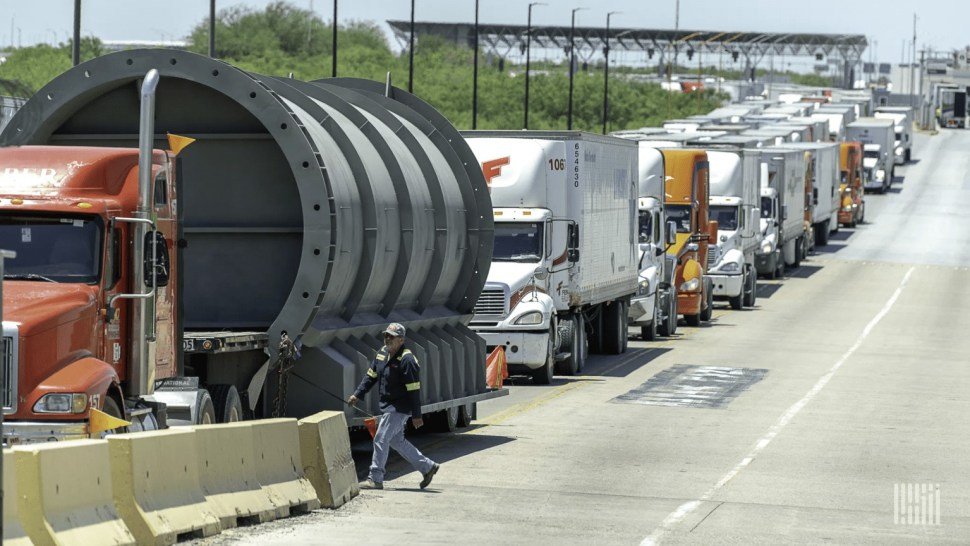
U.S.-Mexico trade reached a record $94.8 billion in July, marking the highest monthly total ever recorded, according to U.S. Census Bureau data analyzed by WorldCity.
Two-way commerce between the United States and Mexico climbed 27.5% year over year, rising from $74.36 billion in July 2025.
Mexico represented nearly 18% of the United States’ $530.37 billion in total international trade during the month. U.S. exports to Mexico reached $34.24 billion, an 18.1% increase from a year earlier, while imports from Mexico surged 33.5% to $60.55 billion.
Canada remained the United States’ second-largest trading partner in July, with approximately $62.8 billion in two-way trade. China ranked third at $36.8 billion.
Mexico’s leading position comes as overall U.S. international commerce continues to expand. During July, the United States recorded $530.37 billion in international trade, including $197.45 billion in exports and $332.92 billion in imports.
Mexico-U.S. trade reaches $588.52 billion through July
The strength of the bilateral relationship is even more apparent in the year-to-date figures.
Through the first seven months of 2026, U.S. trade with the world reached $3.51 trillion, up 6.2% compared with the same period in 2025. Mexico, Canada and China maintained the top three positions among U.S. trading partners, followed by Taiwan and Vietnam.
Mexico-U.S. commerce totaled $588.52 billion through July, representing a 16.1% year-over-year increase.
U.S. exports to Mexico rose 16.6% to $229.82 billion, while imports from Mexico increased 15.8% to $358.71 billion.
The figures reinforce Mexico’s increasingly important role in U.S. supply chains, particularly as tariffs and changing sourcing strategies continue to reshape trade relationships with other major international partners.
Laredo remains the No. 1 U.S. trade gateway
At the gateway level, Laredo, Texas, retained its position as the busiest international trade gateway in the United States in July.
The South Texas gateway handled $36.95 billion in two-way commerce, up nearly 22% from the $30.29 billion recorded a year earlier.
Exports moving through Laredo increased 16.5% to $12.46 billion, while imports climbed 25% to $24.48 billion.
Chicago O’Hare International Airport ranked second among U.S. trade gateways in July, with $36 billion in commerce. The Port of Los Angeles ranked third at $26.5 billion.
Mexico accounted for the vast majority of Laredo’s trade activity. U.S.-Mexico commerce moving through the gateway totaled $35.9 billion in July, up 21.9% year over year.
July was also Laredo’s strongest July on record in WorldCity data dating back to 2013.
Automotive freight drives a major share of Laredo exports
Automotive-related freight remained a key component of Laredo’s outbound trade.
Motor vehicle parts were the gateway’s leading export commodity in July, generating $1.31 billion, up 19.2% year over year.
Exports of diesel engines jumped nearly 85% to $433.8 million, while motor vehicle engines increased 21% to $284.7 million, reaching $284.7 million.
The figures highlight how closely Laredo’s cross-border freight flows are tied to North American manufacturing and automotive supply chains.
Trucking capacity remains tight in Laredo
Despite the record trade volumes, transportation capacity remains a challenge for shippers operating through the gateway.
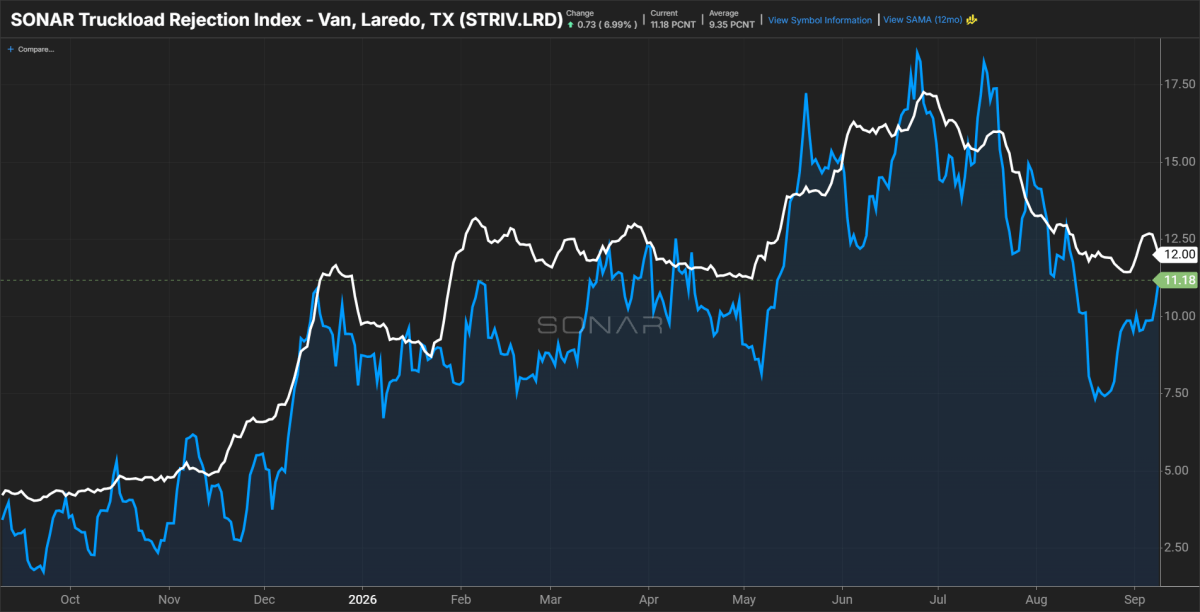
According to SONAR, a freight market analytics and data platform, Laredo is experiencing tight capacity. As of Wednesday, the Laredo Van Outbound Tender Rejection Index stood at 11.18%.
That level indicates that securing trucking capacity in the market can be difficult for shippers and gives carriers greater negotiating leverage because available capacity is limited.
Why it matters
The nearly $95 billion monthly trade relationship illustrates the growing importance of Mexico to U.S. manufacturing, cross-border logistics and supply chains.
At the same time, Laredo’s record July performance confirms the gateway’s central role in moving freight between the two countries. Strong automotive exports combined with elevated trucking rejection rates point to a market where trade demand is expanding while transportation capacity remains under pressure.