



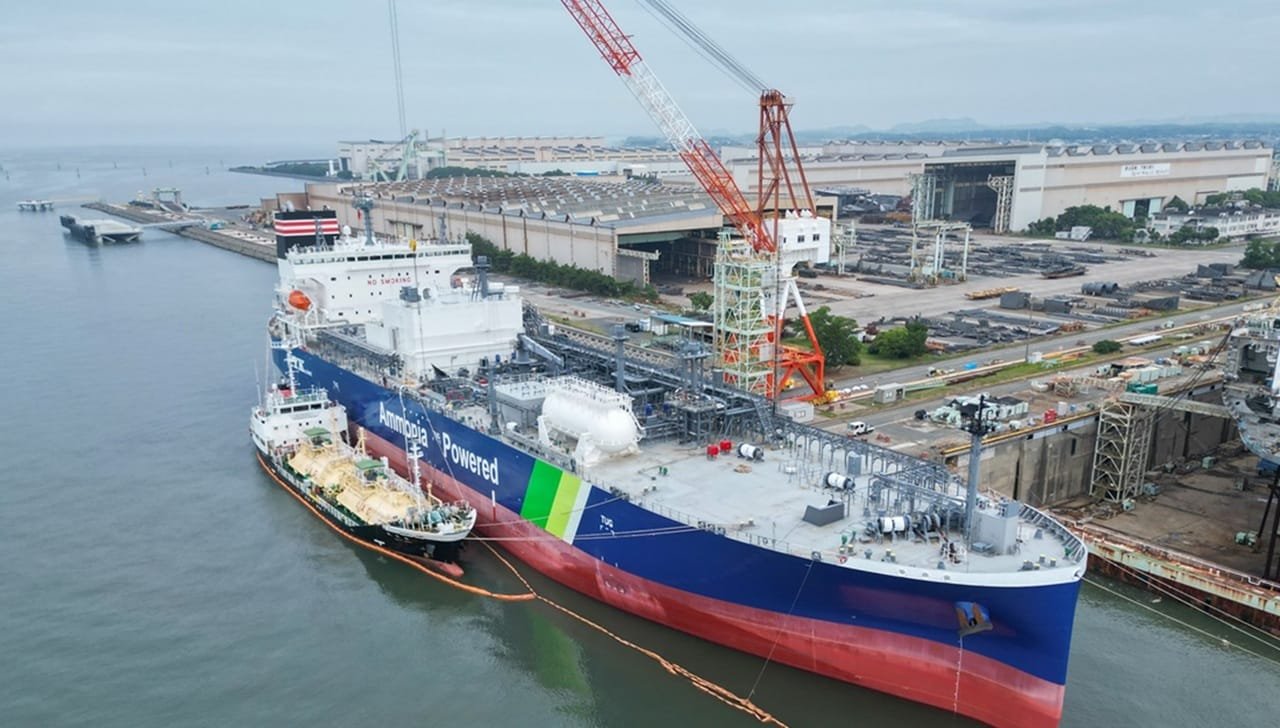
A Japanese consortium led by NYK Line has completed what it describes as the first ship-to-ship bunkering operation involving ammonia fuel for an ammonia-powered vessel, marking a significant step in efforts to develop ammonia as a viable zero-carbon fuel for maritime transport.
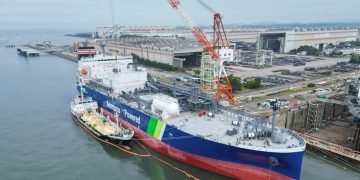
The operation was carried out on September 17 at Japan Marine United’s Ariake Shipyard. During the transfer, ammonia was moved from the 998gt carrier Shoei Maru to a newly built ammonia-fueled medium gas carrier.
The receiving vessel is now undergoing its final preparations for sea trials ahead of its scheduled delivery in November 2026.
The project brings together several major Japanese maritime and industrial companies. Alongside NYK Line, the consortium includes Japan Marine United, Nihon Shipyard, Mitsubishi Gas Chemical and Kokuka Sangyo. The initiative is being conducted under Japan’s Green Innovation Fund, administered by NEDO.
The successful operation comes after months of preparation focused on developing procedures for the safe handling and transfer of ammonia. Although ammonia does not produce CO₂ when combusted, its toxicity presents additional safety challenges compared with conventional marine fuels.
Developing reliable bunkering procedures has therefore been a central issue for the consortium. The September 17 transfer was intended not only to demonstrate that the operation could be carried out safely, but also to generate practical data that can support future ammonia fuel supply operations.
That operational data will be increasingly important as shipping companies and fuel suppliers move closer to the commercial deployment of ammonia-fueled vessels.
The ammonia-fueled medium gas carrier, or AFMGC, is being developed through Japan’s JPY 2 trillion Green Innovation Fund. The government-backed program supports projects designed to help Japan achieve carbon neutrality by 2050.
The fuel source used in the operation, Shoei Maru, normally transports ammonia for Mitsubishi Gas Chemical’s Niigata Plant. The carrier is 71.5 metres long and has a beam of 12.5 metres.
The completion of the ship-to-ship bunkering operation provides the consortium with a practical foundation for further development of ammonia fuel logistics and handling systems as the maritime industry examines alternatives to conventional fossil fuels.