



Global air cargo demand recorded a strong rebound in February, but escalating geopolitical tensions are now casting uncertainty over the trajectory for the rest of 2026.
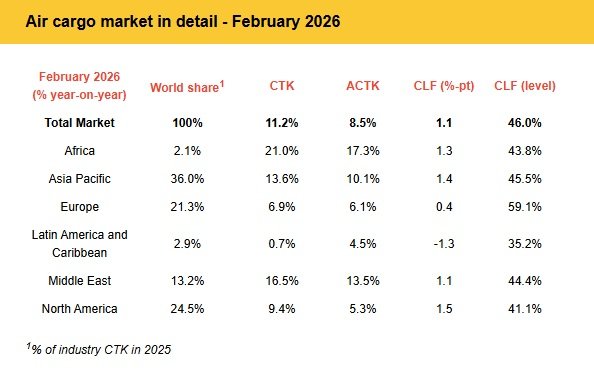
According to data released by IATA, total cargo demand—measured in cargo tonne kilometres (CTK)—increased by 11.2% year-on-year compared to February 2025. The growth was supported by seasonal factors, including shipment acceleration ahead of the Lunar New Year, which fell mid-month.
The industry also benefited from a post-holiday normalisation effect following December, combined with sustained trade flows linked to Asia.
However, the positive momentum is now being challenged by developments in the Middle East. IATA highlighted that the outbreak of conflict at the end of February is already disrupting operations, increasing fuel costs and affecting key cargo hubs.
Director General Willie Walsh acknowledged the strength of February’s performance but warned that the outlook remains difficult to assess. Rising fuel prices, supply constraints and operational disruption across Gulf hubs are creating a more volatile environment.
Capacity trends broadly followed demand. Available cargo tonne kilometres (ACTK) rose by 8.5% year-on-year, while the cargo load factor improved to 46%, up 1.1 percentage points.
Underlying economic indicators had also been supportive. Global goods trade expanded by 5.2% in January, while manufacturing sentiment strengthened in February, with the PMI reaching 53.1—above the expansion threshold. Export orders also showed growth, hitting their highest level since mid-2021.
However, fuel markets are becoming increasingly unstable. Jet fuel prices rose 1.2%, while refining margins remain volatile, reflecting broader energy market tensions.
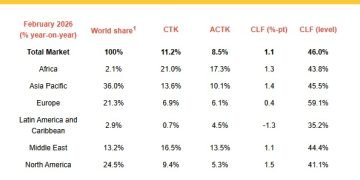
Regionally, Africa led global performance with a 21% increase in demand, followed by the Middle East at 16.5% and Asia Pacific at 13.6%. North America and Europe recorded moderate growth, while Latin America and the Caribbean lagged behind with just 0.7% demand growth.
Despite strong fundamentals, the industry now faces a familiar challenge: balancing resilience with rising geopolitical risk.