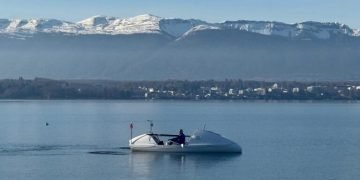


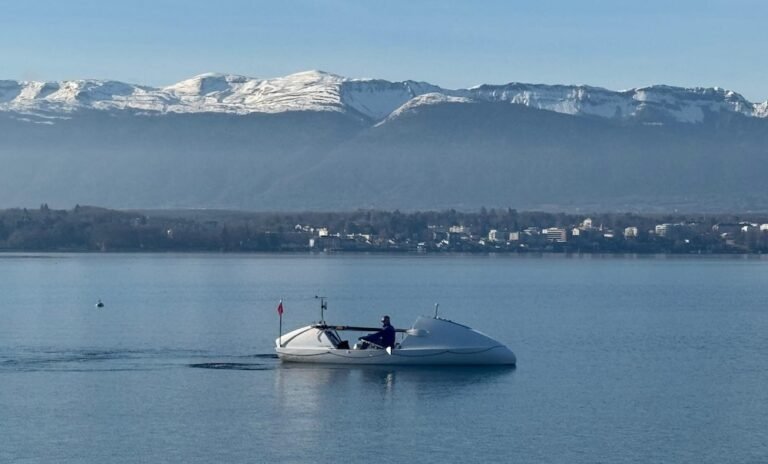
A decade-spanning idea is about to turn into reality for Stuart Macdonald, a professional mountain guide based in the Alps, who is preparing to row solo across the Atlantic Ocean after first reading about the feat nearly twenty years ago. At the start of next year, he plans to take on what he has named the “Summit to Sea” challenge, a 6,000 km journey from Portugal to French Guiana.
Beyond the sporting ambition, the project also carries a strong fundraising purpose. Macdonald is raising money for two charities closely connected to his personal story: Pancreatic Cancer UK and the Martin Moran Foundation. The effort will place him alone in one of the most demanding maritime environments on the planet for weeks at a time.
The routine he is preparing for is extreme even by ocean rowing standards: up to 14 hours of rowing per day, sleep broken into four-hour cycles, and a daily intake of around 6,000 calories, all while navigating unpredictable weather conditions far from any support network.
“At the time I read the book, I was training to be a mountain guide, so taking a winter off for the row wasn’t possible,” Macdonald explained. “Twenty years later, I’m at a point in my life where I can probably afford – just – to miss a winter season. So I thought I’d better get on with it before I get any older.”
Despite the scale of the challenge, Macdonald approaches it with a notably measured mindset, shaped by years of guiding in high-risk alpine environments. That background, he suggests, has helped him stay focused on preparation rather than fear.
“I don’t find the crossing as daunting as some people expect,” he said, “but that’s because I’m training hard for it and preparing every aspect as well as I possibly can.”
His preparation already exceeds typical standards. Where many ocean rowing teams complete around 120 hours of sea training before departure, Macdonald has logged more than 500 hours, including a coastal crossing from Italy to Corsica. He continues daily training in both the gym and on rowing machines. “The ocean doesn’t make exceptions for age, so I need to be ready in every way,” he added.
The boat itself is a purpose-built carbon fibre ocean rowing vessel, designed to self-right in the event of a capsize. It is equipped with systems more commonly found on yachts, including a chart plotter, auto-helm, AIS, VHF radio, and a combined solar and battery power system. A desalinator provides fresh water, while a compact cabin allows for rest at sea. The vessel is currently available for naming rights, offering a premium sponsorship opportunity tied to the project.
Nutrition planning has been treated with equal precision. Macdonald will consume between 5,500 and 6,000 calories per day, roughly half from freeze-dried meals and the remainder from high-energy foods such as chocolate, biscuits, nuts, sausage, and cheese. “It’s not just about calories,” he said. “Getting the right balance of carbohydrate, protein and fat will be essential in order to perform at my best.”
As a solo rower, he will structure his own rhythm at sea, aiming for around four hours of sleep per night, supplemented by short naps during the day, and expecting to row between 12 and 14 hours daily depending on conditions.
The destination of French Guiana also plays into the logistical planning. Macdonald was struck by what he discovered during his research: “It blew my mind a little. Despite being in South America, it’s in the EU – a department of France, just like Corsica. The president is Emmanuel Macron and the currency is the euro.” That administrative detail, and the relative simplicity of arrival procedures, helped confirm it as the chosen endpoint.
Macdonald is now actively seeking sponsorship to support the expedition, with boat naming rights positioned as the most prominent commercial partnership available for what is expected to be one of the most visible ocean rowing challenges leading into 2027





