



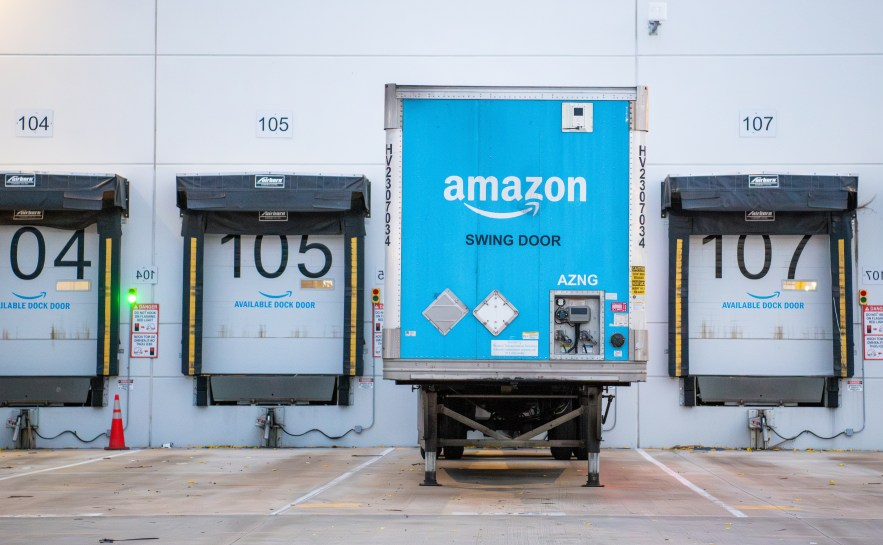
Amazon is expanding its global fulfillment network with a new approach that allows sellers to send a single manufacturing run to one Amazon-operated facility near their factory and use that inbound shipment to serve customers across eight countries.
The company said Thursday that its Global Warehousing and Distribution (GWD) service currently connects to the United States and will add seven additional markets by the end of the year: the United Kingdom, Japan, Germany, France, Italy, Spain, and Canada.
Once all eight markets are connected, Amazon said sellers could see storage costs of up to 45% lower than using Amazon Warehousing and Distribution (AWD) in the U.S. Replenishment into Fulfillment by Amazon (FBA) could also be up to five days faster.
Under the model, inventory remains in a single shared pool and is moved into a specific country only when demand emerges there. From that point, the products can flow into local FBA fulfillment centers.
Amazon said only 30% of its selling partners currently list products in more than one country. Sellers operating across multiple countries generate 70% more revenue on average than those selling in only one market.
For many businesses, international expansion has traditionally required establishing separate operations in each destination. Sunny Jain, Amazon’s vice president of Worldwide Fulfillment by Amazon, described the challenge in a company blog post, saying that going global had effectively meant starting a new business in every country.
GWD will operate alongside Amazon Warehousing and Distribution (AWD). Amazon has already expanded AWD beyond the U.S. into the European Union, the U.K., and Australia, offering sellers low-cost bulk storage with automatic replenishment into FBA.
Amazon is also preparing another supply chain upgrade. Over the coming weeks, the company plans to roll out end-to-end supply chain visibility, allowing sellers to track shipments across Amazon-managed fulfillment through a single interface from the moment an order is created. The system will also provide one reconciled unit count throughout the process.
Compliance testing begins with toys
Amazon said sellers consistently identify compliance requirements as the biggest obstacle to international expansion.
Each country can impose different rules covering packaging, labeling, safety testing and ingredient restrictions. According to Jain, sellers have often had to determine those requirements only after their products had already been manufactured.
Amazon is now starting with toys, providing sellers with a single specification covering testing, labeling and packaging requirements for each destination country.
The company said one test submission can satisfy certification requirements across multiple countries, while existing certifications are also recognized. Sellers participating in Amazon’s pilot program for one-submission testing reported savings of up to 60% on compliance costs, according to Amazon.
The same approach will extend to electronics and baby products by the end of the year. In 2027, Amazon plans to expand the program to additional product categories and provide sellers with compliance requirements and associated costs before a single unit is manufactured.
One company already using Amazon’s international logistics network is MORALVE, a family-run home organization business based in Canada. The company has expanded from the U.S. into Canada, the U.K., and Germany.
“Being able to understand the requirements for each country and then use Amazon’s logistics network to move inventory across multiple countries removed a lot of the complexity that traditionally comes with global expansion,” said MORALVE co-founder Mo Kuhail in Amazon’s announcement.
Seller Central expands into multichannel commerce
Amazon is also broadening the role of Seller Central beyond its own marketplace.
In a separate post published the same day, Mary Beth Westmoreland, Amazon’s vice president of Worldwide Selling Partner Experience, said the first version of the company’s new multichannel selling tools allows sellers to connect eBay, Shopify, TikTok and Walmart accounts directly to Seller Central.
The tools allow sellers to import and link listings from outside Amazon, view sales and orders from multiple channels, and fulfill those orders across the different marketplaces.
Amazon said the tools will be introduced gradually to sellers on its U.S. store over the coming months, with no additional cost.
The company also said that more than 95% of independent sellers in Amazon’s store sell through multiple channels.
Within the Manage Orders page, for example, a seller can select a Shopify order and fulfill it through Amazon. Tracking information is then automatically sent back to Shopify.
Orders placed through rival storefronts can now be routed directly into Amazon’s fulfillment network, further extending the role of Amazon’s logistics infrastructure beyond transactions made on Amazon itself.
A new profitability dashboard will also bring together sales, advertising spending and traffic from connected channels in a single view.
For businesses currently managing those figures manually across different platforms, the change could reduce a significant amount of administrative work.
“We have a team of three dedicated to reporting, and I’d estimate they spend about 5 hours at the end of each month to compile everything by logging into each channel individually,” said Pamela Lee, director of digital operations at Elizabeth Mott, an Amazon selling partner.
Westmoreland said Amazon’s longer-term objective is for Seller Central to become “the single place where independent sellers manage their entire business, not just their Amazon listings, across every channel where they sell.”