




The air cargo market is facing a year of significant disruption, but not without important areas of opportunity, according to Marco Bloemen, managing director of aviation consultancy Aevean.
Speaking at the IATA World Cargo Symposium in Peru, Bloemen said geopolitical tensions are once again becoming the dominant force shaping the sector, particularly following the outbreak of war in the Middle East.
He noted that while Gulf capacity has shown some signs of recovery in recent days, the market has still experienced severe reductions on key corridors. Over the four days leading up to 3 March, available cargo tonne-kilometers on the Asia-Middle East-Gulf corridor were down 39% compared with the period before Chinese New Year, while global cargo capacity fell by around 22%.
The impact has been especially severe on Gulf-origin services, where capacity dropped by roughly 79% from pre-Chinese New Year levels.
Other regions also saw notable declines. Levant and Caucasus capacity fell by around 30%, South Asia by 33%, Africa by about 19% and Europe by 16%.
Even so, Bloemen said the market has reacted quickly. Airlines increased direct cargo capacity from China and Hong Kong to Europe by 26% compared with levels seen just before the conflict began. Capacity from China and Hong Kong to Europe via non-Gulf stopovers also rose by 14%.
Beyond the immediate conflict, Bloemen also reviewed the structure of the air cargo market in 2025, pointing to both the challenges and the strongest areas of expansion.
According to Aevean data, high-tech cargo was the fastest-growing segment last year, with volumes rising 25% year on year. Low-value e-commerce was the second fastest-growing segment, with volumes increasing by 16% compared with 2024.
That e-commerce growth, however, was much slower than the 43% increase recorded in 2024, largely because the United States ended its de minimis exemption.
Bloemen said the surge in high-tech volumes was mainly driven by data center-related exports, with Taiwan, Vietnam, Thailand and Malaysia emerging as the main beneficiaries of stronger U.S. demand.
High-tech cargo also helped sustain trade flows into the U.S. Despite tariffs introduced in April, volumes to the American market still rose 4% between April and December. Bloemen noted, however, that high tech was the only air cargo segment to grow into the U.S. over that nine-month period.
Air e-commerce volumes to the U.S., by contrast, were down 24% compared with 2024.
Data center-related goods represented around 1.4 million tonnes of air cargo in 2025, up 39% year on year. Bloemen pointed out that most of these commodities are exempt from U.S. tariffs, helping explain their continued momentum.
At the other end of the market, volumes in vehicles and transport declined by 5%, while apparel and footwear dropped by 3%.
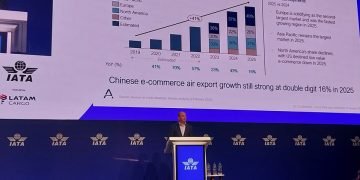
He also highlighted a shift in Chinese e-commerce export geography. Europe overtook North America last year to become the second-largest Chinese e-commerce air export market, taking a 26% share compared with 22% in 2024. North America’s share, meanwhile, fell from 30% to 21%, reflecting the impact of the U.S. decision to end the de minimis regime.
Overall, Bloemen said 2026 is shaping up to be another unpredictable year for the air cargo business.
He pointed out that much of the widebody bellyhold and freighter capacity due to enter the market this year was expected to come from Middle East and South Asia carriers, many of which are now facing operational restrictions. At the same time, fuel prices are rising quickly as a consequence of the regional conflict.
Still, he said there are positive structural drivers. In his view, e-commerce will continue to play a supportive role in the years ahead, while high tech is likely to remain one of the sector’s strongest growth engines, especially across Asia.