Air Nov 19, 2026
Alaska Airlines cargo: Ian Morgan outlines the priorities for 2027 and the US$750 million ambition
From the expansion of long-haul routes and a stronger foothold in Hawai’i to its partnership with Amazon, Alaska Airlines is preparing its cargo business for another phase of growth, with a US$750 million annual revenue target by 2030.

Alaska Airlines is preparing for a new phase of development in its cargo operations, with 2027 budgets, international network expansion and additional freight capacity among its priorities. For Ian Morgan, Vice President of Cargo at Alaska Airlines, the challenge is not simply to establish financial projections, but also to remain prepared for market changes that could reshape the industry throughout the year.
His advice to shippers preparing their 2027 budgets is straightforward: keep a red pen, a black pen and an eraser close at hand. After 47 years in air freight, Morgan believes flexibility is essential in an environment where assumptions can quickly become outdated.
He shared his views during an interview in Miami at TIACA’s Air Cargo Forum, recorded for Conversations, the on-site interview series produced by STAT Publishing Group and presented by Agos Aviation. As Alaska Airlines works through its own budgeting exercise, Morgan stressed the importance of distinguishing between predictable developments and unforeseen circumstances.
“You can budget for what you know, what you think you can expect, and then you have to be at a point where you can also be prepared for the unknown,” he explained.
With fuel prices remaining high, he expects 2027 to require close coordination between airlines, shippers, freight forwarders, ground handlers and international partners. Maintaining open communication and discussing potential changes honestly will be particularly important.
His message to industry stakeholders is to remain flexible and approach challenges collectively. In his view, transparent conversations can help resolve many of the difficulties that arise as market conditions evolve.
K-pop vinyl and Washington cherries strengthen international cargo flows
Alaska Airlines’ expanding long-haul network is generating cargo opportunities that were not necessarily anticipated when the airline began developing its international operations. Alongside established shipments of electronics and industrial components, the carrier has started transporting K-pop vinyl records, a product Morgan said he would not have expected to see among its cargo flows.

The shipment has even been a topic of discussion at home. Morgan said his six-year-old daughter is a huge fan of K-pop Demon Hunters, but admitted he doesn’t know much about the phenomenon himself. But now, the airline is moving K-pop vinyl as part of its international cargo business.
Trade flows are also in the other direction. Alaska is shipping cherries from Washington state to South Korea and Japan, markets where demand has traditionally exceeded capacity.
“There is a demand. We could never meet it, and now we can,” Morgan said.
The carrier intends to expand its long-haul network from Seattle dramatically, from five intercontinental destinations today to 15 by 2030. Osaka, Tahiti, Paris and Athens are all on the expansion list for 2027.
Cargo volumes are already significant on some services. Some flights out of Asia carry 15,000 to 20,000 kilograms of freight just in the lower-deck compartments, Morgan said. Alaska is using every cargo position it can find.
Alaska was a relatively unknown airline in Europe when it entered the market, but London and Rome have also performed strongly. At the same time, the development of connecting traffic between Asia, Europe, Hawai’i and Alaska is accelerating the carrier’s international presence.
Cargo is increasingly driving decisions that were once led by passengers. On certain transpacific routes, freight can be up to 20% of total flight revenue.
Now, Morgan said, the passenger division consults the cargo team when evaluating network opportunities and asks where freight can add the most dollar value. This is a big shift in the airline’s strategy, giving cargo a bigger say in how routes are planned and in commercial decisions.
Hawai’i inter-island cargo: 6% market share to 50% ambition
Alaska Airlines has an ambitious goal for its operations in Hawai’i: to increase its share of the inter-island cargo market from about 6% to 50% by 2030.
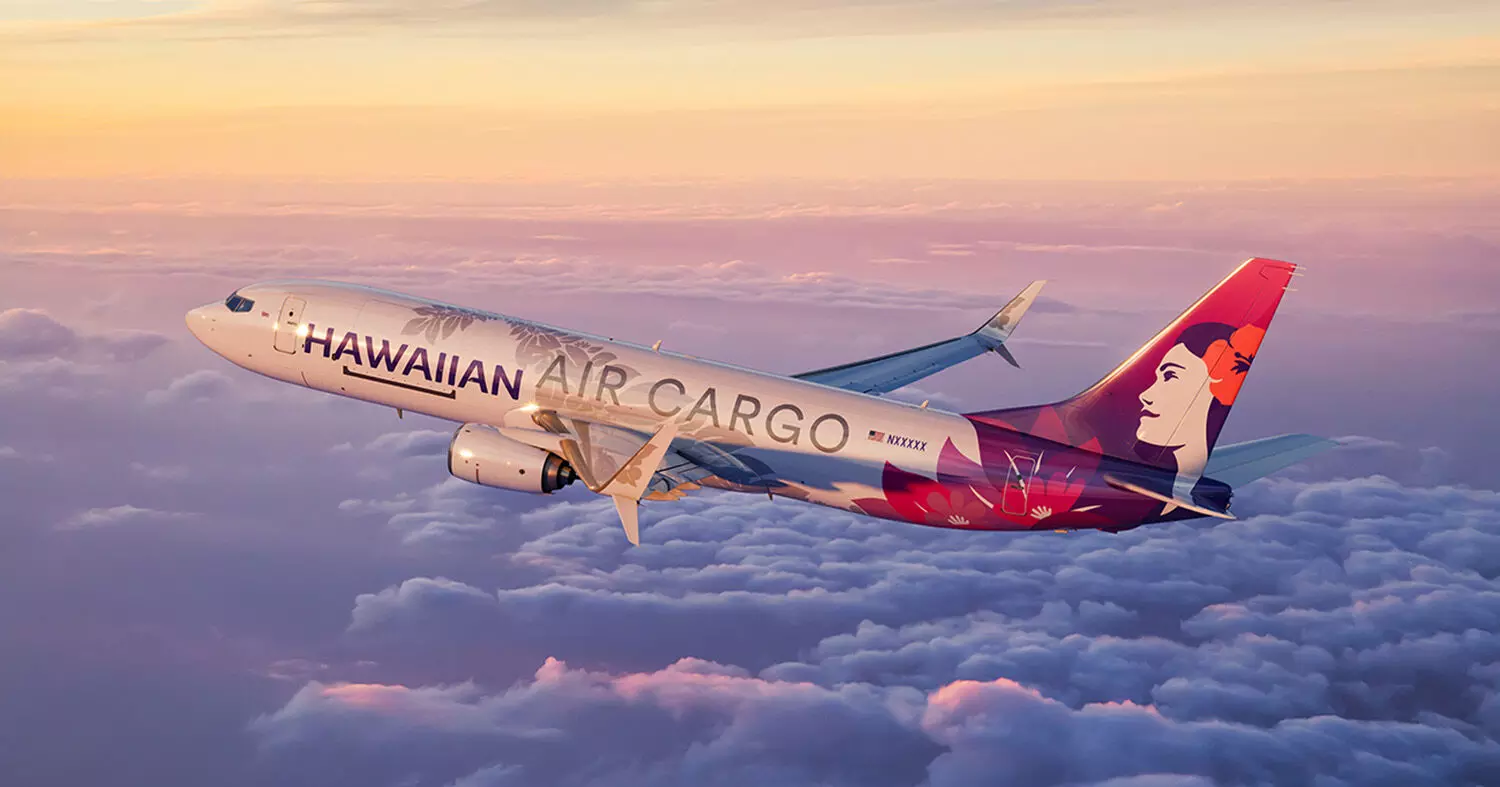
Two converted Boeing 737-800 freighters, wearing Hawaiian Air Cargo livery, are expected to arrive in the first half of 2027 to support the expansion.
Up to now the airline has used its passenger planes to carry freight between the islands. But Morgan conceded this strategy no longer has the capacity to serve the market's needs.
Dedicated freighters are therefore coming into play to tackle a perceived capacity gap, while underpin the airline’s longer term commercial ambitions.
“We already have that model in place in Alaska and we want to replicate that in Hawai’i,” Morgan said. Alaska is taking an existing freighter model and tailoring it to the unique nature of the island market.
“We’re taking a rule book and playbook that we’ve had and we’re replicating it in Hawaii,” he said.
The market itself has also approached the airline, he said, which adds to the commercial case for increasing dedicated cargo capacity.
The strategy reflects Alaska’s desire to build on its experience serving geographically isolated communities, where reliable air freight connections are particularly important.
Alaska Air Group targets US$750 million in annual cargo revenue by 2030
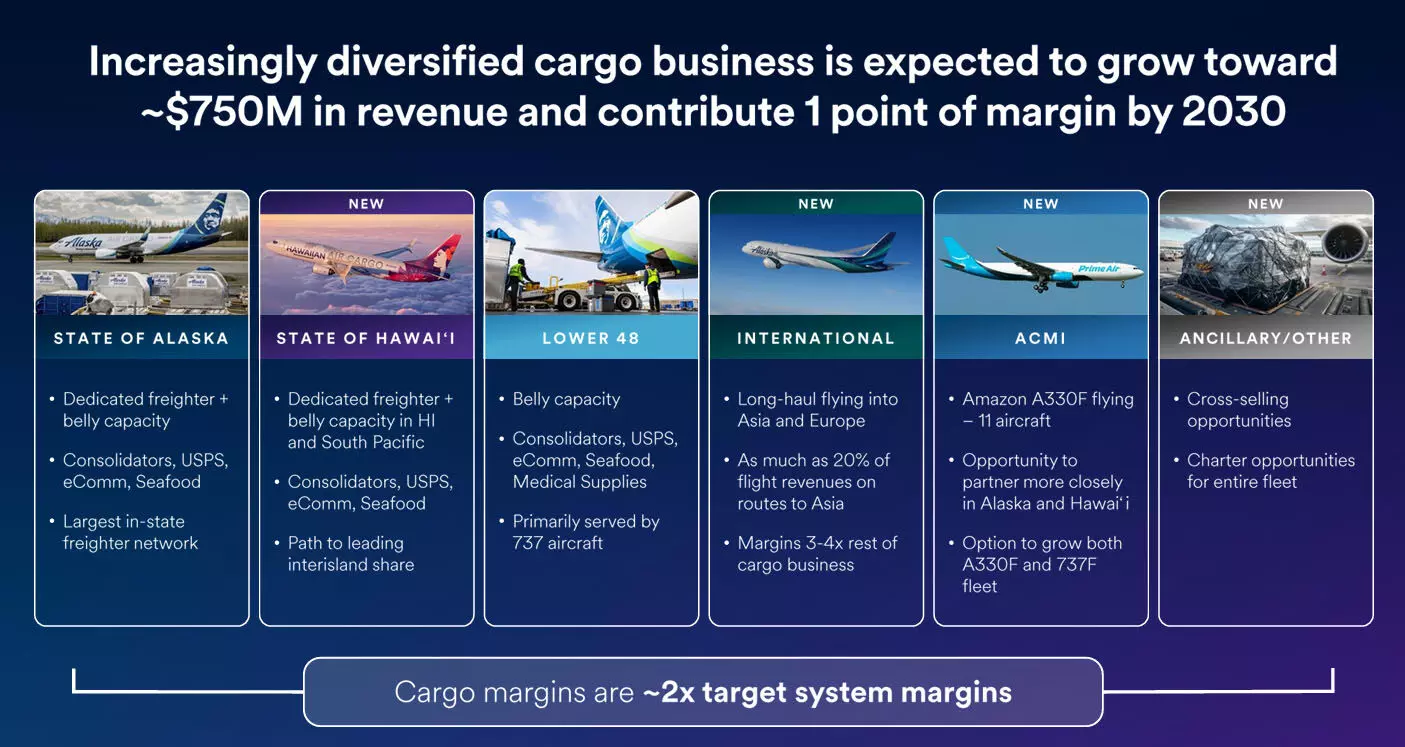
Cargo is also gaining greater strategic importance at group level. During its Investor Day on 1 October, Alaska Air Group announced an objective of generating US$750 million in annual cargo revenue by 2030.
Morgan described the figure as achievable, emphasising that its inclusion in the group's Investor Day presentation demonstrates the growing recognition of cargo as a business capable of multiplying overall corporate value.
The target is supported by six cargo franchises. Rather than relying on one particular activity to deliver exceptional growth, Morgan believes the objective will be achieved through cooperation and complementary performance across the different businesses.
“There is cross-pollination, and I think that’s where the success comes from and that’s where the unlock of the US$750 million will come from,” he explained.
This ambition comes at a time when Alaska's passenger business is facing pressure from elevated fuel costs. Cargo, however, continues to demonstrate positive momentum: the airline recorded approximately 9% cargo revenue growth in the third quarter.
Morgan acknowledged that some of the increased operating costs will have to be passed on to customers. Nevertheless, he stressed that pricing decisions must take into account the airline's responsibility towards the remote communities it serves.
In many locations, Alaska's aircraft provide essential connections for food supplies, life-saving medicines and human organs. Maintaining these services requires a financially sustainable operation.
“Passing along that price enables us and allows us to continue serving those markets,” he said.
The balance between commercial performance and maintaining essential connectivity remains an important part of the airline's cargo strategy.
Amazon partnership – still a long-term priority
Alaska’s relationship with Amazon is another important part of its cargo operations. Under a contract that came with its acquisition of Hawaiian Airlines, the airline operates Airbus A330 freighters for the e-commerce company.
In 2026 the contract was renegotiated, reinforcing a commercial relationship that Morgan believes is strategically beneficial for both companies.
The length and stability of the Amazon deal represents a contrast to a market where many shippers are moving toward shorter-term commitments, sometimes just three months.
The partnership length is core value for both sides, Morgan said and emphasized Alaska’s desire to be a preferred provider.
“We really want to be their best provider,” he said.
Although he did not disclose specific details about future commercial arrangements, Morgan confirmed that both companies are examining additional opportunities to cooperate, participate in each other's development and expand their respective networks.
This includes exploring ways in which their operations could complement one another, potentially creating further opportunities beyond the existing freighter agreement.
Ian Morgan reflects on 47 years in the air cargo industry
Beyond network development and financial targets, Morgan also reflected on his own professional journey, which now spans 47 years in air freight.
Asked about approaching half a century in the industry, he responded with humour, saying he preferred to describe his experience as 47 years, although he was willing to let the half-century reference stand.
He also spoke about his longstanding professional relationship with Jason Berry, whom he has known for 25 years.

Morgan joked that he was probably old enough to be Berry's father, before adding that his colleague was an exceptional leader. He described their working relationship as complementary, with Berry providing the strategic framework while Morgan manages the day-to-day cargo business.
He said he feels entirely comfortable bringing questions and operational issues directly to Berry, highlighting the transparency that characterises their collaboration.
The leadership structure was established following Alaska Airlines' acquisition of Hawaiian Airlines. In September 2024, Alaska announced two appointments within its expanded cargo organisation.
Jason Berry was appointed Executive Vice President of Cargo at Alaska Air Group, giving him group-wide responsibility for overseeing cargo activities. Ian Morgan, meanwhile, was elected Vice President of Cargo at Alaska Airlines, with responsibility for managing the combined Alaska and Hawaiian cargo operations on a daily basis.
The leadership structure evolved again in 2025. Berry was named Chief Operating Officer of Alaska Airlines, effective 3 November 2025, while retaining his cargo responsibilities at group level.
As Alaska Airlines moves towards its 2030 objectives, Morgan's priorities point to a cargo business increasingly integrated into the airline's wider strategy. International network expansion, dedicated freighter capacity in Hawai’i, a stronger Amazon partnership and the US$750 million revenue ambition all form part of the same development plan.
For shippers preparing for 2027, however, his opening advice remains relevant: budgets must provide direction without becoming rigid. In a market shaped by changing costs, evolving demand and new trade flows, the ability to adapt may prove just as important as the targets themselves.
END OF REPORT