Tech Nov 4, 2026
Amazon expands smart-glasses rollout to 5,000 delivery drivers, targeting greater last-mile efficiency
Wearable technology brings navigation, customer instructions and delivery verification directly into drivers’ field of view, as Amazon accelerates its use of automation across its logistics network.
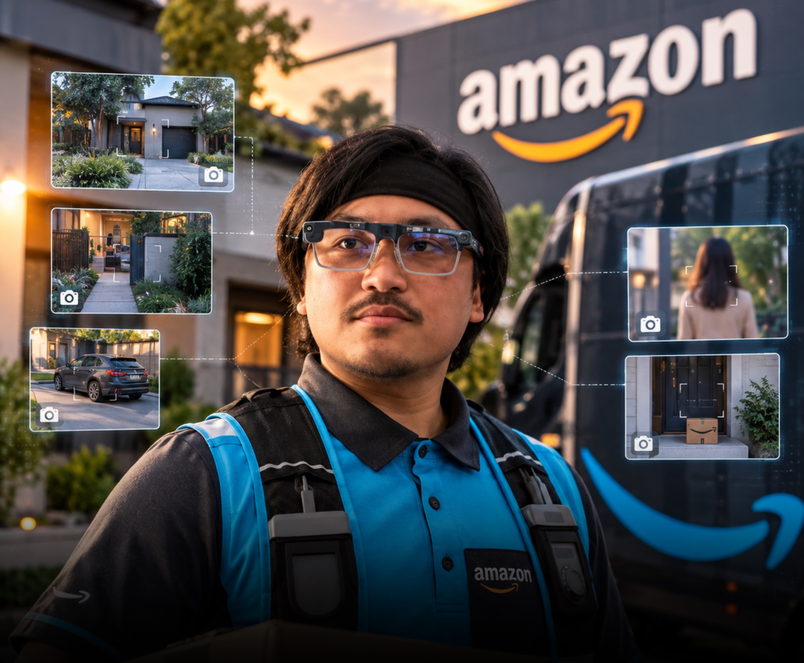
Amazon is stepping up its investment in wearable technology to improve last-mile delivery operations, with plans to equip 5,000 delivery drivers with smart glasses during 2026. The e-commerce giant also intends to accelerate the deployment in 2027, targeting more than 20,000 units by the end of next year.
Announced in October, the initiative is designed to simplify delivery procedures by giving drivers immediate access to navigation guidance and customer instructions without requiring them to repeatedly consult a handheld device.
The smart glasses display essential information directly within the driver's field of vision once the delivery van has been parked. This includes directions to the delivery location, access codes for gates and specific customer preferences regarding where packages should be left.
By keeping this information visible while drivers carry parcels and move through their surroundings, Amazon expects to reduce distractions and make deliveries more efficient.
“Wearable technology can be used at any stage of delivery
The technology is intended to support drivers throughout the entire delivery process, from ensuring the correct packages are loaded into the vehicle to the final handover.
The glasses take drivers through operational steps, such as checking parcels in the van, displaying customer delivery preferences when walking to the address and automatically taking proof of delivery, Amazon says.
The company introduced the technology last year. Since then, hundreds of drivers working with more than 300 Delivery Service Partners (DSPs) have tested the glasses. These partners are independent businesses that Amazon contracts to deliver packages on our behalf.
Participation by drivers is still not required.
There have been practical changes too, based on feedback gathered during the initial deployment. In particular, Amazon moved the computing components and battery from the glasses themselves to a compact controller integrated into the driver’s delivery vest.
The change is consistent with the company’s effort to make the equipment more convenient for everyday use and is based on operational feedback.
Smart alerts to help avoid delivery errors
In addition to navigation and package identification, the glasses can identify potential problems during the delivery process and alert drivers before a problem occurs.
One feature is a paw-print symbol and an audio alert, when available data suggests a pet may be present near the delivery location. This alert is intended to help drivers keep in mind potential safety concerns.
It can also trigger concerns if a package seems to have been left at a location that doesn’t match the delivery address.
These functions respond to a major problem for logistics operators: the reliability of deliveries. Unsuccessful or wrong deliveries cause additional operational costs and may shake the confidence of the customer.
The financial and customer-service implications of last-mile delivery failures were highlighted by third-party logistics provider GoBolt, making accurate delivery execution a key priority for carriers and shippers alike.
Safeguards for privacy remain a key consideration
Smart glasses are increasingly being used in the workplace, but they also raise questions about data protection and surveillance, especially when the devices can take pictures.
Amazon says privacy is built into the design of its delivery glasses. The technology automatically anonymizes the images it captures, blurring faces and vehicle registration plates.
The company also noted that the glasses do not record video or audio.
The company said blurred images are encrypted and can be viewed only by a limited number of employees who need to see them to improve delivery operations and reduce errors. Images are automatically deleted after a limited retention period.
These measures address privacy concerns, and also allow the company to use visual information to improve the delivery experience.
Amazon expands broader logistics tech strategy
The smart-glasses push is one part of Amazon's larger strategy to embed advanced technologies across its logistics and supply chain operations.
The company has been adding more robotics to warehouses and artificial intelligence to get better at forecasting and mapping deliveries.
Its latest investment seeks to bring this technology approach to the final mile of the delivery journey beyond fulfillment centers where driver productivity and accuracy have a direct impact on customer satisfaction.
Amazon isn’t the only one looking at tech-enabled solutions to last-mile operations. Other parcel delivery operators are also harnessing artificial intelligence to improve performance. Multiple other carriers are deploying AI-enabled tools to verify photos of deliveries, assess operational processes and identify opportunities to cut costs.
As pressure mounts on the industry to speed up, improve the reliability and efficiency of delivery, wearable technology and artificial intelligence are rapidly becoming key tools for logistics companies that want to maximize their last-mile networks.
Amazon’s planned expansion to over 20,000 smart glasses by the end of 2027 is another step toward a more connected, tech-driven delivery operation.
END OF REPORT