
Cargo Nov 18, 2026
Container freight rates still 50% above 2025 levels as Red Sea capacity risks grow
But a gradual reopening of Suez Canal transits and rapid fleet expansion could result in substantial overcapacity in 2027. Despite high freight rates, congestion, labor disputes and geopolitical uncertainties continue to complicate the outlook for global shipping.
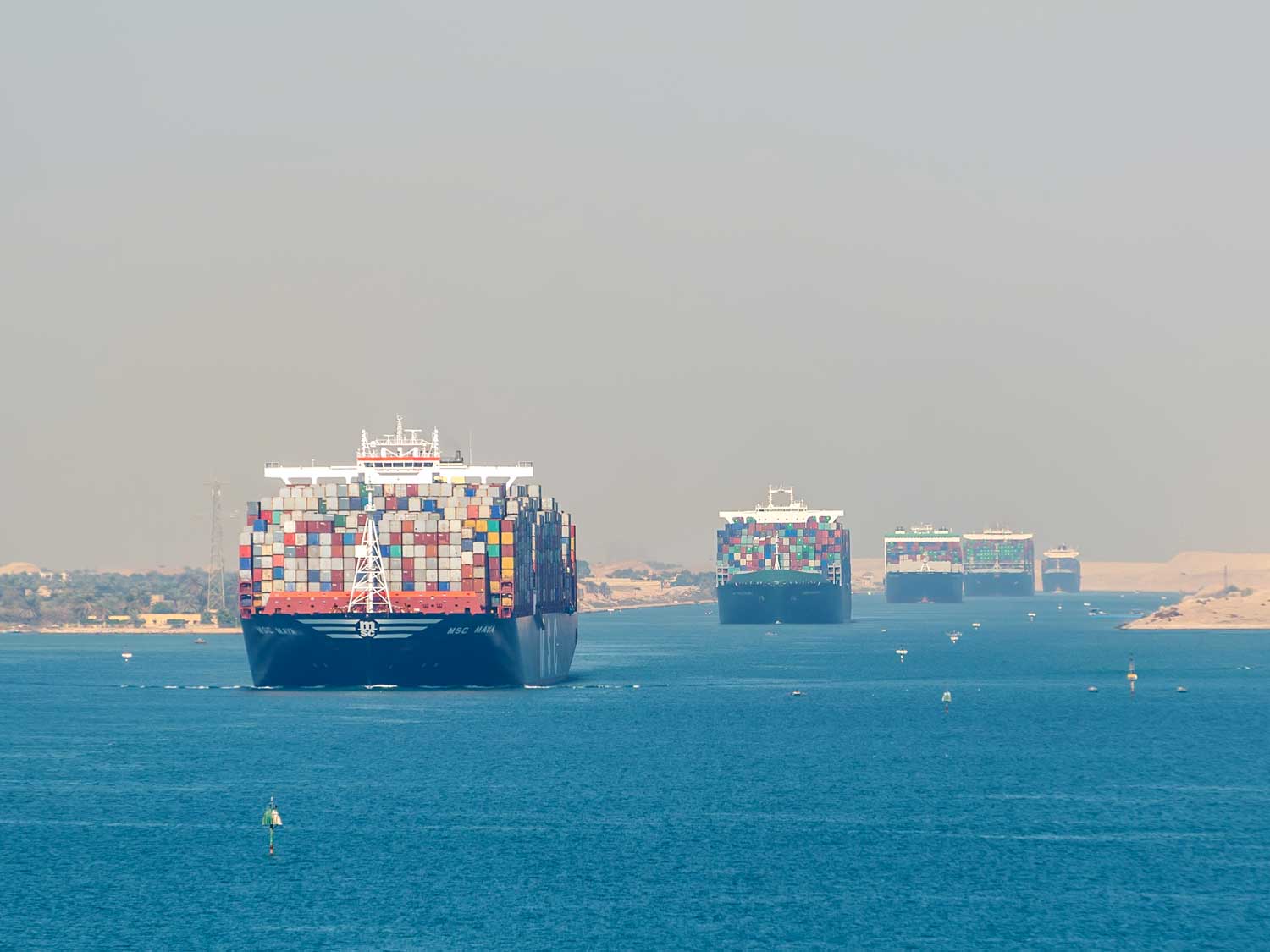
Ocean container freight rates on key east-west trade routes remain significantly higher than year-ago levels. But the gradual return of shipping services to the Red Sea, coupled with the continued expansion of the global container fleet, is fueling concerns of a potential oversupply of capacity in 2027 that could erode carriers’ ability to sustain current pricing levels.
Suez Canal returns may reshape global shipping capacity
Container shipping lines are gradually resuming services via the Suez Canal and Red Sea, decreasing dependence on longer routes around the Cape of Good Hope. The widespread diversions began in late 2023 after Houthi rebels in Yemen attacked commercial vessels in support of Gaza.
The recent merchant shipping security incidents from the Black Sea to the Strait of Hormuz and Somalia have also played a role in keeping freight rates under pressure.
Maersk and Hapag-Lloyd announced on November 16 that their Gemini AE1, AE2 and AE3 services would return to the trans-Suez route. The first departures under the new arrangements are planned for December and January, pending continued security and stability in the region.
The return of shorter hauls will have a big impact on shipping capacity. Shorter voyage times mean that vessels can complete their rotations more quickly, and thus effectively increase the number of available shipping services without having to add ships.
This is happening when the global container fleet is already growing considerably. Alphaliner data shows the orderbook for containerships is now 15.12 million twenty-foot equivalent units (TEU) or 43.9% of the operational fleet in service. The total fleet capacity is expected to increase by 9.2% in 2027.
The introduction of new tonnage and shorter sailing distances could, therefore, create a serious imbalance between demand and supply in the cargo market. This scenario would increase pressure on carriers to defend freight rates and maintain profitability next year.
Rates are firm in Asia-Europe, despite carrier pressure
Asia-Europe freight prices are still 40% to 50% higher than a year ago and still supported by congestion and higher fuel costs, the market update said.
Asia-North Europe rates remained stable at around $3,400 per forty-foot equivalent unit (FEU), but that was down 5% from the end of October. Rates on the Asia-Mediterranean corridor also remained relatively flat at around $4,300 per FEU.
Prices barely budged, indicating that general rate hikes put in place by carriers in early November are struggling to gain traction. This is leading to questions about whether the shipping lines can get another round of hikes in the middle of the month.
Carriers are increasingly using blank sailings – the cancelation or postponement of scheduled departures – to cut supply and prop up prices as weaker demand bites. Five blank Asia-Europe sailings next week have increased to eight, according to reports.
But carriers still have more price increases planned. Freightos said shipping lines are preparing for more increases in late November and December. Demand may provide further support for rates ahead of the Lunar New Year as exporters rush to ship products before the holiday period.
Trans-Pacific freight rates approach record levels
Trans-Pacific container rates recorded modest gains during the latest reporting week, unlike the relatively stable Asia-Europe market.
Rates remained near recent peaks, with rates of around $8,460 per FEU for shipments to the US West Coast and $9,850 per FEU for cargo headed for major East Coast hubs.
But other market indicators suggest some weakening. The Drewry World Container Index posted weekly decreases on the Shanghai-Los Angeles and Shanghai-New York routes.
Freight forwarders have also said they have been given discounts below the published freight rates. This highlights the discrepancies that can occur between benchmark indexes and the actual prices negotiated by individual shippers.
European labor disputes add to supply chain pressure
Disruptions at European ports are another factor affecting shipping reliability.
* French dockworkers and port workers were called out for a 24-hour stoppage on Nov. 17. Spanish port terminals meanwhile were still coming to grips with the impact of a general strike on November 11, although the impact was not uniform across locations.
These industrial actions take place in Europe, but their effects can spread far beyond individual ports. Terminal delays may affect vessel schedules, inland transportation and cargo delivery operations, causing knock-on effects across international supply chains.
Traffic congestion is on the rise in inland Southern California.
Challenges are not only in maritime transportation. Inland logistics operations in the US are also under significant pressure, particularly around the ports of Los Angeles and Long Beach.
Containers moving on rail through these gateways are facing delays as record volumes of Asian imports are colliding with weather-related disruptions affecting BNSF’s Southern Transcon network.
The combination has led to longer rail dwell times throughout Southern California, making it harder to move imported cargo from the ports to inland locations.
Another labor-related risk is simmering. Watchmen represented by the International Longshore and Warehouse Union (ILWU) Local 26 at the Los Angeles-Long Beach complex have set a strike deadline of Nov. 20 in their dispute. But negotiations on the contract continue.
Any disruption could cause further operational headaches at two of the most important container gateways on the US West Coast.
US-China trade talks add another layer of uncertainty
The container shipping outlook is also closely linked to developments in trade relations between Washington and Beijing.
U.S. President Donald Trump is set to meet Chinese President Xi Jinping this week before the interim U.S.-China trade deal expires on Jan. 10.
Further progress in easing trade tensions is possible but disagreements within the US administration and new restrictions on technology exports make the negotiations complicated.
The Wall Street Journal reported that Trump’s advisers are divided on the direction of U.S. policy toward China ahead of the summit. Beijing’s negotiating position is also unclear, particularly with the possibility of a Democratic controlled Congress taking over in January.
Washington has also moved to restrict China’s access to sophisticated American AI chips via overseas computing infrastructure, creating yet another flashpoint between the two countries.
The trajectory of the talks could directly affect demand for international shipping as companies gage the future of the trade pact and determine when to move cargo.
Panama Canal gains transit capacity after better rainfall
The Panama Canal is also seeing improving conditions, with heavier rains allowing the Panama Canal Authority to relax restrictions put in place due to below-normal precipitation in the summer.
The authority, in an advisory issued Nov. 9, raised the total number of daily booking slots to 34 and returned the maximum authorized draft for vessels transiting its Neopanamax locks to 50 feet.
The decision is due to better water availability, more favorable hydrological forecasts and the implementation of water conservation measures.
The threat of El Niño, however, has not gone away. Recent forecasts have reduced the likelihood of an extreme event, but weather uncertainty still has relevance to long-term operating conditions of the canal.
The US Climate Prediction Center had cut the odds of an El Niño event exceeding the intensity of the 1982-1983 episode to around 60% from a prior estimate of 83%, according to Bloomberg.
Therefore, Freightos is now less likely to see a major disruption to Panama Canal operations in the first half of 2027 than it was over the summer. But further restrictions cannot be excluded if the water situation deteriorates.
High rates and increasing capacity squeeze shipping market
The current situation in container shipping is a complicated one for both carriers and cargo owners. Freight rates are still far above year-ago levels, backed by congestion, higher operating costs and geopolitical disruptions.
But the slow restart of the Red Sea corridor, the arrival of new ships and the growth of the global fleet are laying the groundwork for a potential surplus of capacity in 2027.
Lower freight rates may offer some respite to shippers, but pricing is only one part of the equation. Schedule reliability and cargo flow are threatened by blank sailings, port labor disputes, rail congestion and geopolitical uncertainty.
The industry’s main problem will be how to manage the transition to higher capacity availability without a sharp fall in freight rates or operational performance.
END OF REPORT