




Diesel futures suffered a dramatic selloff on Monday, but motorists and freight operators are still seeing prices move in the opposite direction.
According to FreightWaves, the drop of more than 55 cents per gallon in ultra low sulfur diesel (ULSD) on the CME commodity exchange appears to have been the largest one-day decline in the contract’s history. The contract originated in 1979 as a heating oil trading platform, and because diesel and heating oil are both distillates, the comparison remains relevant.
Although diesel prices also fell sharply during the economic shock of 2020, those declines were more gradual. The price slide seen in 1991, when US forces drove Iraqi troops out of Kuwait, was also significant, but came from a much lower price base, making a 55-cent daily move effectively impossible in practical terms.
Despite Monday’s collapse in futures, pump prices continued to rise.
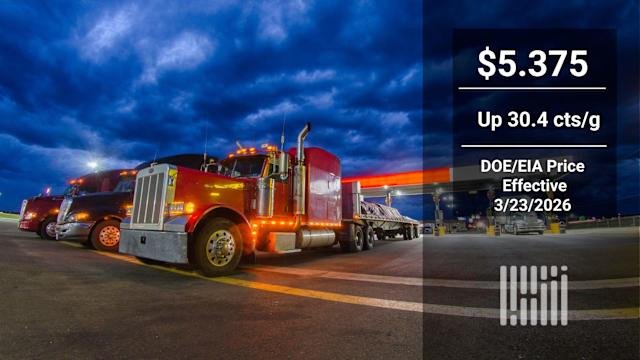
The Department of Energy/Energy Information Administration average weekly retail diesel price, which forms the basis of most fuel surcharges, increased another 30.4 cents per gallon to $5.375 per gallon. That marks the 10th consecutive weekly increase.
The last three weekly rises — all recorded after the beginning of military action in the Middle East — added 96.2 cents, 21.2 cents and 30.4 cents respectively, for a combined increase of $1.47 per gallon. Over the full ten-week streak, diesel prices have risen by $1.916 per gallon.
The latest DOE/EIA price is the highest since October 24, 2022, when the benchmark stood at $5.31 per gallon amid the combined effects of the war in Ukraine and broader global inflation. The highest level ever recorded in the DOE/EIA series remains $5.81 per gallon on June 20, 2022.
The AAA average daily retail diesel price also offered no immediate relief. It rose for the 24th consecutive day, with the streak dating back to March 1, reaching $5.345 per gallon on Tuesday. That was up 6 cents from Monday and $1.587 per gallon higher than on February 28.
Meanwhile, part of Monday’s futures collapse had already been reversed by Tuesday morning. At around 11 a.m., ULSD was trading at $4.2779 per gallon, meaning roughly 40% of the previous day’s decline had already been recaptured. At one stage during Tuesday trading, the recovery had reached about 52%.
On the supply side, the market is now dealing with another source of pressure. Media reports said Valero Energy experienced a fire on Monday in a diesel hydrotreater at its 380,000-barrel-per-day refinery in Port Arthur, Texas, and that the refinery had been shut down. A diesel hydrotreater removes sulfur and other impurities from fuel.
There may also be an unexpected financial upside for larger trucking operators. In a research note published earlier this month, Citi said rising diesel prices and the associated fuel surcharges could actually benefit large fleets more than smaller carriers.
In the report, which upgraded Knight-Swift from neutral to buy, Citi said fuel surcharge mechanisms should help blunt the medium-term impact of higher prices on transport companies. It added that the sophistication of surcharge systems tends to favour larger operators.
Speaking to CNBC from CERAWeek in Houston, US Energy Secretary Chris Wright was asked what the federal government could do to ease rising gasoline and diesel prices beyond releasing oil from the Strategic Petroleum Reserve. He said there are measures under review to improve refinery efficiencies, though he offered no details.
For oil consumers, however, the central issue remains the scale of the supply disruption. Global supply is estimated to be down by at least 10 million barrels per day in a market of roughly 104 million barrels per day.
In its March report, the International Energy Agency said this represents the largest supply shock global oil markets have ever faced. London-based consultancy Energy Aspects said over the weekend that the situation is no longer simply about delayed or disrupted flows, but about permanent supply loss. It added that the remainder of 2026 will be needed to make up for missing supply through stronger refinery runs — otherwise prices may need to rise further in order to significantly curb demand.