Business Nov 20, 2026
Einride secures $167 million in contractually committed revenue, targeting $250 million annual run rate by 2027
The Swedish autonomous freight specialist is speeding up its expansion with both electric and driverless truck operations, and deploying Nvidia’s standard artificial intelligence (AI) technology to progress with highway autonomy. The company is experiencing growing operating losses and dwindling cash reserves, even as its commercial commitments are increasing.
Einride expects to see significant revenue growth over the next few years and expects to reach an annualised revenue run rate of approximately $250 million by the end of 2027. More than 65% of that amount is expected to be supported by signed customer contracts, reflecting the Swedish company’s growing commercial footprint in electric and autonomous freight transport.
In a business update released Wednesday, the company said it had contracted annual recurring revenue of roughly $167 million as of November. This is a 76% rise from the $95 million recorded at the end of June.
The company’s latest figures also suggest ongoing commercial growth. In the third quarter, revenue rose 27% sequentially to SEK 185.9 million ($18.3 million) on a constant-currency basis. Since June, Einride has signed up eight more customers, bringing its total to more than 40.
The company revised its second half revenue outlook to $39 million to $42 million. It also expects to end December with an annualised revenue run rate of $85 million to $95 million, up from about $76 million at the end of September and $49 million in December 2025.
Einride’s autonomous strategy powered by Nvidia tech
A major focus of Einride’s long-term growth strategy is to make autonomous freight transportation work on highways. To speed this development, the company is using an artificial intelligence model developed by Nvidia, instead of developing all of its driving technology itself.
Back in October, Einride said it would take Nvidia’s Alpamayo self-driving model and train it on data from its own freight network. This approach is expected to reduce the cost of adding autonomous features to more types of vehicles and routes, and to shorten development cycles.
Einride’s chief technology officer, Henrik Green, explained the strategic advantage in an interview with FreightWaves on Nov. 13. “Several companies that entered the autonomous driving space earlier have spent billions of dollars to develop and train their own AI models,” he said.
Now those advanced models are becoming available to other companies, and “Einride has the opportunity to begin with a technology that’s already highly developed rather than building everything from scratch,” Green said. He said the opportunity was a particularly good starting point.
Growing the electric and autonomous fleet
Today, Einride’s operational network consists of more than 260 electric trucks and 10 autonomous vehicles. Green said about 4% of its fleet mix is now fully autonomous trucks, with five operating in Europe and five in the United States.
The company is also making strides in commercial driverless operations.
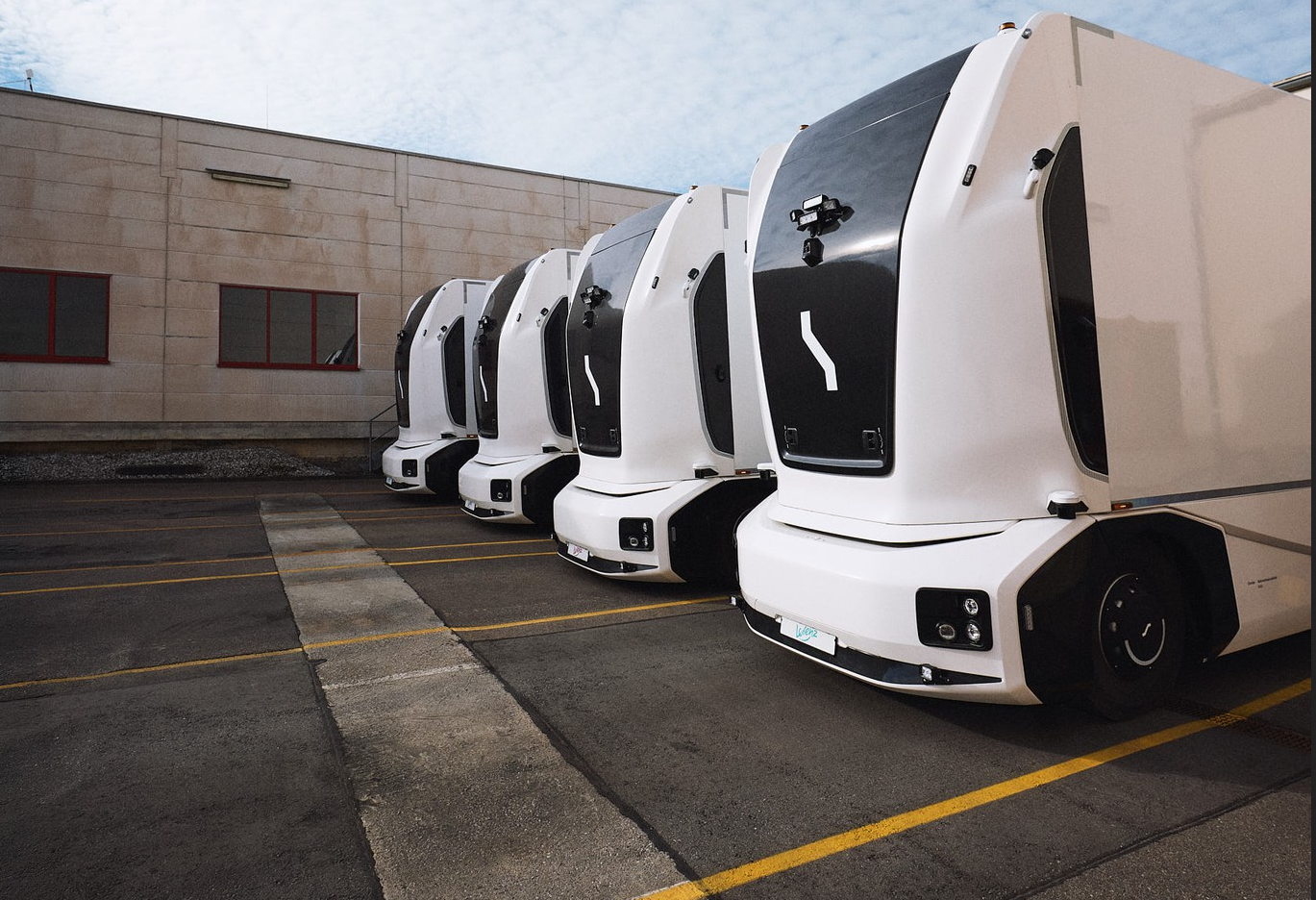
In September, Einride and Lidl unveiled what they called the first cab-less SAE Level 4 truck to operate daily on a German public road. The deployment is being conducted under a permit from Germany’s Federal Motor Transport Authority.
Einride is running two cabless trucks for EASE Logistics in the United States, making daily deliveries of freight in Marysville, Ohio.
The company has logged some 8,500 hours of cumulative driverless operating time in contracted customer operations as of Nov. 13. This compares to some 5,400 hours in June, reflecting the growing operational experience of its autonomous fleet.
Einride develops its next-generation driving system with Nvidia Hyperion
The company's technology roadmap is also progressing through its collaboration with Nvidia announced in September. Under this agreement, Einride is developing the next generation of its Einride Driver autonomous driving system on Nvidia's Hyperion platform.
Green said the partnership provides access to lidar, camera and radar sensors already manufactured in large volumes by automotive suppliers for Hyperion-based applications. This availability of standardised components is expected to improve both product quality and cost competitiveness.
The onboard computing architecture will use two Nvidia Drive Thor chips. Since Nvidia does not directly sell onboard computers, Einride sources these systems through Tier 1 suppliers.
Green added that the components are also prepared for vehicle type approval as the company moves towards larger-scale deployment.
Adapting Alpamayo using data collected from freight operations
Einride plans to begin its adaptation process with Alpamayo's 34-billion-parameter version, which Green described as a model initially designed around robotaxi applications.
The company intends to distil this technology into a smaller model of approximately one billion parameters, allowing it to operate directly inside trucks.
According to Green, the two-chip computing configuration provides sufficient processing capacity to run the one-billion-parameter AI system onboard the vehicle. Einride is targeting a live road test during the second half of 2027.
The company is not alone in pursuing this approach. PlusAI, a developer of Level 4 autonomous trucking software, announced in March that it was also adapting Alpamayo for heavy-duty trucks using Nvidia Hyperion.
To make the model suitable for freight transportation, Einride will equip its human-driven electric trucks with sensors and use them as mobile data-collection platforms.
Green explained that a sensor-equipped truck can generate approximately five terabytes of data per hour. However, a significant proportion of this information is subsequently selected, annotated or discarded during the data-processing process.
An important advantage of this strategy is that these vehicles can continue carrying freight for customers while collecting the information required to improve autonomous driving technology. In other words, data generation takes place alongside revenue-generating transport operations.
Green said this approach allows Einride to obtain the necessary operational data without having to dedicate an entirely separate fleet to data collection, before using it to train the remaining components of the AI model.
Existing safety architecture remains in place
While the company develops its next-generation AI system, its current autonomous driving technology, referred to by Green as Einride 1.0, will continue operating as a safety layer around the new model.
This existing system has been instrumental in securing regulatory authorisations for public-road operations.
According to the company's update, Einride holds permits covering four countries and five US states for autonomous operations without a safety driver.
Green explained that maintaining this established safety architecture around the AI system will allow the company to continue deploying vehicles under the existing public-road authorisations.
Once Alpamayo has been adapted and trained specifically for freight trucks, Einride expects to be able to deploy the technology across as much as 80% of its current network.
The company is targeting the introduction of highway autonomous driving capabilities from the first half of 2028.
Lower cash reserves and higher expected operating losses
Despite its commercial and technological progress, Einride is facing financial pressures as it continues investing in fleet expansion and autonomous technology.
Cash reserves declined to SEK 533 million, approximately $53 million, on September 30, compared with SEK 748 million, or around $77 million, on June 30.
Adjusted EBITDA, a non-IFRS financial measure, showed a loss of $20.3 million for the third quarter on a constant-currency basis.
The company has also revised its expectations for the second half of the year. It now anticipates an adjusted EBITDA loss of between $39 million and $41 million, compared with its previous forecast of $35 million to $37 million.
On a reported basis, Einride recorded a third-quarter net profit of $95.3 million. However, this result was primarily driven by a $133.8 million gain on financial instruments measured at fair value. The company excludes this gain when calculating adjusted EBITDA.
Einride noted that the quarterly figures remain preliminary and unaudited. It also clarified that contracted annual recurring revenue remains subject to termination rights and management assumptions and should not be interpreted as a revenue forecast.
Tesla Semi orders, third party financing help grow fleet
Fleet growth is another key part of Einride’s strategy. It expects most of the 500 Tesla Semi trucks it ordered in August to come into service in 2027.
To fund this expansion, Einride plans to use asset-backed financing instead of directly using all fleet investments from its own cash reserves.
“We are on a disciplined growth path with third-party financing to grow our fleet, while focusing our capital on technology development and operations,” said Chief Financial Officer Anubhav Verma.
The company is still targeting cash-flow breakeven in 2028, by which time it expects to have between 1,500 and 2,000 vehicles in operation.
Further down the line, Einride aims to exceed $2 billion in annualized run-rate revenue by 2030. This ambition includes the possible conversion of approximately $800 million of annual recurring revenue from non-binding joint business plans agreed with customers.
The company also plans to transition to full quarterly financial reporting, including detailed financial statements, in 2027.
Deploying the Einride Driver across truck platforms
Einride’s autonomous driving technology is currently running on its own cab-less trucks, but the company is also working to extend its system to vehicles made by other industry players.
One key activity is to integrate the Einride Driver into DAF’s electric truck platform. Software integration and commissioning activities are planned for 2027.
“The longer-term goal for the company is to develop a driving system that can adapt to different vehicle configurations, traffic conditions, countries and geographical environments,” Green said.
This flexibility could allow Einride to take its autonomous technology beyond its own fleet and to support a wider range of commercial freight applications.
END OF REPORT