Maritime Nov 25, 2026
Fincantieri’s VARD Joins Norway-Backed Push to Develop Nuclear-Powered Offshore Vessels
The MarNuPS project secures NOK 20 million in initial funding to develop and test an integrated marine nuclear propulsion system. A full-scale land-based demonstrator is targeted for 2027, with the first offshore vessel application expected in 2031–2032.
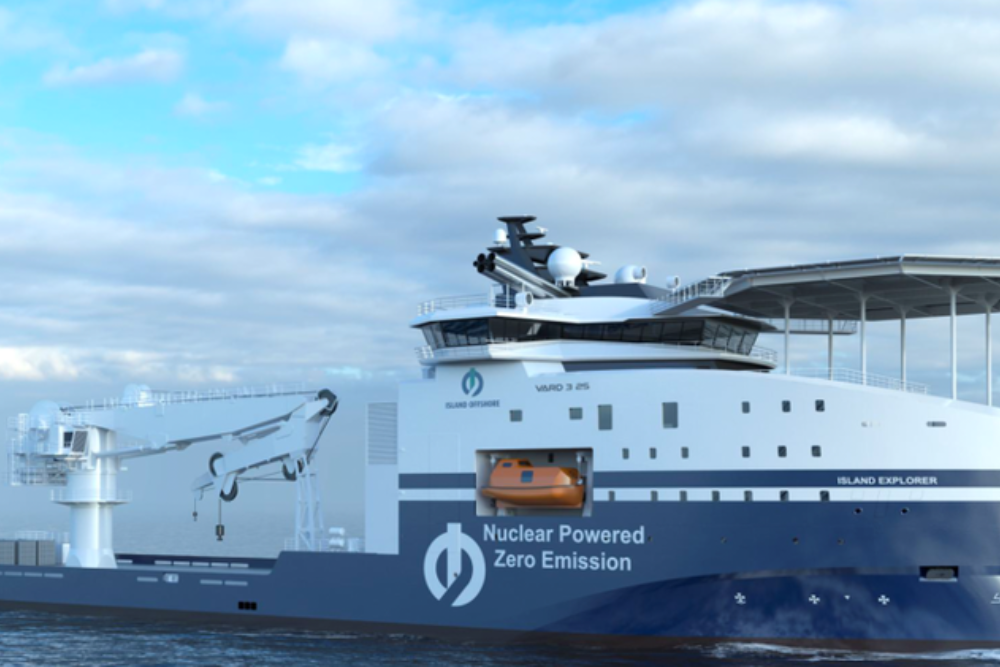
TRIESTE – The development of nuclear-powered commercial vessels is taking another step forward, with VARD, the Norwegian shipbuilding subsidiary of Fincantieri, joining an international initiative aimed at bringing nuclear propulsion technology closer to practical maritime applications.
The project, known as MarNuPS (Marine Nuclear Propulsion System), is led by Norway-based Emerald Nuclear Norway and has secured an initial grant of NOK 20 million (approximately USD 2 million) from the Research Council of Norway. The funding will support the development and testing of an integrated nuclear energy and propulsion system designed primarily for offshore vessels, with the first onboard application targeted for 2031–2032.
The consortium brings together Emerald Nuclear Norway, VARD Group, its subsidiary Vard Electro, offshore vessel operator Island Offshore, the Norwegian University of Science and Technology (NTNU), Imperial College London and Maskindynamikk. Their shared objective is to move marine nuclear propulsion beyond the research and development stage by building and validating a fully integrated system through physical testing and land-based demonstrations.
gas-cooled reactor with supercritical CO2 technology
The core of MarNuPS is an energy architecture that couples a gas cooled nuclear reactor with a supercritical carbon dioxide (sCO2) gas turbine to generate electricity.
The proposed system will also include energy storage technologies, remote monitoring and control, onboard power management and integration with the vessel’s Integrated Automation System (IAS). These elements are to ensure that the technology can meet the operational needs of offshore vessels, while maintaining a reliable energy supply and effective control of the onboard systems.
One major difference is the first test phase of the project. The reactor will be powered up by heating it with electricity, not by an active nuclear reaction. The actual nuclear operation will only be considered at a later stage after the integrated system has passed the necessary safety assessments and has demonstrated compliance with the required parameters.
Norway to build full-scale testing facility in 2027
The first major development milestone will be in 2027 when a land-based test center is planned to be built in Stette, near Ålesund, Norway.
Inside the facility will be a full-size model of the propulsion system to be installed on future vessels. tests will be carried out under normal operating conditions, rapid changes in power demand, transients, stresses, overall system performance and interaction with the crew
This stage of testing will be important to see how the different components work together before the technology moves to a floating demonstrator and finally to possible commercial use.
Moreover, engagement with MarNuPS is a chance to strengthen VARD’s competencies within electrical engineering and on-board control systems, with specific attention to the integration of new generation energy technologies in maritime platforms.
Through its subsidiary Vard Electro, it plans to develop and validate solutions for electrical and control systems for use in a land-based nuclear energy system, before moving on to a floating demonstrator.
“Having a real nuclear energy system on land before moving to a floating demonstrator will allow us to further develop electrical and control systems on board, said Håvard Vollset Lien, VARD’s Vise President of Research and Innovation.
Lien also said that MarNuPS is a follow-up of earlier research efforts led by NTNU like NuProShip I, NuProShip II and the SFI SAINT program. These projects have been crucial to the development of knowledge and technologies for the advancement of nuclear propulsion in maritime transport.
“MarNuPS is another important step toward the possible commercial use of nuclear energy in shipping and the public funding shows Norway’s national support for the development of nuclear technologies for use at sea,” he said.
Fincantieri boosts investment in advanced nuclear propulsion
VARD’s involvement is also part of Fincantieri’s wider interest in advanced nuclear technologies for the maritime sector.
The Italian shipbuilding group is studying the use of advanced lead-cooled modular reactors for naval propulsion, and is conducting specific feasibility studies on the integration of these technologies in future vessel designs.
The MarNuPS program therefore complements the group’s research on alternative energy systems, especially in a maritime industry looking for new solutions for long-term energy supply and vessel propulsion.
Island Offshore to deliver first nuclear-powered OSV
“The project will be driven by real life needs of offshore operations with Island Offshore, the offshore vessel owner, playing a key role.
The Norwegian shipowner has said it aims to be first operator to install a nuclear-powered energy system on board an Offshore Support Vessel (OSV). Its involvement will help ensure that the technology is developed with real operational needs in mind, and not just technical performance.
In addition to the engineering and vessel integration work, MarNuPS also includes a proposed commercial framework from Emerald Nuclear for its GEM Microreactor.
The microreactor is designed for use at sea and for power generation at remote floating sites and will be operated under a leasing business model.
The proposed arrangement by Emerald Nuclear would see the company retain ownership and operation of the reactor. It would also handle the maintenance and the nuclear fuel cycle, and shipowners would pay for the energy they actually consume.
Under this model, ship operators could reap the benefits of nuclear power without owning and operating the nuclear plant.
MarNuPS is a concrete development effort to bring nuclear energy in commercial maritime operations, with funding secured from Norway and with a land-based demonstrator planned for 2027 and deployment on an offshore vessel targeted for 2031-2032. The development will be subject to successful validation of the technology, meeting the safety requirements and translating the proposed system into a solution that is commercially viable for shipowners.
END OF REPORT