



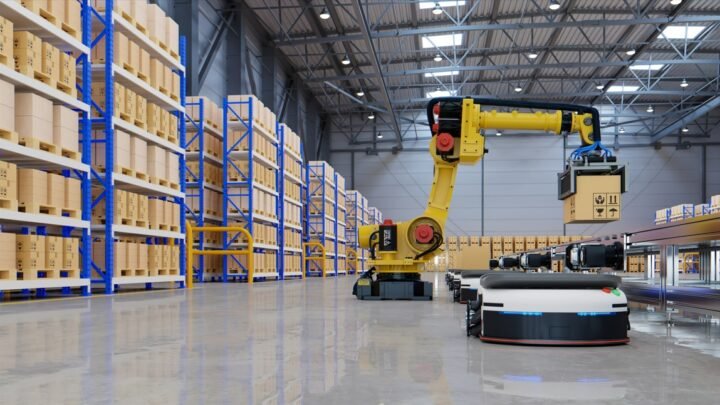
Artificial intelligence may have dominated conversations at Manifest, but for investors looking at logistics technology, the real story may be the growing convergence between AI and warehouse hardware.
According to Mike Plasencia, group director of new product strategy and RyderVentures at Ryder System, the next major leap in warehousing will come from what he calls “physical AI” — a combination of artificial intelligence and adaptable hardware able to perform multiple functions rather than a single fixed task.
Plasencia, who oversees RyderVentures’ investment strategy across more than 20 portfolio companies, said warehouse automation continues to offer major growth potential, even if adoption remains lower than many expected.
The main reason, he argues, is not lack of utility but fear. Traditional warehouse automation often requires high capital commitments for equipment designed for a specific use case. If business needs change, that investment can quickly become difficult to justify.
Physical AI, by contrast, makes hardware more flexible. Instead of buying machines locked into one task, operators could deploy systems able to adapt to multiple functions and ramp up more quickly.
For Plasencia, that flexibility directly addresses automation’s biggest adoption barrier. The issue is not whether the technology works, but whether companies are willing to commit significant capital to equipment that may later become misaligned with the business.
He illustrated the point with autonomous forklifts. Buying one is one thing, but outfitting an entire warehouse with dozens of units represents a far bigger risk if the solution turns out to be the wrong fit.
RyderVentures expects two areas to move particularly fast in 2026: trailer unloading automation and new warehouse system architectures that challenge conventional facility design.
One recent example is Mytra, a company in which RyderVentures has invested. Plasencia describes its concept as something close to a large automated storage and retrieval system for pallets, in which each pallet position becomes its own autonomous device capable of moving within a matrix. Instead of relying on elevators and traditional put-away systems, the racking itself becomes dynamic and self-optimizing.
This reflects a broader shift toward software-defined warehouse automation, where goods move through a system designed around intelligent optimization rather than through aisles navigated by individual robots or forklifts.
Plasencia also believes the industry faces a deeper issue: a lack of imagination. He compares the situation to the early adoption of electricity, when some factories used it merely to replace a single pump while others fundamentally redesigned the factory around the new technology. Warehousing, he argues, is now approaching a similar turning point.
Consumer packaged goods companies are emerging as likely early adopters, though Plasencia did not identify specific customers.
For founders hoping to attract investment, his message is clear: basic AI is no longer enough. Companies must show why their data, customer base or domain expertise creates a differentiated solution strong enough to build an initial foothold and expand from there.
As technology costs fall, he believes the competitive edge in physical AI will come down less to the technology itself and more to execution, implementation and trusted partnerships. Once a logistics provider has earned trust inside an organization and continues to expand successfully, customers are likely to stay with that partner.