Air Nov 24, 2026
Global air cargo rates continue climbing despite temporary volume slowdown
Worldwide airfreight rates increased for a seventh consecutive week in mid-November, reaching US$3.49 per kilo. Despite a decline in global cargo volumes linked to Diwali and disruptions to US aviation, tightening capacity and growing peak-season demand continue to support higher prices.
The air cargo market continued its positive trend in terms of rates in week 46 (9–15 November), although there was a short-term dip in the volumes of shipments. The global average airfreight rate rose by 2% week on week (WoW) to US$3.49 per kilo, according to the latest figures from WorldACD Market Data.
The latest increase marks the seventh straight week of price rises compared with an average of US$3.04 in mid-September. Supporting the trend was a 2% decline in global week-on-week capacity, while chargeable weight fell 4%.
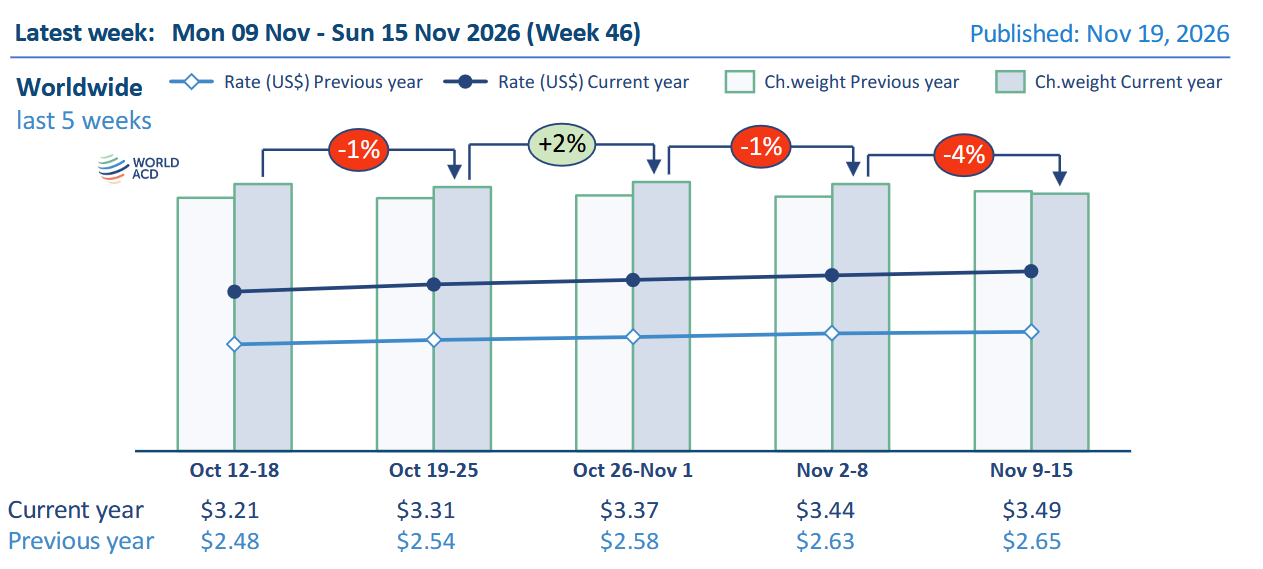
Volumes were weaker due to a combination of factors including the Diwali celebrations which slowed export activity across South Asia, and the disruption to US aviation operations on 13 November which impacted international cargo flows.
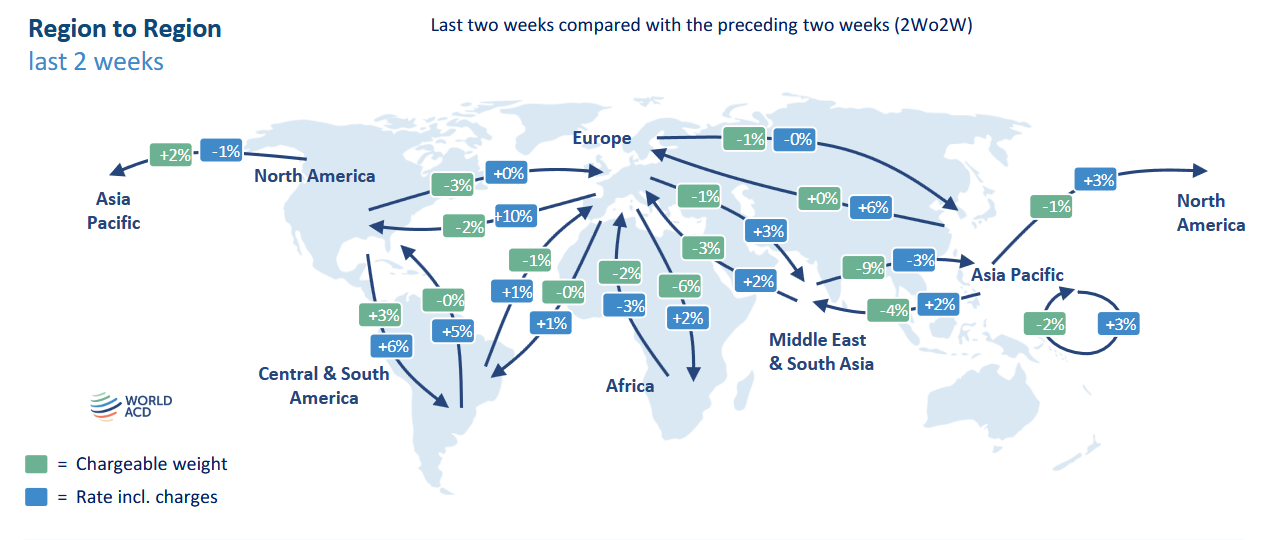
Still , the regional pricing trends were generally positive . Rates fell by 1% from the Middle East and South Asia (MESA) and by 2% from North America. Elsewhere they kept climbing. The biggest rise was in Central and South America (CSA) with 6%, followed by Africa with 4%. Asia Pacific and Europe also rose 2%.
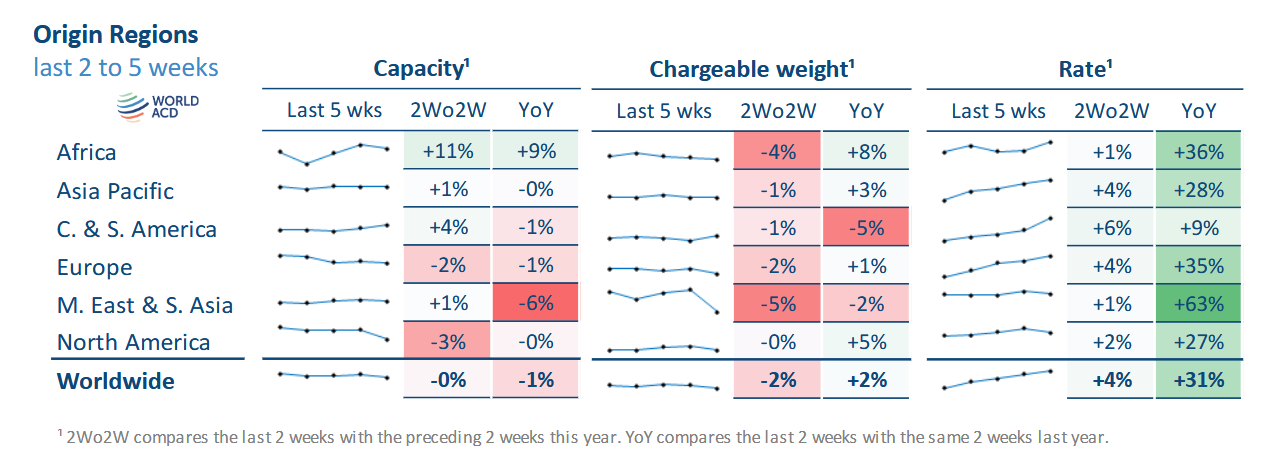
Global airfreight rates increased by 4% in the latest two-week period compared to the previous fortnight (2Wo2W). Growth was seen in all regions of origin, with CSA again leading 6% ahead of Asia Pacific and Europe both 4% up.
Also the strength of the market is visible in the year-on-year comparison. Globally, rates were 32% higher than in the same week a year ago. The largest increase was in MESA, with 62%, and the smallest was in CSA, with 13%.
Capacity contraction further supports airfreight prices
A reduction in available capacity was important to maintaining the upward movement in rates. Global air cargo capacity was down 2% WoW, with the fall coming from lower bellyhold capacity on passenger aircraft, not freighters.
Bellyhold capacity fell for a third week in a row, as pressure on the passenger aircraft segment continued. North America saw the steepest decline, with available capacity down 8%.
Elsewhere the declines were: Africa down 3%, Europe 2% and MESA 1%. Capacity from Asia Pacific was unchanged.
The only region to report an increase in capacity was the CSA origin region, up 3%. This development occurred simultaneously with the transfer of this bellyhold capacity from transatlantic services to North America–Central and South America services.
Chargeable weight down in most origin markets
The latest numbers, even with stronger pricing, don’t provide any clear sign that the peak-season increase in chargeable weight has peaked.
Chargeable weight declined in almost all origin regions in week 46. CSA was the exception, with a weekly gain of 6%.
MESA experienced the largest contraction with volumes down 21%. Europe followed with a 6% decrease, North America decreased 4%. Africa and Asia Pacific saw more moderate falls of 2% and 1% respectively.
Worldwide tonnage was down 2% on a 2Wo2W basis. North America was flat while all other regions showed lower volumes. Declines ranged from 1% in both CSA and Asia Pacific to 5% in MESA.
The weaker figures were also driven by the disruption to US aviation on Friday 13 November. The US air traffic control outage halted commercial aviation operations throughout the country. Canada, Mexico and the European Union aviation regulators also stopped all flights bound for the US during the period of disruption.
Operations resumed, but the effects were felt into the next weekend. International flight capacity from the US was still around 10% lower than the previous week.
Global chargeable weight was 1% lower than week 46 last year. But Africa, Asia Pacific and North America had modest single-digit increases. By contrast, volumes were down 2% in Europe, 7% in CSA and 15% in MESA.
Asia Pacific-US volumes recover slightly as European shipments weaken
Air cargo flows between Asia Pacific and the United States showed a modest improvement during the reporting week. Chargeable weight increased by 1% WoW, partially recovering from the 3% decline recorded in the previous week.
China, Hong Kong and Japan contributed to the recovery, with higher US-bound volumes. Thailand and Vietnam remained broadly stable, while several other origins experienced declines.
Singapore recorded a 10% contraction, followed by Taiwan at 6%, Malaysia at 5% and South Korea at 1%. Indonesia stood out in the opposite direction, posting the strongest weekly increase, at 10%.
The annual comparison remains significantly more positive. US-bound exports from Asia Pacific were 14% higher than a year earlier. Taiwan led the regional performance with a 32% increase, while South Korea and Vietnam both recorded growth exceeding 20%.
China, Japan, Thailand and Indonesia also achieved increases of more than 10%. Singapore and Malaysia were the only origins to register lower year-on-year volumes, declining by 14% and 2%, respectively.
Meanwhile, cargo movements from Asia Pacific to Europe lost momentum. After two consecutive weeks of stable volumes, chargeable weight fell by 1% WoW, reflecting weaker shipments from Malaysia, Hong Kong, Thailand, Vietnam and Japan.
South Korea, Indonesia and Taiwan recorded increases ranging between 3% and 5%. Volumes from China and Singapore remained unchanged.
The longer-term trend on this trade lane is less encouraging. Compared with the same period last year, Asia Pacific-to-Europe tonnage was down 15%, extending the sequence of double-digit annual declines to seven consecutive weeks.
Hong Kong recorded the sharpest contraction, at 34%. Lower volumes from Thailand, Taiwan, China and Japan also contributed to the overall weakness, outweighing growth from Malaysia, Singapore, South Korea and Vietnam.
Asia Pacific export rates continue to strengthen
Pricing developments across Asia Pacific remained favourable, with rates increasing on both major trade lanes.
For shipments to the United States, average rates rose by 2% WoW. Most origins contributed to the increase, although Indonesia, South Korea and Taiwan recorded declines of 3%, 4% and 8%, respectively.
The year-on-year comparison shows that pricing remains more than 40% higher overall. Singapore recorded the largest increase, at 86%, followed by Japan at 75% and Malaysia at 57%. These represent the strongest annual increases in US-bound pricing from the respective origins this year.
On routes connecting Asia Pacific with Europe, average rates increased by 4% WoW.
The movement was not uniform across the region. Malaysia and Singapore recorded low single-digit declines, while Thailand remained stable. All other origins experienced higher rates.
China led the increases, with a 6% rise, followed by Hong Kong and Vietnam, both up 4%.
Compared with the same week last year, average pricing on the Asia Pacific-Europe trade lane was 26% higher. Indonesia, South Korea, Malaysia and Thailand recorded increases of nearly 50%, while rates from China and Hong Kong rose by 16% and 18%, respectively.
MESA exports volumes slump on Diwali, regional uncertainty
One of the most pronounced contractions in air cargo volumes was seen in week 46 in the Middle East and South Asia region.
Chargeable weight on Europe routes fell 25% week on week, with services to the US down 23%. The fall is due to lower South Asian export activity during the Diwali period and continued volatility in the Middle East.
On the European trade lane, shipments from India declined by 27%, Sri Lanka by 29% and Bangladesh by 17%. Dubai saw a slight decline of 3%.
The year-on-year comparison reveals a much more serious deterioration. MESA-to-Europe tonnage was down 29% on a year ago. Individual origin markets were down from 13% for Bangladesh to 67% for Dubai.
However, flows to the US also weakened, though the performance varied a lot by origin. Bangladesh and Sri Lanka shipments were up by low single digit percentages WoW, while India volumes were down 22% and Dubai down 40%.
On a weekly basis, the MESA-to-US traffic was still positive, although the growth had slowed. Tonnage was up 6% helped by higher exports from India, 23% and Bangladesh, 38%.
MESA pricing remains broadly stable despite falling volumes
In contrast to the sharp contraction in shipments, airfreight pricing from MESA showed relatively limited movement during the reporting period.
Average rates to the United States remained unchanged WoW. A 1% decline in pricing from India offset increases from Dubai, Bangladesh and Sri Lanka. The latter recorded a particularly strong weekly increase of 11%.
On routes to Europe, average rates from MESA decreased by just 1%. Pricing across most origins remained broadly stable.
Nevertheless, the year-on-year figures underline the extent of the increase in freight costs. Rates from MESA to Europe were 68% higher than during the corresponding week last year. India and Dubai recorded particularly substantial increases, at 76% and 97%, respectively.
The US-bound market showed an even stronger annual increase, with average MESA rates climbing by 81%. India and Dubai were again the main contributors, both recording increases of 88%.
Peak season demand to maintain upward pricing momentum
Looking ahead, the air cargo market is expected to continue its upward pricing trend as the peak shipping season approaches.
The National Retail Federation has upgraded its earlier prediction for the U.S. holiday shopping season, expecting sales volumes to rise by 4.2%. A brighter outlook points to sustained demand for international freight services as retailers prepare for the year-end shopping season.
But consumer shopping habits are changing, too. More shoppers are starting their Christmas shopping earlier and the National Retail Federation is expecting a busy Thanksgiving weekend for sales.
These developments are of particular interest to air cargo operators as they suggest that a significant part of the seasonal demand may come to fruition before the usual peak in airfreight volumes.
Airlines have also demonstrated the ability to react fairly quickly to changing market conditions with capacity adjustments. The flexibility has been most apparent on transpacific routes where extra capacity has been put in place to meet variations in demand.
Hence, although seasonal demand and tighter capacity should still underpin higher freight rates, the market may not experience a sharp acceleration in pricing.
The combination of stronger retail expectations, changing shipping patterns and airlines' capacity adjustments suggest that airfreight rates will continue to come under upward pressure, but that any further increases could be relatively moderate as the industry moves further into peak season.
END OF REPORT