



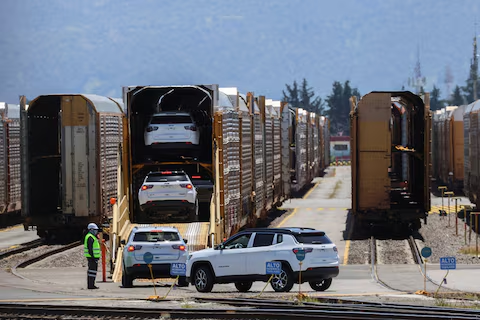
Mexico’s automotive industry turned out 311,457 light vehicles in February, down 1.8% from the same month last year, while exports fell 4.4% to 247,945 units, according to fresh data from the country’s national statistics agency, INEGI.
Even with the monthly slowdown, the sector remains one of North America’s most powerful export engines, particularly for the US market.
During the first two months of 2026, Mexican plants produced 625,774 vehicles, a slight 0.6% decline compared with the same period in 2025. Exports, however, rose 1.4% year over year to 485,426 units, underscoring the resilience of cross-border automotive flows.
The United States remained by far the dominant destination. Between January and February, 75.7% of all vehicles exported from Mexico were shipped to the US. Canada followed with 12.1%, ahead of Germany, Colombia and other international markets.
That concentration reflects how deeply integrated North America’s automotive supply chains have become under the USMCA framework. Production decisions made in Mexico remain closely tied to demand conditions in the United States, where most of the vehicles assembled south of the border are ultimately sold.
Among automakers, General Motors led February production with 69,652 vehicles, followed by Stellantis at 40,865 units. Nissan and Ford also ranked among the country’s largest producers. Export activity followed a similar pattern, with GM shipping 57,473 vehicles abroad, ahead of Stellantis, Ford, Nissan and Toyota.
Mexico’s role in the continental automotive system is anchored by major assembly operations from GM, Stellantis, Ford, Toyota, Volkswagen, Volvo and BMW. Large industrial clusters in Coahuila, Nuevo León, Guanajuato, Puebla and San Luis Potosí have made the country a critical export platform for manufacturers serving the broader North American market.
The production mix also continues to reflect consumer preferences in the region. Light trucks and SUVs accounted for around 80.4% of Mexico’s total output in the first two months of 2026, confirming the continued dominance of those vehicle types across North America.