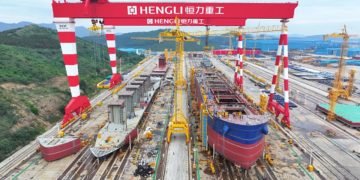





The Chinese shipyard Hengli Heavy Industry confirms its status as a new major player in global shipbuilding. According to Seatrade Maritime, the group has secured eight new ship orders, mainly from Greek and Norwegian shipowners. On the menu: two LR2 product tankers, five Kamsarmax bulk carriers, and one capesize bulk carrier of approximately 180,000 dwt, destined for a leading international shipowner.
These contracts add to an already impressive series of orders signed in 2025, to the point that the Dalian shipyard now has a full order book until 2029. A remarkable performance for a site taken over only three years ago, on the ruins of the former STX Dalian yard. Hengli also inaugurated a second production base this year, described by the group as a “factory of the future,” also located in Dalian.
The momentum is driven by two converging trends: the surge in bulk demand linked, among other things, to the rise of the Simandou iron ore deposit in Guinea, and the renewed vigor of the oil market, which supports the appetite for modern tankers. For European shipowners, these new vessels offer an opportunity to modernize their fleets with more energy-efficient units, while securing construction slots before the order books become completely saturated.
Hengli also benefits from strong public support: the project has received several rounds of government grants this year, amounting to nearly 46 million dollars in total, which strengthens its ability to invest in its industrial tools and in technological upgrades.
For the global logistics community, this ramp-up in China will result in a massive influx of new bulk and product tonnages in the second half of the decade. This will increase competitive pressure on older ships, accelerate their scrapping, and influence freight rates on certain key routes (ore, coal, petroleum products). Ports, terminals, and land-based service providers must already integrate these larger, more sophisticated, and more numerous ships into their investment plans, which will shape the maritime landscape until 2030.