




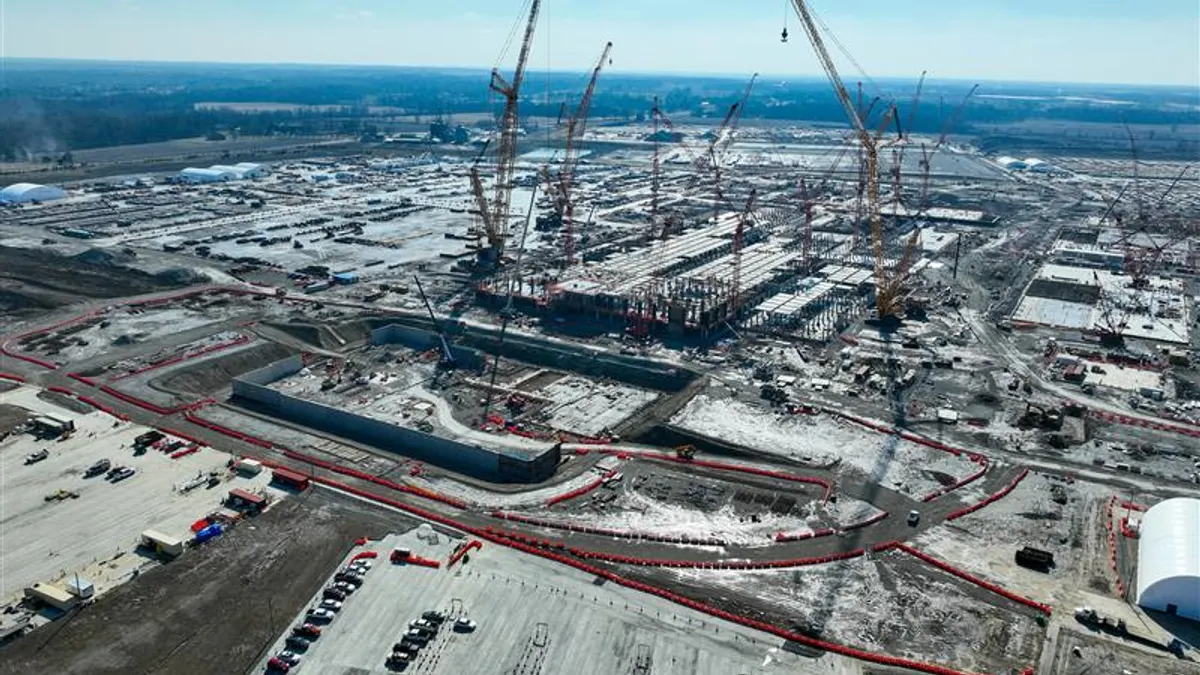
Global technology companies are racing to secure the processors needed to power the next generation of data centers, particularly hyperscale operators expanding their AI capabilities. But for Intel, meeting that demand has become increasingly difficult.
Facing tight manufacturing capacity, the U.S. chipmaker has redirected part of its production lines away from consumer processors in order to increase output of Xeon server chips. The decision reflects the surge in demand from data center operators, but also highlights the structural constraints within Intel’s production system.
During the company’s earnings call on January 22, Chief Financial Officer David Zinsner explained that wafer supply remains particularly constrained during the first quarter of the year. While improvements are expected over the next six months, Intel is currently managing production output on an almost day-to-day basis.
“It’s essentially a hand-to-mouth situation,” Zinsner said, referring to the company’s ability to deliver chips to customers as soon as they leave the fabrication plants.
Unlike competitors such as AMD and Nvidia, which operate under a “fabless” model and rely entirely on external manufacturers, Intel still maintains its own semiconductor production facilities. In theory, this should give the company greater flexibility when demand outpaces supply.
However, available manufacturing capacity remains limited.
Entering 2026, Intel reported that its buffer inventory had largely been depleted. The shift toward producing more server chips will only begin to translate into additional supply later in the first quarter.
The timing is critical. The global semiconductor market is currently experiencing a transformation driven largely by artificial intelligence applications.
Intel’s data center segment posted a 9% year-over-year increase in revenue during the fourth quarter, reaching $4.7 billion. At the same time, consumer processor sales — which still represent the majority of the company’s revenue — declined by 7% as Intel focuses on expanding its foundry business and positioning itself within the AI ecosystem.
CEO Lip-Bu Tan acknowledged the challenge.
“I’m disappointed that we are not able to fully meet the demand in our markets,” Tan said during the earnings call. He added that rebuilding Intel’s competitive position would be a “multiyear journey” requiring sustained effort.
Investors were also hoping for stronger signals from the company. According to Morningstar analyst Brian Colello, many on Wall Street expected supply shortages to push pricing higher or anticipated the announcement of a major foundry customer such as Apple or Nvidia.
Neither materialized.
“I think Intel let them down on both fronts,” Colello said.
Meanwhile, the broader semiconductor industry is facing similar pressures. Nvidia CFO Colette Kress recently noted that supply constraints for server processors are likely to continue despite efforts to secure additional inventory. AMD CEO Lisa Su also confirmed that the company is working with supply chain partners to increase output.
AMD reported data center revenue of $5.4 billion during the quarter, representing a 39% year-over-year increase.
Both AMD and Nvidia rely heavily on manufacturing partners such as Taiwan Semiconductor Manufacturing Company (TSMC) and Samsung for chip production. Intel also uses external partners for some advanced components, but its strategy to build a competitive foundry business introduces higher overhead costs.
Bank of America analyst Vivek Arya believes Intel’s foundry ambitions may require another two to three years before reaching full potential. He pointed to challenges with Intel’s current 18a semiconductor process node, where yields remain relatively low.
If the company struggles with output at the current generation of chips, Arya warned, it may face difficulty convincing external clients that future nodes will deliver consistent performance.
Intel recently began shipping products built on the 18a process, with the company reporting gradual improvements in yields.
At the same time, new developments in artificial intelligence are reshaping processor demand. According to Omdia analyst Manoj Sukumaran, the rise of agentic AI systems — which require less processing power than traditional AI workloads — is reviving demand for general-purpose CPUs.
“The market was not prepared for this level of CPU demand,” Sukumaran explained.
Another challenge lies in the broader semiconductor supply chain. Leading-edge manufacturing capacity at TSMC is already fully booked by companies including Nvidia, Apple, AMD and Broadcom.
As a result, Intel’s ability to increase shipments may be constrained not only by its own factories but also by limited access to external manufacturing capacity for certain chip components.