Air Nov 26, 2026
Jet Fuel Prices Extend Four-Week Decline, but Relief May Come Too Late for Peak Season
Global average prices dropped 8.9% in the week ending November 20, marking the sharpest weekly decrease in recent weeks. However, ongoing geopolitical risks and advance capacity bookings could limit the impact on air cargo rates during the peak season.

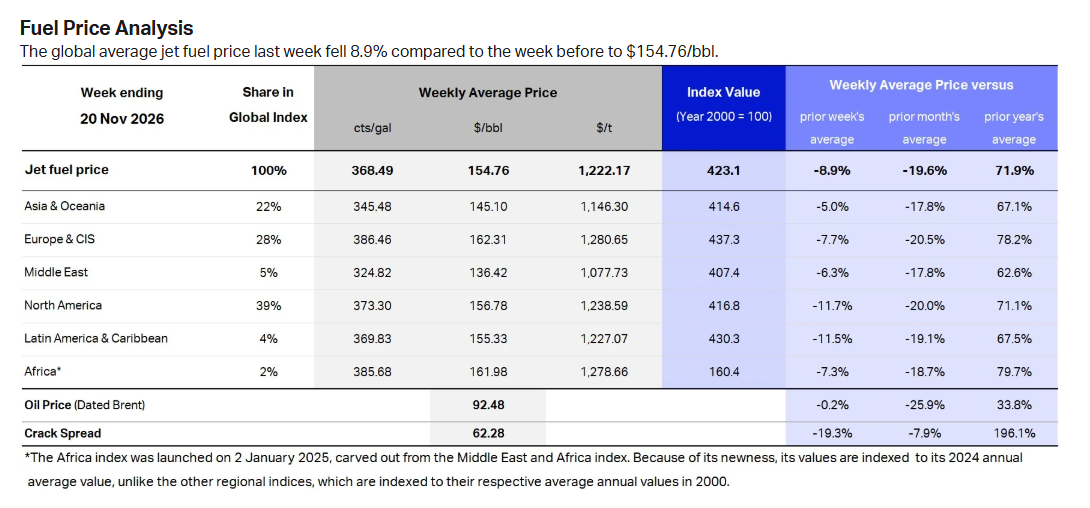
The International Air Transport Association (IATA) said in its latest data the global average price of jet fuel dropped for the fourth straight week, settling at $154.76 a barrel for the week ended November 20. The latest figures, revised on November 23, showed an 8.9% fall on the week before.
The latest decline was the biggest weekly fall in a month. Jet fuel prices had already fallen 5.1% in the week ended Nov. 13, down 6.6% in the week ended Nov. 6 and 2.6% in the week ended Oct. 30.
The decline is mostly due to falling crude oil prices. "Expectations of a quicker resolution to tensions between the US and Iran have strengthened since the US midterm elections, which has helped to push oil prices lower," said Neil Wilson editor at data aggregator TAC Index.
All regions saw price falls
IATA’s latest data shows that jet fuel prices declined week-on-week across all regions monitored by the system. North America saw the biggest fall, down 11.7%, just ahead of Latin America where prices fell 11.5%. Europe and the Commonwealth of Independent States (CIS) registered a decrease of 7.7%.
Fuel prices were also below the average prices recorded in the previous months in all the monitored regions, registering decreases ranging from 17.8% to 20.5% depending on the market.
The improvement has not brought the price of jet fuel back down to where it was a year ago. Regional prices were still 62.6% to 79.7% higher than their respective previous-year averages. Globally, the average price for the week ending November 20 was 71.9% higher than the same year-ago average.
Wilson warned that the oil market remains vulnerable to geopolitical disturbance. Ukraine has stepped up its strikes on Russian refineries, pushing oil product production and distribution far from normal operating conditions.
There are also risks around the Middle East. Gulf countries have been steadily building alternative routes to avoid the Strait of Hormuz, said Tim van Leeuwen, vise president and head of consulting at consultancy Rotate. But he warned that a single strike on a pipeline could once again cause major disruption.
There are still only rather small regional price differences
Jet fuel prices were largely the same across the regions, with the Middle East the cheapest market, averaging $136.42 a barrel.
Asia and Oceania recorded the lowest average price of $145.10 a barrel, followed by Latin America excluding the Middle East at $155.33 a barrel.
At the other end of the scale, Europe and the Commonwealth of Independent States reported the highest average price, at $162.31 a barrel. Africa was not far behind with $161.98 per barrel on average.
Peak season sees air cargo rates largely flat
Although fuel prices have fallen for the fourth week running, providing some respite for airlines and air cargo operators, the timing may restrict the industry’s immediate gains.
The cuts were too late to have much effect on peak season costs because most of the available space is booked months in advance, Wilson said. But if the downtrend continues, lower fuel prices may help to gradually ease air cargo rates in the coming weeks.
Van Leeuwen is also hopeful that the fall in jet fuel prices will eventually lead to some easing in airfreight rates. But he stressed that doesn’t necessarily mean prices will fall during the current peak season.
Airfreight rates were up for six straight weeks through Nov. 24, according to rotated data, a sign of the continuing strength of seasonal demand.
“In case of worse market conditions the rates in the peak season might have been considerably higher,” van Leeuwen said.
Thus, recent changes in fuel prices are a good omen for the air cargo industry, but the coming weeks are still marked by geopolitical insecurity, supply chain fragilities and high seasonal demand.
END OF REPORT