



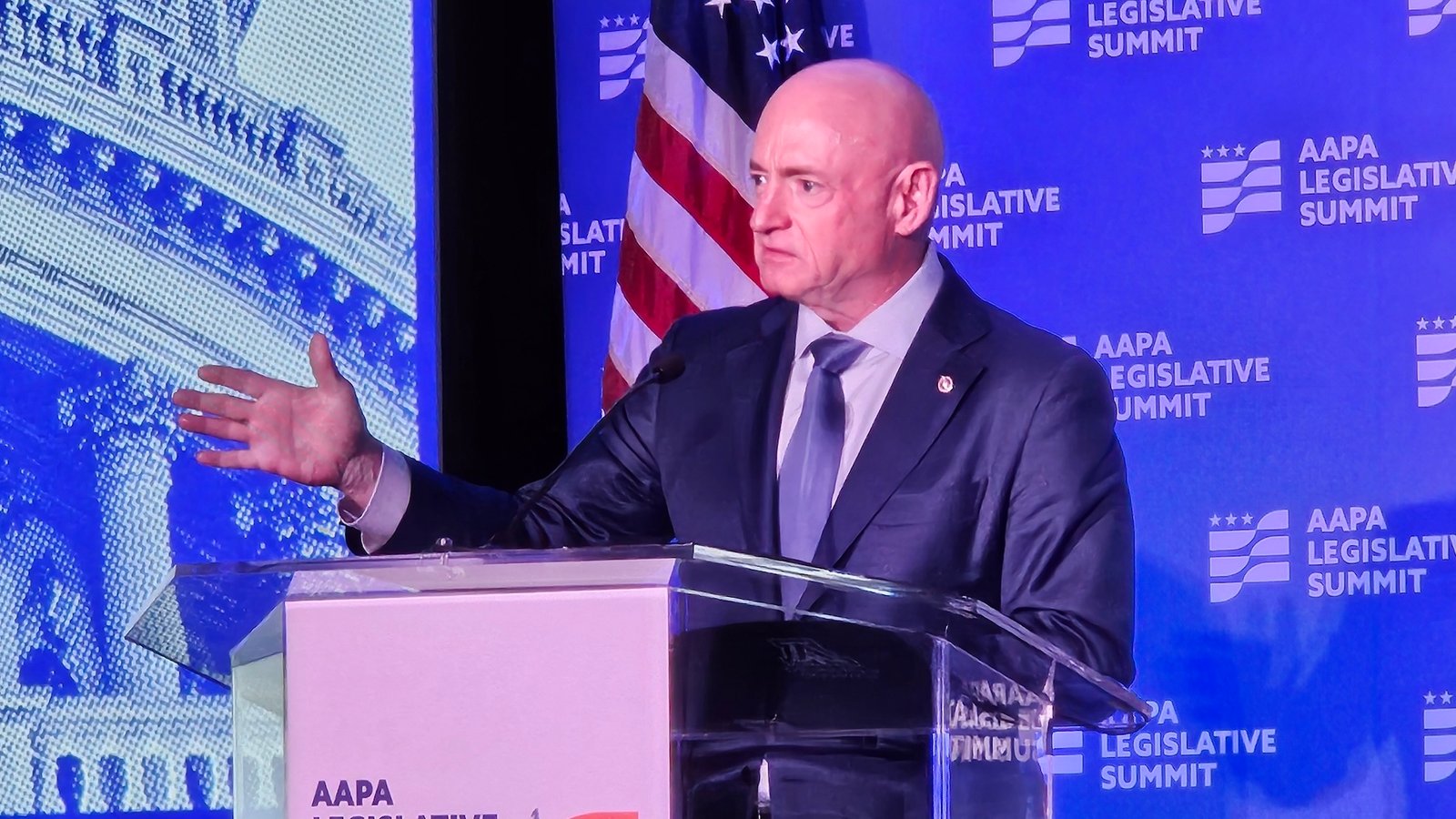
U.S. Senator Mark Kelly has renewed his call for a broad national effort to revive the American maritime sector, describing the industry as essential not only to the country’s economy but also to its national security.
Speaking at the American Association of Port Authorities Legislative Summit in Washington on March 5, the Arizona Democrat received a warm reception as he promoted the SHIPS for America Act, bipartisan legislation introduced in April 2025. The bill proposes a wide-ranging framework to modernise U.S. maritime strategy, strengthen the competitiveness of U.S.-flag vessels, rebuild domestic shipbuilding capacity and support the development of a new maritime workforce.
The legislation is co-sponsored by Sen. Todd Young, Rep. Trent Kelly and Rep. John Garamendi.
Kelly told port executives that the maritime industry affects the entire country, regardless of whether a state has ports or not. He said the sector plays a central role in the economy and should matter to every American.
His maritime connection, he noted, is also personal. Kelly traced it back to his grandfather, who served in the Merchant Marine aboard a Liberty ship during World War II. He later attended the U.S. Merchant Marine Academy, worked on cargo ships and graduated with a third assistant engineer’s licence before going on to serve as a Navy fighter pilot in the Gulf War and later as a NASA astronaut.
Kelly said that more than 80% of goods imported into the United States arrive by sea through the nation’s ports, making the maritime domain vital to U.S. economic wellbeing. Yet, he argued, the country has lacked a coherent national maritime strategy for decades.
He warned that more than 99% of cargo ships calling at U.S. ports are owned, controlled and built overseas, while fewer than 100 U.S.-flag vessels currently operate in international trade. By contrast, he said, China has spent a generation building a comprehensive maritime strategy and now operates more than 5,500 vessels in international commerce.
Kelly also pointed to the shipbuilding gap, saying Chinese yards hold 62% of the global merchant vessel orderbook, while U.S. shipbuilders account for less than 1%. He added that Chinese entities have invested hundreds of billions of dollars worldwide in strategic ports and technologies linked to global trade.
He stressed that the United States should not seek conflict with China, nor regard it as inevitable, but said a stronger U.S. maritime posture would help deter confrontation by demonstrating that any conflict would come at a greater cost to Beijing.
Kelly said the answer is a full national maritime strategy and argued that the issue cannot be addressed through isolated support for shipyards, ports, ships or workforce alone. Instead, he called for a whole-of-industry and whole-of-government approach.
He also warned against what he described as an outdated view in Washington that support for one maritime segment comes at the expense of another. That mentality, he said, has held the industry back for decades and left the U.S. with fewer ships, less competitive shipyards, ageing ports and workforce shortages across the sector.
For Kelly, the most encouraging sign is the emergence of bipartisan consensus around maritime policy. He said that for the first time in nearly 50 years, Washington appears broadly aligned on the need to strengthen the American maritime industry, creating a rare opportunity for meaningful reform.
The senator said the 300-page SHIPS bill has already had a Senate hearing and is expected to receive one in the House soon. He said he believes there is a real opportunity to move the legislation forward this year, but only if the maritime industry can set aside internal turf battles and unite around a common goal.
Kelly also encouraged ports and stakeholders to review the proposal and suggest improvements. Among its provisions is support for ports and terminal operators seeking to divest from Chinese-built ship-to-shore cranes, which U.S. authorities have identified as a potential security concern.
He said a stronger American maritime presence is necessary not only to protect national interests but also to ensure U.S. ports remain globally competitive. If cargo destined for the United States is diverted to Canada or Mexico, he said, no one benefits.
Kelly argued that the global maritime system underpinning modern trade was built by the United States, but is now under pressure from China’s expanding influence at sea. Passage of the SHIPS Act, he said, would help address a strategic weakness in national defence, counter Chinese influence in the global economy and support domestic jobs and manufacturing at the same time.
America has always been a maritime nation, he said, and with the right collective effort it can reclaim that heritage. But he warned that waiting another decade or two would only make the challenge far harder to fix.