



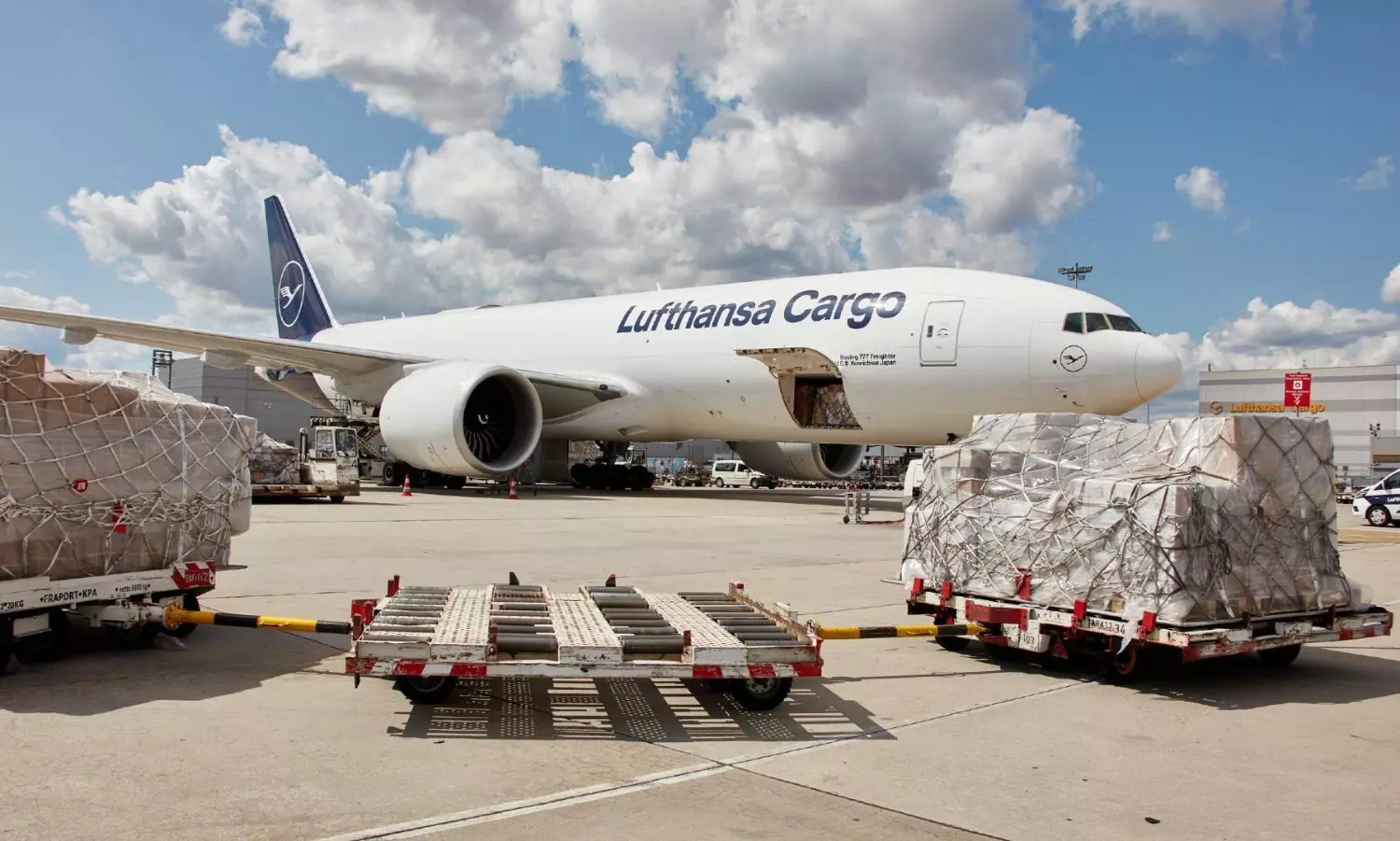
Lufthansa Cargo delivered solid financial and operational growth in 2025, supported by stable market demand and particularly strong performance in Europe and Asia.
The carrier reported full-year revenue of €3.4 billion, up 4% from €3.3 billion in 2024. Adjusted EBIT rose 29% to €324 million, while the adjusted EBIT margin improved by 1.8 percentage points to 9.5%.
Demand also strengthened over the year. Revenue cargo tonne kilometres increased by 7% to 9.1 billion, while available cargo tonne kilometres rose 5.4% to 14.5 billion. Average load factor improved by 1.1 percentage points to reach 63%.
Lufthansa Cargo described demand conditions during the year as generally stable. Chief financial officer and chief human resources officer Gregor Schleussner said the airline grew by 7.3% in 2025, more than twice the overall market growth rate of 3.4%.
The company said its results were supported by additional freighter capacity, including the introduction of a Boeing 777F in the second half of 2024, as well as the continued expansion of passenger operations and the resulting increase in bellyhold space.
Lufthansa Cargo also highlighted progress under its “BOLD MOVES” strategy, which aims to return the company to the world’s top three cargo airlines by 2030 based on RCTKs. The carrier said it has already regained a place among the global top five.
The airline expanded its network significantly in 2025, reinforcing its footprint in Europe while also strengthening its reach in the Middle East, Asia and North America. New A321-200P2F destinations included Katowice, Rome and Beirut. Freighter flights to Tel Aviv were resumed and increased to as many as seven per week.
On long-haul routes, Lufthansa Cargo added freighter links to Almaty and launched a new Shanghai–Los Angeles service across the Pacific. These additions complemented a broader network offering of up to 50 weekly frequencies in Asia-Pacific and more than 30 destinations across North and South America.
Bellyhold capacity also grew through new passenger routes from Vienna to Los Angeles and from Munich to Orlando, as well as services to Windhoek and Calgary.
The airline said its Asian business remained especially strong throughout the year. It is also relying increasingly on strategic partnerships to grow its presence in Europe.
ITA Airways joined the Lufthansa Group at the beginning of 2025 after the group acquired a 41% stake in the Rome-based airline. Lufthansa Cargo began marketing ITA’s cargo capacity in June 2025 and added Rome as its fifth cargo hub that summer.
The airline said that since the winter schedule, it has marketed nearly the entire continental and intercontinental network of ITA Airways, excluding routes to and from the United States and Canada until regulatory approval is granted. It added that Rome will strengthen Lufthansa Cargo’s position in Southern Europe and should expand global bellyhold capacity by around 20% over the longer term.
In July 2025, Swiss WorldCargo joined Lufthansa Cargo and United Cargo’s transatlantic alliance. During the 2026 financial year, Lufthansa Cargo said it will deepen that cooperation further by adding Zurich as the sixth cargo hub in its European network.
The company also continued to invest in specialist cargo verticals including pharmaceuticals, automotive, aviation and semiconductors. Projects introduced in 2025 included joining Silicon Saxony, implementing new standards for vehicle transport and optimising the handling of aircraft engines.
At the same time, Lufthansa Cargo invested €600 million in its Frankfurt hub and accelerated its digital transformation. According to the airline, a new online booking system is improving process speed, upgraded tracking tools are increasing transparency, and AI-powered solutions such as automated email booking and VR training are raising both efficiency and service quality.
Chief executive Ashwin Bhat said the airline’s return to the global top five already in 2025 demonstrates the impact of the BOLD MOVES strategy and the commitment of its teams worldwide. He added that partnerships with ITA Airways and Swiss WorldCargo are creating new opportunities for customers and moving Lufthansa Cargo closer to its goal of becoming one of the world’s top three cargo airlines by 2030.