



Air cargo operations are beginning to move again across parts of the Middle East, but the recovery remains uneven as airlines and ground handlers work through shipment backlogs, operational constraints and tightening fuel availability.
Emirates SkyCargo said in its latest update on 5 March that cargo is once again moving through both bellyhold and freighter capacity, although priority continues to be given to shipments already in the system. The airline added that all scheduled freighter services are currently open for booking.
Export cargo is being accepted on bookable passenger and freighter services departing from Dubai International (DXB) and Al Maktoum International/Dubai World Central (DWC), with the exception of Class 1 dangerous goods. Emirates SkyCargo also said that, excluding live animals, human remains and Class 1 dangerous goods, cargo from offline stations destined for the UAE or transiting through DXB or DWC may be accepted, subject to flight availability confirmation in SkyChain.
Etihad Airways also announced a limited resumption of commercial passenger and cargo operations from 6 March 2026 between Abu Dhabi and a number of key destinations. Its freighter schedule between 6 and 12 March includes Amsterdam, East Midlands, Ezhou, Frankfurt, Hanoi, Hong Kong, Paris, Riyadh, Shanghai and Shenzhen.
Even so, Etihad warned that operations remain subject to regulatory and operational approvals and may still change depending on regional airspace conditions.
Qatar Airways Cargo continues to operate under tighter restrictions. In an update issued on 6 March, the carrier said flights to and from Doha remain suspended following the closure of Qatari airspace. However, it is still operating a number of limited freighter services that do not route through Doha. All other flights remain suspended until further notice, and temporary restrictions continue to affect the booking and acceptance of new shipments until a new operating schedule is released after the official reopening of the airspace.
The disruption is not confined to Middle Eastern carriers. Airlines based in Europe are also operating with restrictions. Air France KLM Martinair Cargo said on 4 March that several services to destinations in the region had been suspended and that no cargo bookings were being accepted for those markets until further notice.
Air France suspended flights to Dubai, Riyadh, Beirut and Tel Aviv. KLM halted services to Dubai, Riyadh, Dammam and Tel Aviv, while Martinair suspended flights to Dubai World Central and Cairo.
Lufthansa Cargo and the wider Lufthansa Group also extended a series of suspensions. As of 5 March, flights to and from Dammam were suspended through 10 March, Amman and Erbil through 15 March, Tel Aviv through 22 March, Beirut through 28 March and Tehran through 30 April. Lufthansa Group carriers also suspended flights to Abu Dhabi and Dubai through 10 March. At the same time, flights to and from Larnaca were scheduled to resume on 7 March, while Riyadh had already returned to the regular schedule on 2 March.
Cargolux has also stopped accepting freight destined for the Middle East until further notice, with Muscat remaining the only exception.
Fuel supply is adding another layer of pressure. Although some services are returning, jet fuel availability has tightened significantly. The Middle East remains a critical producer and exporter of crude and refined fuels, and the conflict has led to the shutdown of oil and gas facilities across the region. Aevean noted that roughly 20% of global jet fuel flows through the Strait of Hormuz, while premiums for short-term jet fuel deliveries doubled over the previous weekend.
According to IATA’s fuel monitor for the week ending 27 February, the global average jet fuel price rose 3.6% week on week to $99.40 per barrel. Updated figures for the week ending 6 March had not yet been released, but lower availability suggests prices may have risen further.
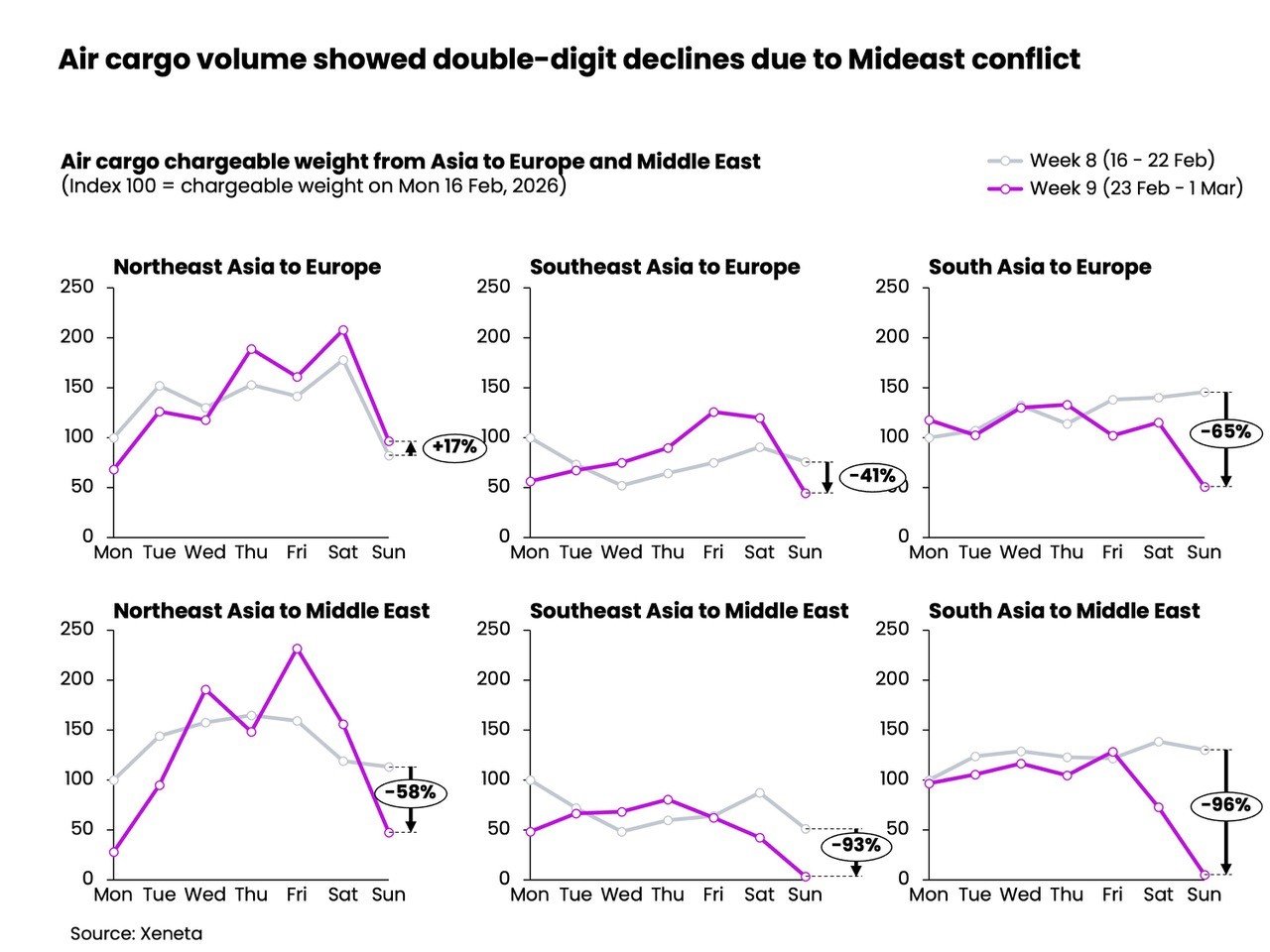
Across the market, freight forwarders are warning customers to expect delays, disruption and higher costs. Global air cargo capacity is estimated to be down by around 18%, and Kuehne+Nagel expects shipment backlogs to begin building in Asia.
Research published by Rotate on 3 March suggested that Sri Lanka, Pakistan and Norway are among the countries most exposed to the reduction in Middle East cargo flights. Meanwhile, Xeneta expects air freight rates on affected trade lanes to climb sharply and has advised shippers to delay signing long-term contracts until conditions stabilise.
Cargo charter brokers Air Charter Service and Chapman Freeborn have also reported increased enquiry volumes as shippers turn to ad hoc solutions in response to the reduction in scheduled capacity.