

• Latest
  • Trending
NACFE finds diesel at 11.5 mpg and Tesla Semi at 460 miles in real-world fleet test

NACFE finds diesel at 11.5 mpg and Tesla Semi at 460 miles in real-world fleet test

March 25, 2026
US launches $500m programme to boost critical minerals supply for batteries

US launches $500m programme to boost critical minerals supply for batteries

March 25, 2026
Elon Musk unveils $25bn chip manufacturing vision with Texas “Terafab” project

Elon Musk unveils $25bn chip manufacturing vision with Texas “Terafab” project

March 25, 2026
ADVERTISEMENT
Diesel prices surge past $5.38 as Iran conflict disrupts global oil flows

Diesel prices surge past $5.38 as Iran conflict disrupts global oil flows

March 25, 2026
Dollar General cuts 1,500 SKUs to streamline supply chain and boost availability

Dollar General cuts 1,500 SKUs to streamline supply chain and boost availability

March 25, 2026

March 25, 2026
WCAworld rebrands SINO Conference into global China logistics event

WCAworld rebrands SINO Conference into global China logistics event

March 25, 2026
AI and geopolitical volatility redefine the future of air cargo

AI and geopolitical volatility redefine the future of air cargo

March 25, 2026
SHEIN partners with DHL to accelerate sustainable aviation fuel adoption

SHEIN partners with DHL to accelerate sustainable aviation fuel adoption

March 25, 2026
Middle East conflict disrupts majority of forwarders as costs escalate

Middle East conflict disrupts majority of forwarders as costs escalate

March 25, 2026
VietJet Air accelerates European expansion with Hanoi–Prague route

VietJet Air accelerates European expansion with Hanoi–Prague route

March 25, 2026
Binani Air secures AOC, marking milestone for Nigeria’s aviation sector

Binani Air secures AOC, marking milestone for Nigeria’s aviation sector

March 25, 2026
Gulf carriers stabilise operations as airspace recovery reaches plateau

Gulf carriers stabilise operations as airspace recovery reaches plateau

March 25, 2026
  • Home
  • About Us
  • Press Room
  • Podcasts
  • Media Kit
  • Contact Us
  • Careers
Wednesday, March 25, 2026
  • Login
  • Register
The Logistic News
  • Logistic
  • Air
  • Maritime
  • Land
  • World
  • Business
  • Tech
  • Events
  • Advertise
No Result
View All Result
  • Logistic
  • Air
  • Maritime
  • Land
  • World
  • Business
  • Tech
  • Events
  • Advertise
No Result
View All Result
The Logistic News
No Result
View All Result
Home Land

NACFE finds diesel at 11.5 mpg and Tesla Semi at 460 miles in real-world fleet test

The latest TMC 2026 report suggests fleets should prepare for mixed powertrains in the near term while keeping battery-electric at the centre of long-term planning.

The Logistic News by The Logistic News
March 25, 2026
in Land, Logistic, Tech
Reading Time: 3 mins read
0
NACFE finds diesel at 11.5 mpg and Tesla Semi at 460 miles in real-world fleet test
ADVERTISEMENT

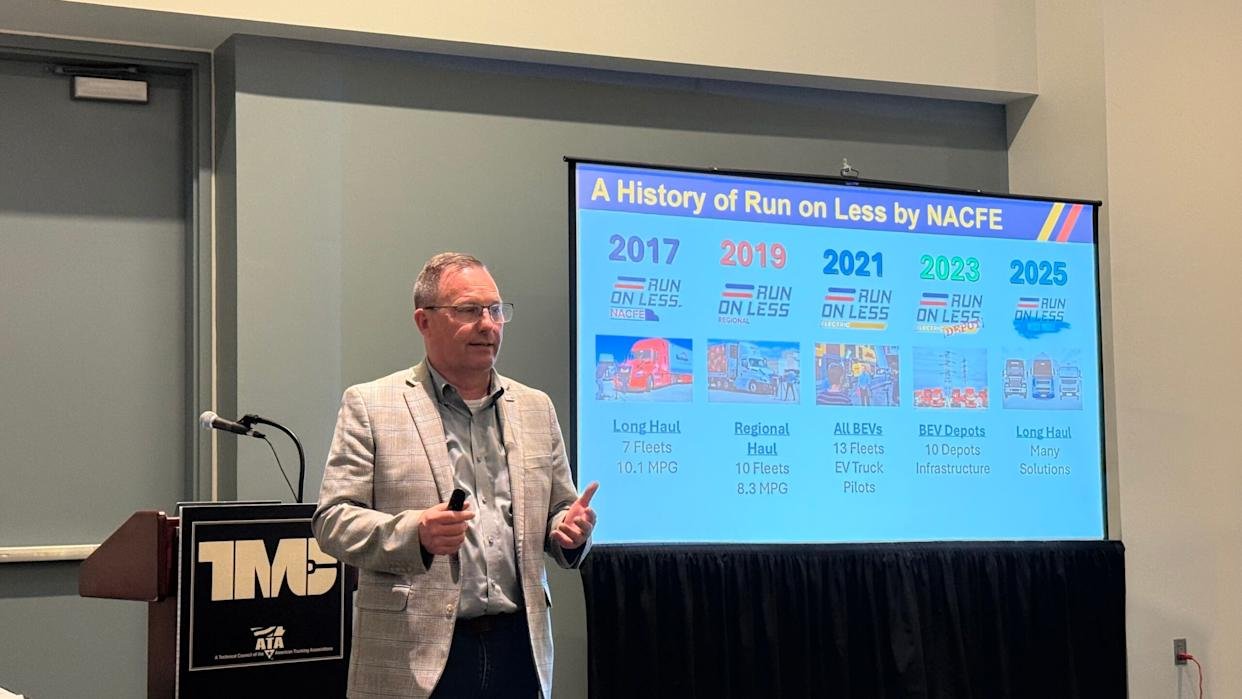
A new report from the North American Council for Freight Efficiency (NACFE), presented at TMC 2026 in Nashville, offers one of the most detailed real-world comparisons yet of Class 8 truck powertrains, with diesel reaching 11.5 miles per gallon and a Tesla Semi covering 460 miles on a single charge.

The 277-page operations report is based on NACFE’s 18-day Run on Less – Messy Middle demonstration. It analysed 14 Class 8 tractors powered by diesel, compressed natural gas, battery-electric and hydrogen fuel-cell systems. In total, the study generated 2.2 million lines of data from 73,000 miles of actual freight hauling, challenging a number of long-held assumptions about which technologies are truly road-ready.

Mike Roeth, NACFE’s executive director, said the project aimed to understand where fleets are selecting battery-electric, hydrogen, natural gas, biodiesel and renewable diesel, and how those options fit within real operating environments.

ADVERTISEMENT

Data was collected every 10 seconds during the September demonstration. NACFE later brought together 26 groups in Boulder, Colorado, for a two-day review, while a panel of major fleets including Amazon, Penske, J.B. Hunt, Covenant and Pitt Ohio evaluated the results.

The 14 trucks represented the full range of Class 8 duty cycles, from long-haul sleeper-cab operations to return-to-base regional work and urban delivery routes as short as 100 miles a day. Roeth said the mix closely mirrors the wider market of 1.8 million to 2 million heavy-duty tractors moving dry vans, reefers and flatbeds across the US.

The study included four diesel trucks, three natural gas trucks, five battery-electric vehicles and two hydrogen fuel-cell units. At Saia’s terminal in Stockton, California, the fleet deployed two Tesla Semis, one for pickup-and-delivery work and the other in a slip-seat arrangement between long-distance less-than-truckload operations and local delivery.

The diesel results stood out sharply. Two of the four diesel trucks achieved 11.5 mpg, while the other two reached 9.5 mpg, far above the national average of 7 mpg, which itself has risen from 6 mpg over the past 15 years. Roeth said that when NACFE talked about 10 mpg during its 2017 Run on Less programme, many in the industry would have thought it was unrealistic. He believes there is still significant fuel economy to be gained from diesel through technology adoption and improved driver performance. Diesel also retains a major infrastructure advantage, with more than 7,500 fuelling stations and unmatched operating flexibility.

The three natural gas trucks in the study used the 15-litre Cummins X15N engine. At Wegmans, they hauled 130,000-pound loads daily across northern New York, one of the toughest duty cycles in the programme. Roeth highlighted three drivers behind renewed interest in natural gas: a purpose-built 15-litre engine, greater availability of renewable natural gas, and better fuelling infrastructure. The natural gas units posted between 4.5 and 6.7 mpg equivalent, though NACFE cautioned that direct comparison with diesel can be misleading because the UPS trucks were pulling doubles and triples and moving substantially more freight. There are now around 1,385 public CNG stations across the US, concentrated in California, Texas and major freight corridors.

Battery-electric trucks showed some of the most striking technological gains. Tesla Semi and Windrose vehicles outperformed Freightliner and Volvo battery-electric models in both charging speed and range. One Saia Tesla Semi completed 460 miles in a day shift on a single charge and then continued making deliveries on a second shift with another driver. Roeth said that performance was achieved at 750 kilowatts, while Tesla is preparing to launch at 1.2 megawatts. He argued that the Tesla Semi demonstrates where battery-electric trucking is heading, with charging for 400 to 500 miles potentially taking just 20 to 30 minutes. NACFE said this is no longer theoretical but already visible in practice. On average, both battery-electric and hydrogen trucks used only 63% of their available range, reflecting infrastructure limitations more than vehicle capability.

Hydrogen remains more constrained. The two Hyundai XCIENT fuel-cell trucks ran efficiently but were held back by limited refuelling access. Penske and Pilot operated those units in Texas and California. Roeth acknowledged that the promise of hydrogen remains difficult to realise at scale. NACFE had to adjust the demonstration after Nikola’s bankruptcy and Hyzon’s difficulties, with only two fleets running Hyundai fuel-cell trucks ultimately taking part.

The report also shows how strongly performance depends on terrain and driver behaviour. Battery-electric vehicles lost more efficiency than diesel on climbs, though they still outperformed diesel on flat routes. Driver technique also proved decisive, both in achieving the 11.5-mpg diesel figures and in maintaining battery-electric efficiency on grades.

NACFE concludes that most fleets are likely to run mixed powertrains in the near term. Operators will need to evaluate each option according to technology maturity, total cost of ownership, duty cycle, infrastructure, regulation, residual value and service support.

At the same time, NACFE is clear about its long-term view. Roeth said the organisation strongly believes battery-electric trucks are the future, arguing that they are simpler, more efficient and less burdened by the complexity and cost that continue to grow around diesel aftertreatment systems. Dean Bushey, NACFE’s director of programmes, agreed and pointed to rapid battery innovation, including new chemistries, lighter packs, possible solid-state cells and faster charging.

NACFE plans to release its emissions report on 15 April, its cost analysis on 1 May ahead of ACT Expo, and its final conclusions in June.


Previous Post

UPS withdraws driver buyout offer in 13 states under union pressure

Next Post

Ambient IoT gains ground as cargo theft losses climb to $725m

Next Post
Ambient IoT gains ground as cargo theft losses climb to $725m

Ambient IoT gains ground as cargo theft losses climb to $725m

Leave a Reply Cancel reply

Your email address will not be published. Required fields are marked *

A D V E R T I S E M E N T

Popular News

  • Drone Delivery Takes Flight: Amazon Partners with UPS for Trial Program

    Drone Delivery Takes Flight: Amazon Partners with UPS for Trial Program

    0 shares
    Share 0 Tweet 0
  • Rail Cargo Group Strengthens European Network with Captrain Netherlands Acquisition

    0 shares
    Share 0 Tweet 0
  • Automotive Inbound Logistics Market: Navigating Future Challenges

    0 shares
    Share 0 Tweet 0
  • Global Inflation Cools to Target After Three Years, Central Banks Face Policy Dilemma

    0 shares
    Share 0 Tweet 0
  • Dubai Mercantile Exchange Rebrands as Gulf Mercantile Exchange Following Saudi Tadawul Group Acquisition

    0 shares
    Share 0 Tweet 0

Recent News

US launches $500m programme to boost critical minerals supply for batteries

US launches $500m programme to boost critical minerals supply for batteries

March 25, 2026
Elon Musk unveils $25bn chip manufacturing vision with Texas “Terafab” project

Elon Musk unveils $25bn chip manufacturing vision with Texas “Terafab” project

March 25, 2026
Diesel prices surge past $5.38 as Iran conflict disrupts global oil flows

Diesel prices surge past $5.38 as Iran conflict disrupts global oil flows

March 25, 2026

Discover a new era of logistics reporting with The Logistic News, your go-to platform for breaking news, insightful features, and exclusive interviews shaping the global logistics and freight landscape. Trust us to deliver accurate, timely, and relevant information that empowers professionals and enthusiasts alike in navigating the intricacies of this vital sector.

Navigation

  • Home
  • About Us
  • Press Room
  • Podcasts
  • Media Kit
  • Contact Us
  • Careers
  • Privacy Policy
  • Terms of Use

© 2024 - thelogisticnews.com

Welcome Back!

Login to your account below

Forgotten Password? Sign Up

Create New Account!

Fill the forms below to register

All fields are required. Log In

Retrieve your password

Please enter your username or email address to reset your password.

Log In

SIgn Up Newsletter

This will close in 20 seconds

Manage Cookie Consent
We use technologies like cookies to store and/or access device information. We do this to improve browsing experience and to show (non-) personalized ads. Consenting to these technologies will allow us to process data such as browsing behavior or unique IDs on this site. Not consenting or withdrawing consent, may adversely affect certain features and functions.
Functional Always active
The technical storage or access is strictly necessary for the legitimate purpose of enabling the use of a specific service explicitly requested by the subscriber or user, or for the sole purpose of carrying out the transmission of a communication over an electronic communications network.
Preferences
The technical storage or access is necessary for the legitimate purpose of storing preferences that are not requested by the subscriber or user.
Statistics
The technical storage or access that is used exclusively for statistical purposes. The technical storage or access that is used exclusively for anonymous statistical purposes. Without a subpoena, voluntary compliance on the part of your Internet Service Provider, or additional records from a third party, information stored or retrieved for this purpose alone cannot usually be used to identify you.
Marketing
The technical storage or access is required to create user profiles to send advertising, or to track the user on a website or across several websites for similar marketing purposes.
Manage options Manage services Manage {vendor_count} vendors Read more about these purposes
View preferences
{title} {title} {title}
No Result
View All Result
  • Logistic
  • Air
  • Maritime
  • Land
  • World
  • Business
  • Tech
  • Events
  • Advertise

© 2024 - thelogisticnews.com