




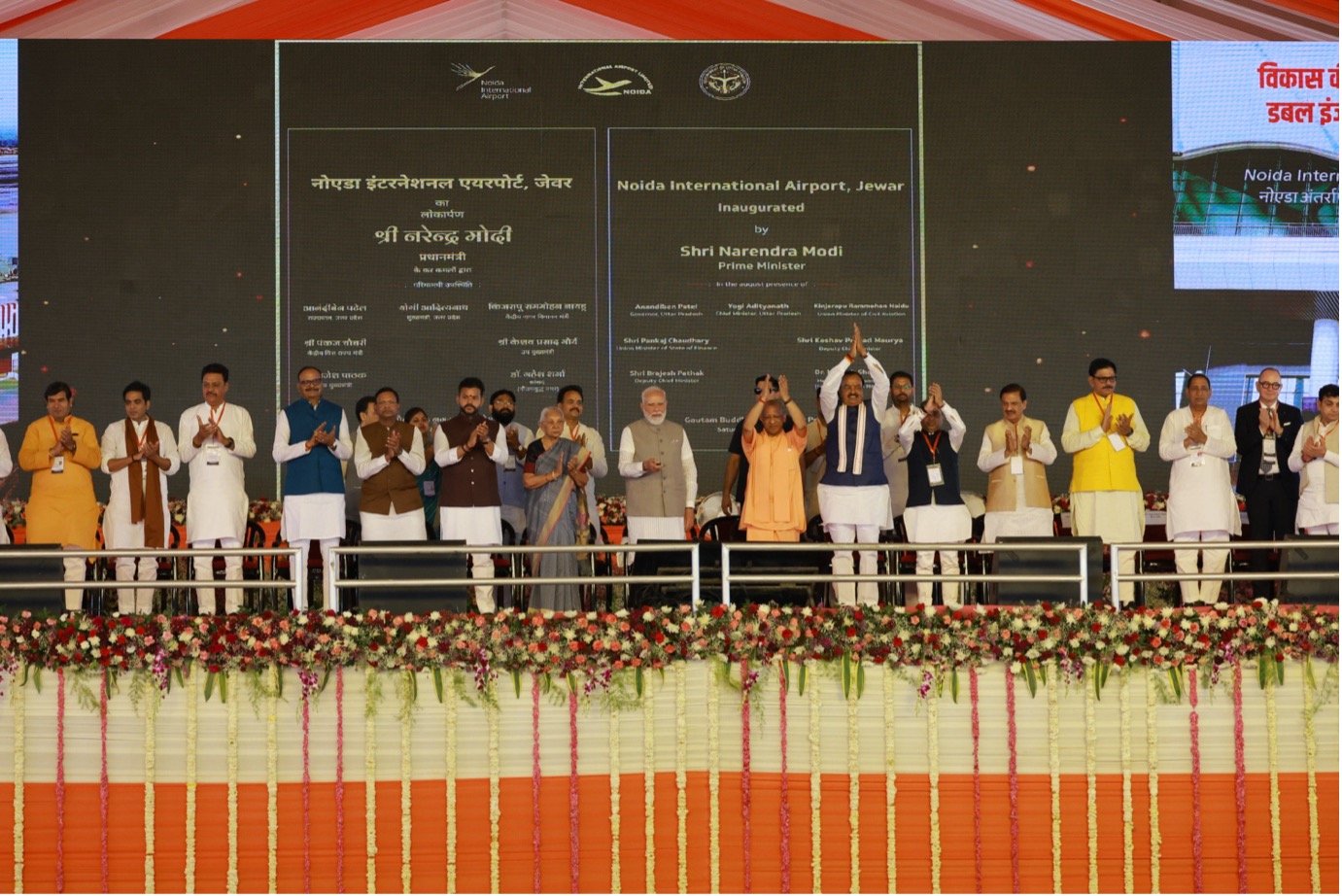
The opening of Noida International Airport marks an important shift in India’s aviation strategy, with the country moving beyond its traditional reliance on primary hubs and toward the development of secondary gateways built to serve both passengers and cargo.
Backed by an estimated first-phase investment of around ₹11,200 crore, or about US$1.3 billion, the airport is positioned in the wider industrial belt of the National Capital Region. Rather than simply relieving congestion at Delhi’s Indira Gandhi International Airport, it is intended to function as a parallel aviation node that can support trade, logistics and regional economic growth.
Prime Minister Narendra Modi described the project as a symbol of a more developed Uttar Pradesh and said the airport would connect Noida to the world while opening wider opportunities for the state’s population and industries. He also linked the project to broader efforts to improve market access, connectivity and industrial development.
The airport’s significance is tied closely to its location. It sits near the manufacturing and agricultural centres of western Uttar Pradesh, giving exporters in sectors such as electronics, agro-processing and smaller-scale manufacturing easier access to international airfreight. By cutting first-mile and last-mile transport distances, the airport is expected to improve logistics efficiency and lower transport costs.
Noida is also designed around multimodal connectivity. It is close to Dadri, where India’s eastern and western Dedicated Freight Corridors intersect, linking rail, road and air movements more effectively. That could help logistics operators route cargo more flexibly and build more resilient networks.
The project also fits into a larger shift in India’s aviation geography. With more than 160 airports now operational across the country, policymakers are working toward a more decentralised system where secondary hubs absorb passenger and cargo demand that would previously have been concentrated at a few metros.
For cargo, that creates advantages including fewer congestion delays, faster turnarounds and more room for regional export growth. Sectors such as pharmaceuticals, perishables and high-value manufacturing are expected to benefit in particular.
Noida is also part of a broader industrial and logistics ecosystem that includes semiconductor investment, urban transport connections and planned MRO capacity. That integrated approach reflects a wider view that aviation infrastructure creates more value when it sits inside a larger economic framework.
The airport is launching at a time of geopolitical uncertainty and disruption in global trade and energy flows, which only sharpens the case for stronger domestic connectivity and more diversified logistics options. In that sense, Noida International Airport is not just additional aviation capacity. It represents a rethinking of how India wants its air transport network to support a more complex and resilience-driven global economy.