



Ocean shipping services across the global market remain broadly stable from an operational standpoint, but fuel costs and bunker availability are now emerging as the main forces reshaping freight rate trends.
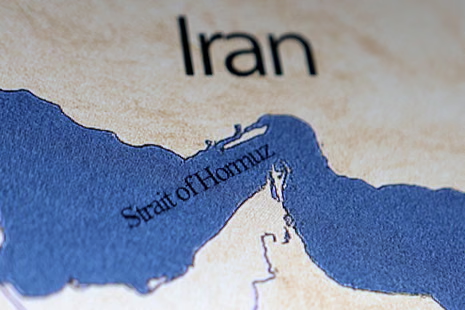
According to Freightos analyst Judah Levine, the market is now approaching six weeks since Iran closed the Strait of Hormuz, with only a limited number of vessels being allowed through each day. He said vessels that are transiting appear to be doing so in coordination with Iran and possibly after advance payments.
Traffic has included a CMA CGM container ship, the first vessel from a major European carrier to make such a passage.
For shipping lines, the main concern is not only the Strait itself but also the rising cost and availability of fuel at key bunkering hubs such as Singapore. Maersk has now asked the US Federal Maritime Commission three times in one month to waive the normal 30-day waiting period so it can implement emergency fuel surcharges, although the regulator rejected its first two requests.
The uncertainty remains high. On Wednesday, Iran reportedly turned away a tanker attempting to enter the Strait and threatened attacks on shipping after accusing the US of violating the ceasefire announced just hours earlier. Other reports suggested Iran may be charging up to $2 million per vessel for safe passage.
Hapag-Lloyd said the situation in and around Hormuz remains unclear and that it is not yet evident whether the announced reopening will be sustained. The carrier added that crew and shore staff safety remains its top priority and that, based on current assessments, it would continue avoiding transit through the Strait for the time being.
The BBC also reported that Iran had provided certain vessels with guidance on how to avoid mines in the waterway.
Despite what is usually a weaker demand period between Lunar New Year and the traditional peak season, trans-Pacific container prices have risen sharply. Levine said spot rates to the US West Coast have climbed by $700 per feu, or nearly 40%, since just before the conflict began in late February, reaching more than $2,400 per feu. Asia-North Europe rates have risen by 20%, or around $500, to $2,900 per feu.
Those gains have overturned earlier expectations that overcapacity and fleet expansion would prevent carriers from maintaining rates above 2025 levels. Before the conflict, average trans-Pacific spot rates were more than 50% below January and February 2025 levels, while Asia-Europe prices were down 30% year on year.
Since late February, however, prices have moved above last year’s levels and are now 8% higher for Asia-US West Coast trades and 22% higher for Asia-Europe services.
Even so, Levine said weak supply-demand fundamentals may still be limiting how far fuel surcharges, general rate increases and other fees can push the market upward. Reports of carrier discounts and benchmark levels below announced FAK rates suggest that some pricing power remains constrained.
Freightos also cited reports indicating that Singapore, the world’s busiest bunker hub, has around one month of fuel supply remaining, while Rotterdam, the second-largest hub, continues to be adequately supplied.
If the conflict continues, Levine warned that carriers may start slow steaming or blanking sailings to conserve fuel, a move that could place further upward pressure on rates.