



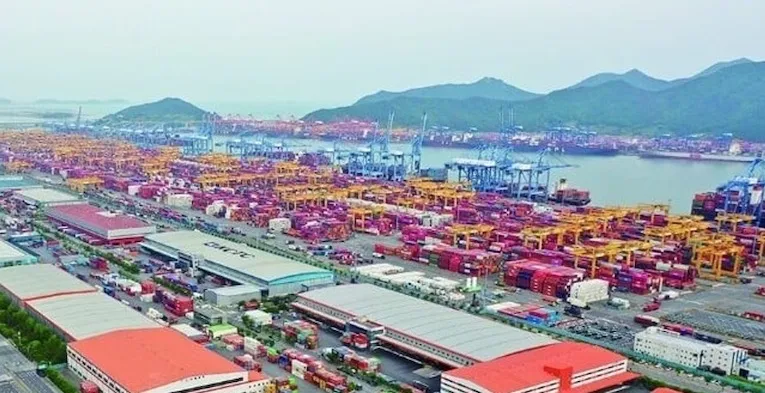
Ocean Network Express (ONE) has strengthened its position in Asia’s terminal sector by acquiring a stake in Dongwon Global Terminal Busan (DGT) from South Korea’s Dongwon Group.
The company did not disclose the price paid or the exact size of what it described as an “indirect but meaningful share” in the fully automated terminal. DGT began operations in April 2024 and, once completed around 2030, is expected to offer capacity of more than 4.5 million TEUs. The terminal will include five mainline berths totaling 5,740 feet, along with one 1,263-foot feeder berth.
The Busan investment follows earlier terminal deals by ONE, including minority stakes in Dalian Container Terminal in China in December and New Priok Container Terminal One (NPCT1) in Indonesia in November 2024.
The move also reflects a broader trend in container shipping. After several years of exceptionally strong earnings driven by supply chain disruption, carriers are investing more aggressively in marine terminals to gain tighter control over landside logistics and reduce exposure to congestion.
Speaking earlier this month at the Journal of Commerce TPM26 conference, ONE chief executive Jeremy Nixon said carriers are increasingly being drawn into terminal ownership and operations at major gateway and hub ports, and that this trend is likely to accelerate over the next decade or more. He also noted that one of the main challenges is the limited number of terminals available for acquisition.
ONE’s latest terminal investment comes just ahead of an important shift in the Premier Alliance’s Asia-Europe network, due to take effect in April. Under the new structure, Busan will become the focal point of the alliance’s North Asia trade, while direct port calls in Japan and Taiwan will end.
Instead, the alliance — made up of ONE, HMM and Yang Ming Marine Transport — will introduce four shuttle services linking Busan to Tokyo, Nagoya and Kobe in Japan, and to Kaohsiung, Taichung and Xiamen.
At the same time, CMA CGM is launching its own direct Asia-Japan service in April. However, that service will use 14 smaller vessels of 7,000 to 10,000 TEU, compared with the 20 ships of 9,500 to 13,000 TEU previously deployed by the Premier Alliance. CMA CGM will also operate a single service, whereas the Premier Alliance had run two direct Asia-Europe services from Japan, both of which have now ended under the new 2026 network design.
The shift is expected to further boost transshipment traffic through Busan, where transshipment has steadily grown as a share of total throughput over the last five years — from nearly 53% in 2021 to 56% last year.
It is also rising faster than origin and destination cargo. Busan Port Authority figures show transshipment volumes increased 4.4% to 14.1 million TEUs last year out of total throughput of 24.9 million TEUs. That followed an 8.8% increase to 13.5 million TEUs in 2024.
By contrast, origin and destination cargo slipped slightly, easing to 10.8 million TEUs from 10.9 million TEUs the previous year.
Busan also continues to outperform rival Japanese ports in liner connectivity. According to UNCTAD’s liner shipping connectivity index for the fourth quarter of 2025, Busan scored 1,648, far ahead of Tokyo at 585 and Kobe at 555. Under UNCTAD’s methodology, a higher number indicates stronger connectivity.
To support that transshipment growth, the Busan Port Authority is introducing a comprehensive digital port community system this year to improve the handling of cargo moving between the port’s nine terminals.
Pilot tests carried out last year already showed significant gains, including a 90% reduction in container rehandling, up to a 50% reduction in truck waiting times, and a threefold increase in load factors, according to Lee Eung-hyuk, the authority’s director of international logistics. Final quantified outcomes are expected around 2027.
Taken together, the investment and the operational upgrades reinforce Busan’s ambition to consolidate its role as the leading transshipment hub in North Asia.