




Technology, facilities and temperature controls all matter in perishables logistics, but according to air cargo leaders speaking at IATA’s World Cargo Symposium, the most decisive factor is still people.
During a panel session focused on perishables cold chain requirements, speakers agreed that successful handling depends on a combination of trained teams, reliable infrastructure and disciplined operational execution. Above all, they stressed that accountability across the chain is what turns good procedures into consistent results.
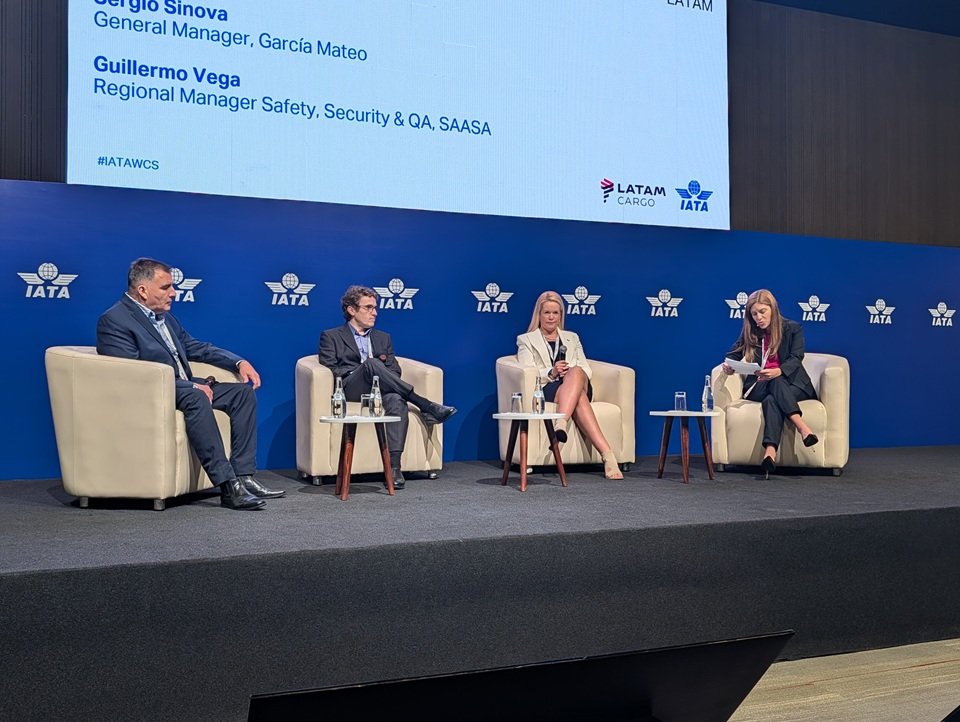
The discussion brought together Anna-Maria Kirchner of Finnair Cargo, Sergio Sinova of Garcia Mateo and Guillermo Vega of SAASA, under the moderation of LATAM’s Desiree Arambura. The panel concluded that cold chain integrity is not achieved through one solution, but through a coordinated, multi-layered approach.
Sinova said the people handling perishables are ultimately the most important part of the operation because they are responsible for making the right decisions in real time. When failures happen, the result is not only financial loss but also reputational damage, which is why stakeholder responsibilities need to be fully transparent.
Vega echoed that view, saying consistency depends on staff who understand the requirements of perishables cargo and monitor it properly. Achieving near-zero product loss requires not only systems, but also the right mindset on the ground.
Kirchner added that ongoing training is a basic requirement. Teams need up-to-date education and operational awareness to maintain product integrity throughout the journey.
The panel also highlighted infrastructure as a growing concern. Kirchner said that resilient facilities are increasingly necessary as temperature-sensitive cargo volumes grow. She pointed to Finnair Cargo’s cold chain investment in Helsinki, where separate areas have been developed for perishables, pharmaceuticals and general cargo. Located next to the runway, the facility minimizes unnecessary cargo movement and reduces waiting times during loading and collection. Trucks can also enter the perishables zone directly.
Vega acknowledged that some companies hesitate to invest because of cost concerns, but argued that the industry needs to be more inventive. Prefabricated solutions, for example, can still deliver the required temperature conditions while helping standardize operations across multiple sites.
Temperature exposure on the apron was identified as one of the most critical risk points. Vega said perishables are particularly vulnerable during loading and unloading, warning that leaving cargo on the apron can cut shelf life by three to five days.
Sinova added that connecting flights present another weak point, with 10% of perishables losses occurring there compared with 2% on direct flights. That makes ground efficiency just as important as in-flight conditions.
Kirchner also underlined the role of digital tools, saying data visibility is increasingly central to monitoring and improving perishables transport performance.