


• Latest
  • Trending
Rethinking Supply Chains: How Companies Are Adapting to the New Global Tariff Landscape

Rethinking Supply Chains: How Companies Are Adapting to the New Global Tariff Landscape

April 8, 2025
Asia–Eurasia — FESCO opens a new corridor Cambodia–Russia via Ho Chi Minh City

Asia–Eurasia — FESCO opens a new corridor Cambodia–Russia via Ho Chi Minh City

February 19, 2026
Towage — MSC and Boluda create a global champion in tugboats (valuation > €2 billion)

Towage — MSC and Boluda create a global champion in tugboats (valuation > €2 billion)

February 19, 2026
ADVERTISEMENT
Macro World Cargo — US trade deficit rises and increased pressure on logistics flows

Macro World Cargo — US trade deficit rises and increased pressure on logistics flows

February 19, 2026
United States — Pure Freight / PX and Redwood Expand Partnership After Key Acquisition in the Midwest and Mexico Border

United States — Pure Freight / PX and Redwood Expand Partnership After Key Acquisition in the Midwest and Mexico Border

February 19, 2026
Rail freight Europe — DB Cargo plans 6,000 job cuts to return to profit

Rail freight Europe — DB Cargo plans 6,000 job cuts to return to profit

February 19, 2026
Air cargo pharma — DHL deploys a dedicated air “cold chain” and locks in controlled capacity

Air cargo pharma — DHL deploys a dedicated air “cold chain” and locks in controlled capacity

February 19, 2026
Red Sea: Maersk strengthens its presence in Jeddah with a strategic stake

Red Sea: Maersk strengthens its presence in Jeddah with a strategic stake

February 19, 2026
LOGISTEC expands its port footprint with the takeover of the IPA terminal in Altamira.

LOGISTEC expands its port footprint with the takeover of the IPA terminal in Altamira.

February 18, 2026
GDI consolidates its regional presence in cold-chain with the acquisition of Transcorp

GDI consolidates its regional presence in cold-chain with the acquisition of Transcorp

February 18, 2026
A.P. Moller Capital mobilizes MAD 2.24 billion to accelerate logistics transformation in Morocco

A.P. Moller Capital mobilizes MAD 2.24 billion to accelerate logistics transformation in Morocco

February 18, 2026
ZEPA publishes “voluntary” standards for terminal electrification: interoperability becomes a total cost issue

ZEPA publishes “voluntary” standards for terminal electrification: interoperability becomes a total cost issue

February 18, 2026
CMA CGM signs with Cochin Shipyard: an industrial step for India… and a lever for future capacity

CMA CGM signs with Cochin Shipyard: an industrial step for India… and a lever for future capacity

February 18, 2026
  • Home
  • About Us
  • Press Room
  • Podcasts
  • Media Kit
  • Contact Us
  • Careers
Sunday, February 22, 2026
  • Login
  • Register
The Logistic News
  • Logistic
  • Air
  • Maritime
  • Land
  • World
  • Business
  • Tech
  • Events
  • Advertise
No Result
View All Result
  • Logistic
  • Air
  • Maritime
  • Land
  • World
  • Business
  • Tech
  • Events
  • Advertise
No Result
View All Result
The Logistic News
No Result
View All Result
Home Logistic

Rethinking Supply Chains: How Companies Are Adapting to the New Global Tariff Landscape

Rethinking Supply Chains: How Companies Are Adapting to the New Global Tariff Landscape

The Logistic News by The Logistic News
April 8, 2025
in Logistic
Reading Time: 2 mins read
0
Rethinking Supply Chains: How Companies Are Adapting to the New Global Tariff Landscape
ADVERTISEMENT

By Eva Richardson | The Logistic News
April 8, 2025

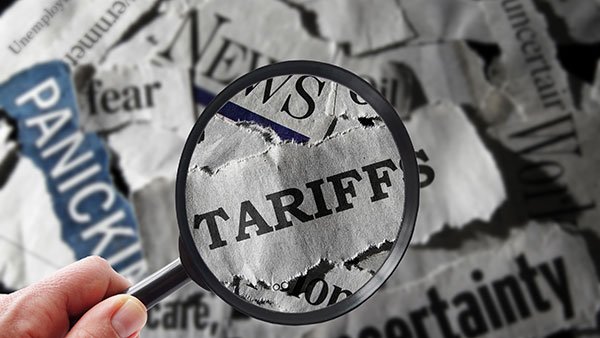
As the latest round of U.S. tariffs sends ripples across the global trading system, companies are scrambling to rewire their supply chains to preserve margins and maintain resilience. With cross-border costs climbing and trade compliance under a microscope, the new tariff paradigm is not just a policy shift—it’s a catalyst for transformation in logistics strategy.

From nearshoring moves to financial safeguards, here’s how businesses are responding to the pressure.

ADVERTISEMENT

1. Diversifying Beyond China: The ‘China +1’ Surge

The once-dominant model of China-centric sourcing is giving way to more flexible strategies. Companies are increasingly pursuing a ‘China +1’ approach, adding manufacturing capacity in Vietnam, India, and Mexico to hedge against tariff shocks. Some are even shifting partial production to higher-cost domestic or regional suppliers to increase control and reduce risk.

“We’re no longer asking where it’s cheapest to produce—but where it’s safest,” said a global sourcing executive from a major electronics manufacturer.

2. Inventory Rebalancing: Holding More, Not Less

While the lean inventory model dominated for years, the tariff environment is reversing course. More companies are stockpiling critical goods and components, building buffer stock to weather customs delays or cost volatility.

This shift comes at a financial cost, tying up working capital—but it’s viewed as necessary insurance in a high-risk trade climate.

3. Strategic Product Redesign

In some sectors, product engineers are playing a new role in tariff mitigation. By redesigning goods to include more local content or alternative materials, firms can reduce import exposure and potentially change a product’s tariff classification entirely.

This technique requires cross-functional alignment between logistics, procurement, and R&D teams, but it’s becoming an increasingly common part of the tariff response playbook.

4. Enhancing Compliance and Governance

Trade compliance is under tighter scrutiny than ever. Regulatory bodies are cracking down on transshipment, mislabeling, and other efforts to skirt tariffs. As a result, companies are increasing internal audits, requesting origin certifications from suppliers, and leaning on customs brokers and legal counsel for classification reviews.

Missteps can mean steep penalties—or worse, reputational damage.

5. Rethinking Financial Reporting and Contracts

The financial implications of tariffs are also showing up in boardrooms. Auditors are insisting on transparency around duty costs, which now must be reflected in inventory valuations and profit forecasts.

Simultaneously, firms are reviewing commercial contracts to account for new tariff risks, with some inserting force majeure clauses and trade disruption insurance requirements.

6. Governance at the Top: Board-Level Engagement

Tariff strategy is no longer the sole domain of logistics or finance departments. Boards and audit committees are demanding comprehensive scenario planning and mitigation strategies. This top-down involvement reflects the systemic risk that tariffs now pose to global operations.

Conclusion: From Disruption to Strategic Advantage

The global tariff shake-up is forcing companies to rethink their operations not as isolated cost centers but as interconnected ecosystems that require agility, foresight, and cross-functional collaboration.

Those who act proactively—not just reactively—stand to turn disruption into competitive advantage.


For deeper analysis of trade disruption, compliance strategies, and supply chain resilience, follow Eva Richardson and The Logistic News on LinkedIn and Google News.


 

Previous Post

Hisense Teams Up with GXO to Power Smarter Logistics in Spain

Next Post

Secure Logistics Surges: Market Forecast Signals $180 Billion Opportunity by 2032

Next Post
Secure Logistics Surges: Market Forecast Signals $180 Billion Opportunity by 2032

Secure Logistics Surges: Market Forecast Signals $180 Billion Opportunity by 2032

Leave a Reply Cancel reply

Your email address will not be published. Required fields are marked *

A D V E R T I S E M E N T

Popular News

  • Drone Delivery Takes Flight: Amazon Partners with UPS for Trial Program

    Drone Delivery Takes Flight: Amazon Partners with UPS for Trial Program

    0 shares
    Share 0 Tweet 0
  • Rail Cargo Group Strengthens European Network with Captrain Netherlands Acquisition

    0 shares
    Share 0 Tweet 0
  • Automotive Inbound Logistics Market: Navigating Future Challenges

    0 shares
    Share 0 Tweet 0
  • Global Inflation Cools to Target After Three Years, Central Banks Face Policy Dilemma

    0 shares
    Share 0 Tweet 0
  • Dubai Mercantile Exchange Rebrands as Gulf Mercantile Exchange Following Saudi Tadawul Group Acquisition

    0 shares
    Share 0 Tweet 0

Recent News

Asia–Eurasia — FESCO opens a new corridor Cambodia–Russia via Ho Chi Minh City

Asia–Eurasia — FESCO opens a new corridor Cambodia–Russia via Ho Chi Minh City

February 19, 2026
Towage — MSC and Boluda create a global champion in tugboats (valuation > €2 billion)

Towage — MSC and Boluda create a global champion in tugboats (valuation > €2 billion)

February 19, 2026
Macro World Cargo — US trade deficit rises and increased pressure on logistics flows

Macro World Cargo — US trade deficit rises and increased pressure on logistics flows

February 19, 2026

Discover a new era of logistics reporting with The Logistic News, your go-to platform for breaking news, insightful features, and exclusive interviews shaping the global logistics and freight landscape. Trust us to deliver accurate, timely, and relevant information that empowers professionals and enthusiasts alike in navigating the intricacies of this vital sector.

Navigation

  • Home
  • About Us
  • Press Room
  • Podcasts
  • Media Kit
  • Contact Us
  • Careers
  • Privacy Policy
  • Terms of Use

© 2024 - thelogisticnews.com

Welcome Back!

Login to your account below

Forgotten Password? Sign Up

Create New Account!

Fill the forms below to register

All fields are required. Log In

Retrieve your password

Please enter your username or email address to reset your password.

Log In

SIgn Up Newsletter

This will close in 20 seconds

Manage Cookie Consent
We use technologies like cookies to store and/or access device information. We do this to improve browsing experience and to show (non-) personalized ads. Consenting to these technologies will allow us to process data such as browsing behavior or unique IDs on this site. Not consenting or withdrawing consent, may adversely affect certain features and functions.
Functional Always active
The technical storage or access is strictly necessary for the legitimate purpose of enabling the use of a specific service explicitly requested by the subscriber or user, or for the sole purpose of carrying out the transmission of a communication over an electronic communications network.
Preferences
The technical storage or access is necessary for the legitimate purpose of storing preferences that are not requested by the subscriber or user.
Statistics
The technical storage or access that is used exclusively for statistical purposes. The technical storage or access that is used exclusively for anonymous statistical purposes. Without a subpoena, voluntary compliance on the part of your Internet Service Provider, or additional records from a third party, information stored or retrieved for this purpose alone cannot usually be used to identify you.
Marketing
The technical storage or access is required to create user profiles to send advertising, or to track the user on a website or across several websites for similar marketing purposes.
Manage options Manage services Manage {vendor_count} vendors Read more about these purposes
View preferences
{title} {title} {title}
No Result
View All Result
  • Logistic
  • Air
  • Maritime
  • Land
  • World
  • Business
  • Tech
  • Events
  • Advertise

© 2024 - thelogisticnews.com