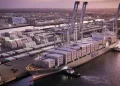
The Port of Rotterdam, Europe’s leading port, has just taken a major step in its decarbonization strategy: the joint venture Rotterdam Shore Power (Port of Rotterdam + Eneco) has selected ABB to design, build, and commission shore power systems for several deep-water container terminals.
Specifically, the project includes 35 connection points spread across three terminals: APM Terminals Maasvlakte II, as well as Hutchison Ports ECT Delta and Hutchison Ports ECT Euromax. The goal is simple: to allow container ships, while in port, to turn off their auxiliary engines and switch to electricity supplied from the land.
Beyond the “green” image, Rotterdam is also moving forward to prepare for European obligations. The system is designed to be fully compatible with the requirements of FuelEU Maritime, which pushes large ships (especially containers and passengers beyond a certain tonnage) to use zero-emission solutions while docked in EU ports by 2030.
According to project estimates, when shore power is used 90% of the time at the relevant stations, the reduction could approach 96,000 tons of CO₂ per year once everything is operational in 2030 — with an expected ramp-up starting in the second half of 2028.