




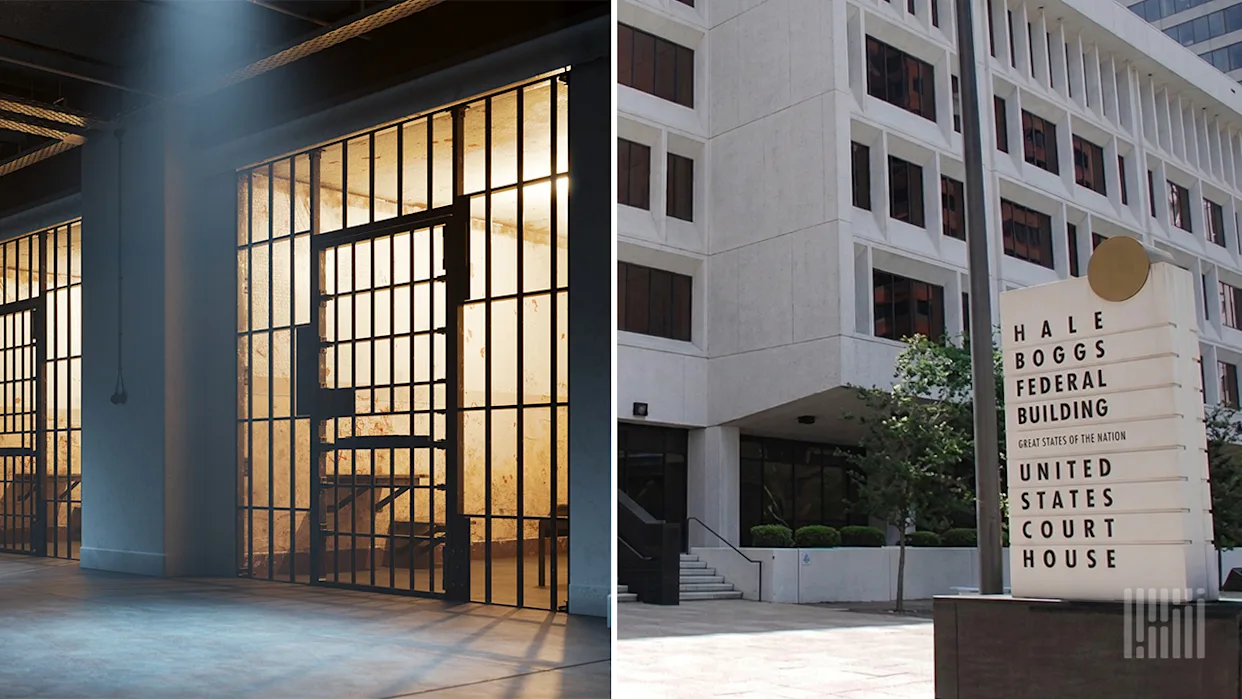
The first major trial in the federal Operation Sideswipe investigation has now ended, but the next major question is just as significant: how long will the convicted attorneys spend behind bars?
Attorneys Vanessa Motta and Jason Giles were convicted on Friday in the US District Court for the Eastern District of Louisiana on multiple counts including mail fraud, wire fraud and witness tampering, all tied to a staged accident scheme in which cars full of passengers deliberately collided with trucks in order to trigger insurance payouts.
In announcing the verdict, the US Attorney’s office said the charges carry potential prison terms of up to 20 years. Mail fraud and wire fraud were also the main charges brought against the 63 people indicted in connection with the broader staged accident conspiracy. Most of those defendants pleaded guilty, and sentences so far have ranged from probation to more than four years in prison.
A third defendant, Daiminike Stalbert, was acquitted on some of the charges that led to the convictions of Motta and Giles, but he was found guilty of making false statements to federal investigators. Giles’ employer, the King Law Firm, was also convicted in the trial.
The Motta-Giles case was the first in Operation Sideswipe to go to trial. Motta is scheduled to be sentenced on July 7, with Giles and the King Law Firm due a week later, and Stalbert to follow a week after that.
Two New Orleans attorneys who closely followed the case told FreightWaves they expect substantial prison terms, though they differ on the likely length.
Joseph Raspanti said one of the biggest factors in sentencing will be the financial damage caused by the fraud. He said the “implied loss” to insurers and others could exceed $1 billion, and that such a figure could lead to a sentence of at least eight years, and possibly as much as 11 years.
Edward McAuliffe III, of the New Orleans office of Wilson Elser, suggested the sentences could be even harsher. In an ordinary fraud case, he said, a judge might not “throw the book” at the defendants. But based on comments made by Judge Wendy Vitter after the verdicts and before ordering Motta and Giles into federal custody, McAuliffe believes the court sees this as anything but a normal case.
Given that the charges carry maximum terms of 20 years, and considering the judge’s statements, McAuliffe said it is possible that both Motta and Giles could receive the full 20-year maximum.
He said the witness tampering convictions are a major reason for that assessment. Testimony during the trial showed that Motta allegedly tried to persuade one potential witness to take a pile of cash and fly to the Caribbean. Another recording introduced by the defense appears to have backfired, showing Motta speaking with a potential witness after she had already been indicted and despite a court order not to contact anyone involved in the case.
Judge Vitter also reportedly expressed skepticism over Motta’s claim that she had no knowledge of any possible involvement by her fiancé, Sean Alfortish, in the killing of Cornelius Garrison, one of the so-called “slammers” who drove vehicles into trucks. Garrison was shot in his home in 2021 after pleading guilty and agreeing to cooperate with investigators. Alfortish is due to stand trial in August with another defendant over that killing.
McAuliffe said the judge’s decision to remand both attorneys to federal custody before sentencing is itself unusual in a fraud case, where defendants would often remain free on bond pending sentencing. That, he argued, may reflect the court’s concern about the seriousness and broader risks of the case.
Another striking issue to emerge during trial was the scale of the scheme. According to Raspanti, the incidents listed in the various indictments appear to represent only a small sample of the total number of staged crashes.
He said prosecutors were never going to list every alleged incident in the indictment and instead used representative cases. But trial testimony suggested there were dozens upon dozens of similar events.
Evidence from attorney Danny Keating, who pleaded guilty in the case five years ago, as well as testimony from individuals connected to Motta, suggested that the financial returns from Operation Sideswipe reached the seven-figure range per lawyer, far beyond what might have been assumed from the specific collisions named in the indictments.
One of the biggest individual cases described involved a $4.5 million payout linked to carrier C.R. England.
Yet any true accounting of the damage would need to include not only the crashes identified in the indictments, but also the financial impact of incidents never formally charged. It would also have to consider how much Louisiana drivers — both personal and commercial — paid in higher insurance premiums as a result of accident rates being inflated for years while the scheme continued.
The widespread fallout from Operation Sideswipe is also believed to have contributed to Louisiana tort reform efforts.
Renee Amar, executive director of the Louisiana Motor Transport Association, said recent tort reform in the state was driven in part by the reaction to the crash wave linked to the fraud operation, though she added that it was not the only factor.
She said Louisiana was particularly vulnerable to this kind of scam because trucks represent high-value targets. As she put it, the perpetrators did not stage these crashes against cars.
Even so, Amar said the state’s legal reforms still do not go far enough. She compared the system to a sinking ship with 100 holes in it, of which only five have been plugged so far.
She also noted that civil racketeering suits have been filed against some law firms connected to claims involving medical procedures that certain indictments said were unnecessary and performed only to inflate insurance payouts.
Despite that, no medical providers have been criminally charged in Operation Sideswipe. Raspanti said those cases are difficult to prove beyond a reasonable doubt and that there has been no indication physicians are being actively pursued by federal prosecutors.
The next court milestones will come with the sentencing of Danny Keating and Damian Labeaud, a leading “slammer” who both pleaded guilty and agreed to cooperate with investigators. Keating pleaded guilty in 2021, while Labeaud did so a year earlier. Both testified in the Motta-Giles trial.
Their sentencings have been postponed several times and are now scheduled for April 2 for Labeaud and April 9 for Keating.