



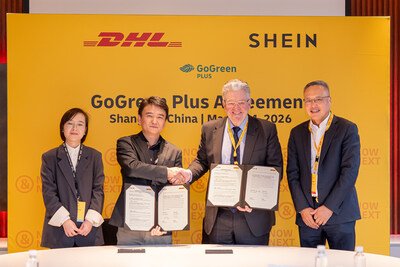
SHEIN has entered into a partnership with DHL to support the adoption of sustainable aviation fuel (SAF) within its air cargo logistics operations, marking another step in the company’s broader sustainability strategy.
Through DHL’s GoGreen Plus service, corporate customers can contribute to the use of SAF within the aviation fuel supply chain. The associated lifecycle emissions reductions, compared to conventional jet fuel, are allocated to participating customers using recognised international accounting standards and certification frameworks.
Mustan Lalani, Head of Sustainability at SHEIN, said the collaboration provides an opportunity to better understand how SAF solutions can be integrated into air cargo logistics and contribute to reducing emissions linked to air transport.
John Pearson, CEO of DHL Express, described the agreement as a significant milestone in advancing the green transformation of air logistics, highlighting DHL’s role as a pioneer in sustainable logistics solutions.
The partnership builds on a broader set of initiatives undertaken by SHEIN across the air cargo ecosystem. In 2025, the company signed a memorandum of understanding with Lufthansa Cargo and launched several pilot programmes to explore SAF adoption.
Among these initiatives, SHEIN deployed 187.3 tonnes of SAF across 14 Atlas Air charter flights, achieving an estimated emissions reduction of 579.1 tonnes of CO₂ equivalent.
The company is also participating in a SAF pilot programme in China, led by China National Aviation Fuel and the Civil Aviation Science and Technology Research Institute. The initiative brings together airlines and corporate partners to support SAF procurement and develop scalable commercial frameworks.
Additionally, SHEIN has joined the World Economic Forum’s Green Fuel Forward campaign, aimed at accelerating SAF adoption across the Asia-Pacific region.
Despite growing interest, SAF still represents only a small share of global aviation fuel supply, with adoption constrained by limited production capacity and higher costs. Industry-wide collaboration and continued investment will be required to scale its use.
SHEIN acknowledges that the current impact of SAF initiatives remains limited relative to its total air transport footprint but views these programmes as a foundation for future expansion as industry capacity grows.