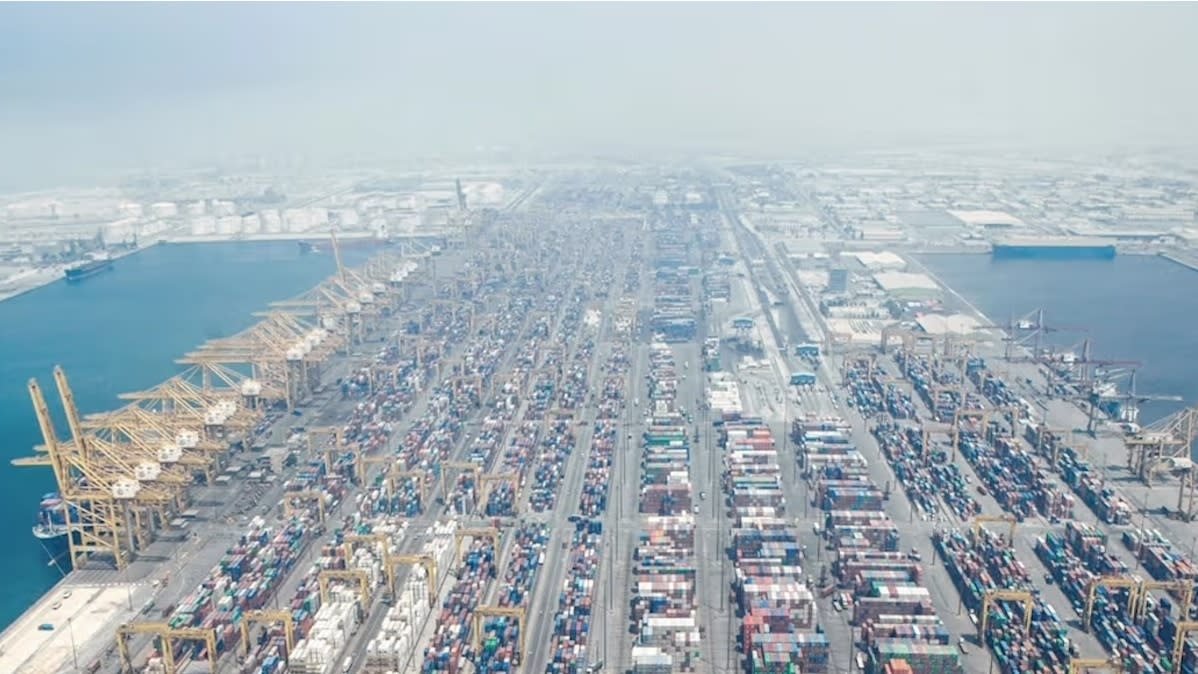
The Strait of Hormuz is not only one of the world’s most strategic maritime chokepoints — it is also the single greatest structural vulnerability in Gulf logistics.
That is the conclusion of a new analysis by Drewry, which argues that decades of underinvestment in bypass infrastructure mean no realistic short-term alternative exists if access through the strait remains severely disrupted.
The narrow waterway connecting the Persian Gulf to the Gulf of Oman and the Indian Ocean carries up to 30% of global crude oil tanker shipments, along with critical flows of LNG, propane gas, petrochemicals and fertilizer. The consequences of the current disruption are already being felt in the United States, where diesel prices have risen and gasoline prices have reportedly increased by 70 cents per gallon.
Container shipping is also exposed. Liner operators have already introduced emergency surcharges and rate increases to account for diversions away from the region.
While Persian Gulf ports represent only 3.5% of global container trade, a prolonged disruption would create severe congestion and supply chain spillovers from Gulf ports into Asia and onward to U.S.-bound services. The strait is the only maritime gateway for the economies of Qatar, Kuwait, Bahrain and Iraq.
According to Drewry, about 33 million TEUs move through Gulf terminals each year, including traffic for the UAE, Saudi Arabia, Kuwait, Qatar and Bahrain. Jebel Ali alone handles around 15.5 million TEUs annually.
The region’s strength has always been its connectivity. Drewry’s Port Connectivity Index for the first quarter of 2026 gave Jebel Ali a score of 16.0 and Khalifa Port 9.4, making them highly connected regional hubs. But Drewry notes that a full closure of Hormuz would remove more than three-quarters of that connectivity.
The study found that Gulf bypass ports collectively have more than 20 million TEUs of latent capacity, but much of that potential is limited by geography and inland logistics.
Among the alternatives, Khorfakkan in the UAE is seen as the only genuinely high-utility bypass port because it sits just 80 miles from Dubai by road. UAE authorities have already introduced emergency customs clearance for cargo moving by truck from Khorfakkan to Jebel Ali and Abu Dhabi free zones. Still, road capacity is likely only a fraction of what the port itself could absorb.
Salalah in Oman offers around 3 million TEUs of spare capacity, but Drewry says it is effectively disconnected from Gulf inland supply chains because it lies more than 1,700 kilometers from Dubai and lacks rail connectivity. Trucking a 40-foot container from Salalah to Dubai costs an estimated $3,000 to $5,000, compared with only $200 to $400 from Jebel Ali.
Saudi Red Sea ports such as Jeddah and King Abdullah Port also have meaningful capacity, but still lack a direct freight rail connection to Riyadh. A planned 600-mile inland freight railway has not yet entered construction.
Qatar, Bahrain, Kuwait and Iraq are considered even more exposed, with no viable overland bypass routes that avoid either Hormuz or Saudi territory.
The problem is even greater for transshipment. Jebel Ali’s 65% transshipment ratio means disruption there affects not only UAE cargo but also feeder services into Kuwait, Qatar and Bahrain. Khalifa Port faces similar structural exposure. Even Abu Dhabi’s investments, including projects involving COSCO and CMA CGM, become vulnerable if relay cargo can no longer move efficiently through the strait. The only alternative link, Etihad Rail to Fujairah, offers just 50,000 TEUs of annual relief, far too little to replace Hormuz-dependent flows.
Drewry sees the crisis unfolding in three stages. In the short term, the next six months would bring severe disruption, with only partial rerouting options. Over six to 24 months, adaptation would be possible, but at a far higher cost, with logistics expenses across the Gulf potentially rising by three to five times. Beyond two years, governments may finally be forced to invest in long-delayed strategic projects such as the GCC Railway or the Jeddah-Dammam-Kuwait corridor, though these would still take years to deliver.
The report’s conclusion is blunt: collective underinvestment in Hormuz bypass infrastructure means the region’s greatest strength — its liner connectivity — becomes its greatest point of failure in a closure scenario.