



At a time when freight markets remain under pressure and trucking bankruptcies continue to mount, executives from smaller carriers say disciplined use of data has become one of the clearest differences between companies that survive and those that fall behind.
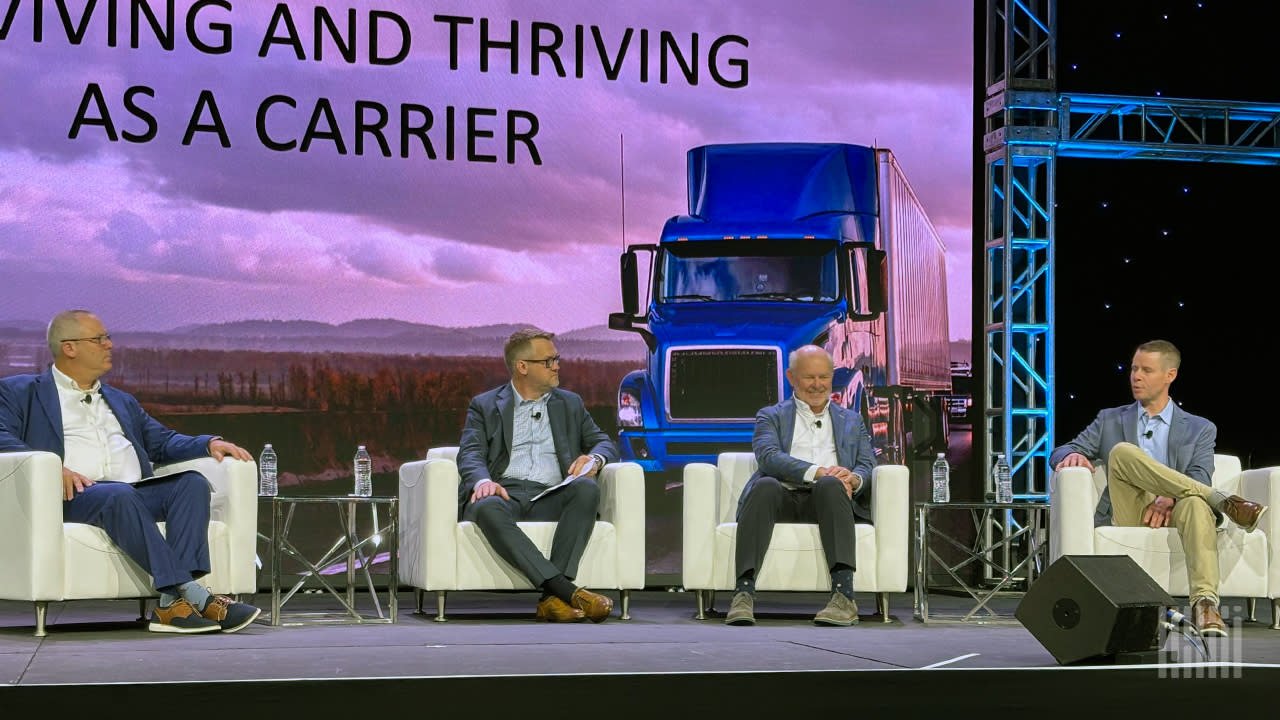
That message came through clearly during a panel at the Truckload Carriers Association annual convention in Orlando, where operators discussed how they have navigated a prolonged freight recession. The panel featured Chris Hummer of Iowa-based Don Hummer Trucking Corp., Mark Walker of Missouri’s TransLand, and Ty Walker of Utah’s Stokes Trucking, with Brown Dog Carriers president Graig Morin serving as moderator.
While the companies are not among the industry’s largest fleets, each has managed to remain operational through a particularly difficult freight cycle. Don Hummer Trucking operates around 300 trucks, TransLand roughly 180, and Stokes about 50. Their shared conclusion was straightforward: waiting for the market to improve is not a strategy.
The panelists credited the TCA Profitability Program, or TPP, as a useful benchmarking tool. The programme gathers financial and operating data from participating members and provides anonymised comparisons that allow fleets to see how their performance stacks up against peers.
Ty Walker said the information provided through TPP was initially overwhelming, but ultimately valuable because it allowed Stokes to compare specific cost items line by line. He noted that the programme drills down to detailed expenses such as lumper payments, giving companies a basis for deciding where adjustments are needed.
Mark Walker said the programme had significantly improved TransLand’s visibility into which numbers matter most. Among the metrics his company prioritised were costs per truck and revenue per truck.
Chris Hummer pointed to network density as one of the critical indicators for Don Hummer Trucking, saying the concentration and efficiency of freight in a given area is central to performance. He added that his company also produces profit-and-loss statements at the individual driver level, giving management another way to benchmark and compare operating performance.
At TransLand, however, the effort eventually narrowed to just two metrics considered more important than the rest: revenue per truck per week and EBITDA. Mark Walker said the simplification made sense operationally, but also highlighted a communications problem. When the company first shared its goals internally, employees struggled to see how those targets related to their day-to-day work.
That led to the creation of a “financial acumen workshop,” designed to break large performance metrics into smaller, practical components. Revenue per truck per week, for example, was connected to sub-measures such as miles driven and the percentage of seated trucks. The aim was to help employees understand not only what the company was tracking, but also how their own roles affected the outcome.
Ty Walker said Stokes now uses a weekly internal scorecard that includes data such as total revenue, revenue per truck per week excluding fuel surcharge, and available load count.
When asked which indicators currently matter most, Hummer said the strongest recent predictor has been loaded percentage within the company’s non-dedicated network. In a low-pricing environment, he said, improving that percentage is one of the few levers fleets can actively control.
Mark Walker added that miles driven per day by each driver has become TransLand’s clearest real-time indicator of whether the company is likely to meet its targets.
Hummer also stressed the importance of perspective, particularly for private and family-owned fleets that can afford to think beyond quarterly results. One lesson he said he had learned from a mentor was not to make permanent decisions in response to temporary market conditions.
The broader takeaway from the panel was clear: data only matters if it is trusted, understood and used in decision-making. Otherwise, as Hummer put it, there is little reason to collect it at all.