Maritime Nov 16, 2026
Two Tankers Reported Struck Near the Strait of Hormuz as Iran Claims VLCC Sunk
Maritime tensions intensify in and around the Strait of Hormuz after two separate incidents involving commercial tankers. While one attack has been confirmed, Iran claims that two vessels struck mines, including a very large crude carrier (VLCC) allegedly sunk in the southern Arabian Gulf. Independent verification of Tehran’s claims remains outstanding.
Commercial shipping in and around the Strait of Hormuz continues to face heightened security threats as further incidents involving oil tankers have been reported. One attack in the Arabian Gulf has been confirmed by maritime authorities, while Iran has claimed that two additional vessels struck mines in the southern section of the strategic waterway.
The first incident occurred on 15 November, when a tanker was reportedly attacked in the Arabian Gulf while approaching the Strait of Hormuz. The UK Maritime Trade Operations (UKMTO), citing information from Indian shipping authorities, confirmed that the crew were safe and fully accounted for.
Maritime security company Vanguard Tech identified the vessel as the Al Dhannah, a very large crude carrier (VLCC) operated by Thenamaris. The tanker sustained damage to its steering gear room at the stern following the strike and subsequently turned back towards Dubai port. The vessel was already listed as non-compliant by Iran's Persian Gulf Strait Authority (PGSA).
Iran reports mine strikes and claims a VLCC has sunk
Amid its continuing campaign against commercial vessels transiting the Strait of Hormuz, the Islamic Revolutionary Guard Corps (IRGC) announced that two tankers had struck mines in the southern corridor.
According to the Iranian military organisation, both vessels experienced what it described as “massive explosions” after hitting mines while undertaking unauthorised transits through the area.
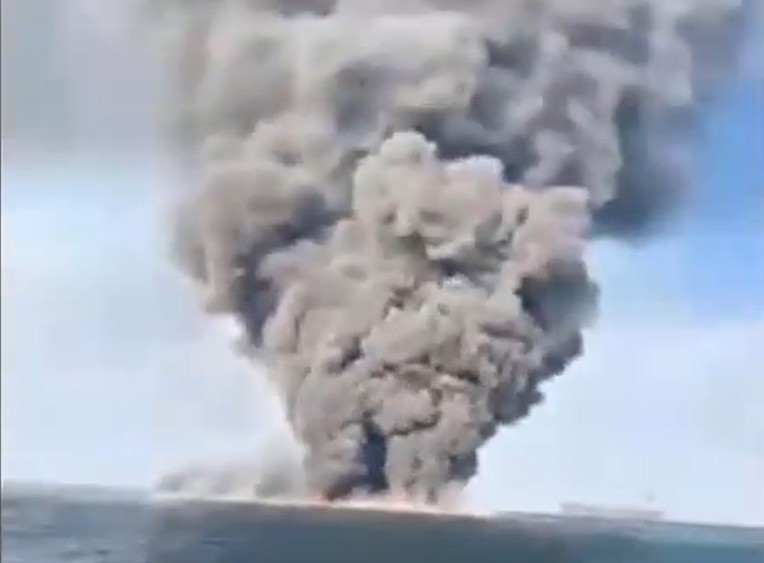
The IRGC further claimed that a supertanker carrying more than two million barrels of crude oil had suffered severe damage and subsequently sunk in the southern Arabian Gulf. The vessel was described as a VLCC.
To support its statement, the IRGC released video footage purportedly showing the tanker engulfed in flames. However, the images show a large fire and thick smoke spreading across the water, without any clearly identifiable vessel.
Iranian authorities have not disclosed the identities of the two tankers allegedly involved. Furthermore, no independent confirmation of these reported mine strikes or the claimed sinking has emerged.
Another tanker struck off the coast of Oman
A separate incident was reported by UKMTO on 16 November, when another commercial vessel was hit by an unidentified projectile while sailing outbound from the Strait of Hormuz.
According to the vessel's company security officer, the incident occurred at 05:58 UTC and triggered a fire in the engine room. All crew members were accounted for, with no casualties reported.
Vanguard Tech identified the tanker as the On Phoenix, a Panama-flagged vessel owned by Onex. The attack reportedly took place approximately three nautical miles off the coast of Oman.
Like the Al Dhannah, the On Phoenix was already included on Iran's PGSA blacklist, having been added to the list on 14 September.
Iran seeks to impose restrictions on shipping routes
The latest incidents come as Iran continues to target commercial vessels using the southern corridor of the Strait of Hormuz, particularly ships receiving guided transit assistance from US forces.
Tehran maintains that the northern corridor, which passes through Iranian territorial waters, is the only authorised route for commercial shipping through the Strait. Under this position, vessels must obtain prior approval from the Persian Gulf Strait Authority (PGSA).
In a report published by the Tasnim News Agency, the IRGC Navy issued a warning to tanker owners, shipping company executives and vessel crews, urging them not to approach what it described as the Strait of Hormuz's “restricted area”.
With further attacks being reported and competing claims over which shipping routes are authorised, security conditions in one of the world's most strategically important maritime corridors remain highly volatile.
END OF REPORT