Business Nov 18, 2026
U.S. Supreme Court Reopens Debate Over Shipper and Receiver Liability Following Montgomery Ruling
The Supreme Court's decision to return the Walmart and Irigoyen Farms case to a California appellate court could revive a crucial legal debate over whether cargo owners and freight recipients can be held responsible for road accidents involving contracted transportation providers.
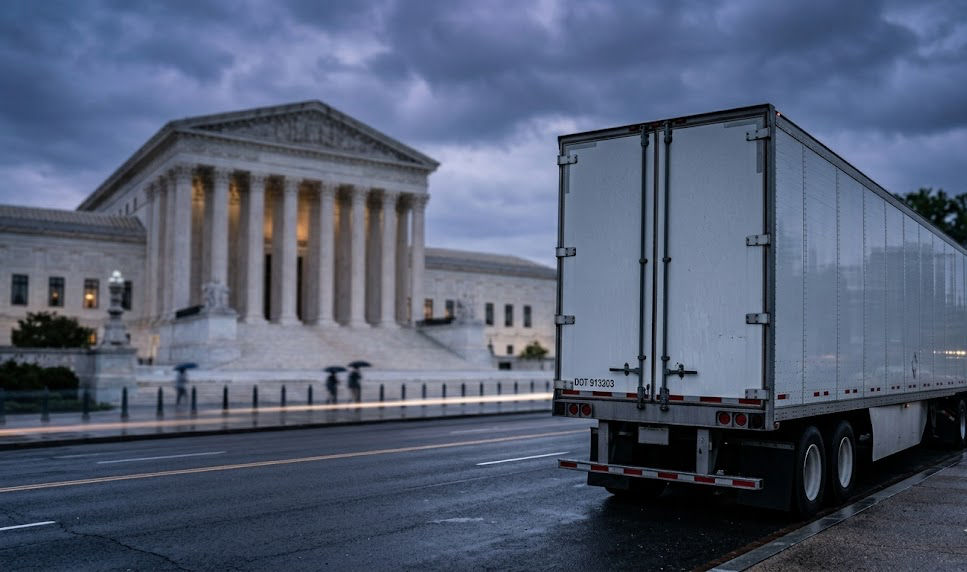
Shippers and freight recipients’ legal liability in trucking accidents is again on the radar in the United States. The U.S. Supreme Court has taken a procedural step that could revive a big legal fight over how much liability companies arranging or receiving shipments of freight may face after highway accidents involving third-party carriers.
On Monday, the Supreme Court granted certiorari in Casarez v. Irigoyen Farms et al. and issued a Grant, Vacate and Remand (GVR) order. Instead of resolving the merits of the case, the justices have sent the dispute back to a California appeals court for further consideration.
The Supreme Court has not weighed in on the issue of liability for shippers or recipients of freight, but the Court’s move has kept the case alive and presents another opportunity to tackle the issue within the parameters of the recent Montgomery v. Caribe Transport II ruling.
That ruling was a major blow to some legal protections that freight brokers had enjoyed, and more broadly it raised the question of whether similar liability arguments might eventually reach further up the supply chain to include shippers and their customers.
The California proceedings had consistently favored Irigoyen Farms and Walmart prior to the Supreme Court's most recent intervention. Absent the GVR order, the case would have been effectively over in California under a line of decisions issued prior to the shift in the legal landscape in Montgomery .
Walmart is one of the companies under renewed legal scrutiny.
The case concerns Walmart (NYSE: WMT), the intended recipient of a produce shipment from Irigoyen Farms operations in Selma, California, bound for a Walmart distribution center in Nevada.
The accident happened in September 2019 near Fresno, California. Reports indicate the truck, driven by independent contractor Andre Hill, was hauling produce from Irigoyen Farms to Walmart when it failed to stop at a stop sign and struck a car driven by Olivia Mendoza. She was dead at the scene.
Casarez, Mendoza’s mother, then sued the parties involved in the transportation operation, including Irigoyen Farms and Walmart.
Hill was later convicted of vehicular manslaughter and given a two-year jail sentence.
Court filings describe the transportation arrangement, which involves a number of intermediaries. Royal Violet Logistics had been contracted by Irigoyen Farms to coordinate the produce delivery. Royal Violet then hired SIO Logistics, who in turn hired Gold Coast Logistics as the carrier. Gold Coast finally hired Hill to get the shipment to Wal-Mart.
It wasn’t immediately clear how any separate litigation between the third-party logistics providers and the carrier would play out.
But the crux of the matter in Casarez v. Irigoyen Farms goes beyond the duties of the companies directly involved in arranging and carrying out the transportation. The case raises a potentially far-reaching question: could the legal exposure created for brokers by Montgomery also apply to the original shipper and the final freight recipient?
The parties to this dispute are Irigoyen Farms and Walmart.
California’s earlier rulings had shielded the shipper and recipient
Both companies had been handed wins in the California court system — until the Supreme Court got involved.
The proceedings initially landed in the Fresno County Superior Court. That court in September 2023 ruled in favor of Irigoyen Farms and Walmart, granting summary judgment and dismissing them from the lawsuit.
They defended themselves on the basis of the Federal Aviation Administration Authorization Act (FAAAA), and in particular the preemption clause. This provision generally bars states from enforcing laws or taking action that affects a company’s prices, routes or services in certain transportation-related contexts.
The defendants also argued that they did not fall within the safety exception to the statute. That exemption allows for certain state laws regarding motor vehicle safety, but the language is specific to motor vehicle-related issues.
Irigoyen Farms and Walmart argued that neither company was a motor vehicle operator or related to a vehicle under the exception.
Ultimately the case made its way to the Fifth Appellate District of the California Court of Appeal, which in September 2025 affirmed the lower court’s decision. The California Supreme Court declined to review the case in January 2026.
By that stage the decisions had effectively reinforced the position that the shipper and recipient could not be held liable on the basis of the arguments advanced.
But the Supreme Court ruling in Montgomery v. Caribe Transport II, issued in May, has largely altered the legal landscape in which the dispute must now be viewed.
Montgomery decision alters legal landscape
The decision in Montgomery v. Caribe Transport II undercut the earlier arguments used to shield freight brokers from multiple liability claims under the FAAAA.
One issue of particular importance was the interpretation of the statutory wording referring to matters "with regard to motor vehicles”. In doing so, the Supreme Court’s decision established that the activities of brokers could be covered by this language, opening the door to a broader set of lawsuits against transportation intermediaries.
Now the freight industry is pondering the implications of that interpretation.
A major question is whether the same rationale might be extended to shippers and recipients of freight where their activities are associated with the organization or management of transportation operations.
Casarez v. Irigoyen Farms could be a significant case in defining the limits of that liability.
But shippers have continued to win favorable results in other cases since the Montgomery decision.
For instance, just days after the ruling, a Texas court dismissed an attempt to hold Home Depot (NYSE: HD) liable for a fatal accident involving products transported by Werner Enterprises (NASDAQ: WERN).
The California case therefore remains of particular significance as it may provide another opportunity to clarify the application of the revised legal interpretation to parties other than brokers and motor carriers.
Walmart has since responded to the Supreme Court’s procedural order, saying the order provides the relief it requested in its response to Casarez’s petition. The retailer said it would continue to defend itself in the California Court of Appeal.
Walmart, in its filing with the Supreme Court, sought to set itself apart from the companies that arranged the shipment.
The retailer stated that it had not been involved in the organization of the transportation since it was the intended recipient of the cargo. It said it neither chose the broker, motor carrier or driver; provided or maintained the vehicle; nor otherwise participated in the transportation arrangements.
Legal experts say it's a case to watch
Gregory Reed is a partner at Hanson Bridgett and heads the firm’s Transportation and Logistics practice group. He has followed the dispute from its earlier stages.
Reed first considered the case following the California appellate court ruling in September 2025, prior to the California Supreme Court’s decision not to review the case and the subsequent Montgomery decision that altered the legal landscape.
The Walmart-Irigoyen Farms dispute is “the most important shipper-carrier liability case to watch right now,” he said in an email to FreightWaves.
But Reed cautioned against assuming the Court's latest action necessarily signals the beginning of another landmark decision.
The GVR order keeps the case alive, he said, but the justices have not yet decided whether to hear the specific legal issue raised by both Irigoyen Farms and Casarez: whether FAAAA preemption is available to parties higher up the supply chain, including shippers and receivers, or only to the brokers and motor carriers specifically named in the statute.
The possibility of eventual Supreme Court review, too, is uncertain.
"There is no disagreement right now between the federal appellate circuits on the issue of shipper and receiver liability that would typically cause the Supreme Court to step in," Reed said.
A split among circuit courts is often a big factor in convincing the justices to take up a legal issue. In Montgomery’s case, for example, the issue of broker liability reached the Supreme Court only after conflicting decisions had built up in different jurisdictions and several requests for review had been denied.
Without a similar split among the appellate courts, another Supreme Court review of shipper and receiver liability may be more difficult to obtain.
Walmart could be gone from Irigoyen Farms for various circumstances
Reed also pointed out a key distinction between the defendants’ positions.
Walmart was the intended recipient, but the driver in the fatal accident had a closer connection to Irigoyen Farms.
Hill had been at Irigoyen Farms, the attorney said, and several people there said he appeared very tired.
That situation might be relevant to an assessment of the potential responsibility of the produce supplier, particularly what the supplier knew or should have known about the driver’s condition before the shipment left.
But Walmart said it had no role in selecting the transportation companies or the driver. The same argument doesn’t necessarily apply.
Those differences may matter when the case returns to the California Court of Appeal to consider whether the legal reasoning developed since Montgomery can apply to either company.
The result is something to watch for the transportation and logistics industry. A broader interpretation of shipper and receiver liability could change contractual relationships and freight procurement practices and risk allocation throughout the supply chain, potentially exposing companies to legal challenges even when transportation is performed by independent third parties.
END OF REPORT