



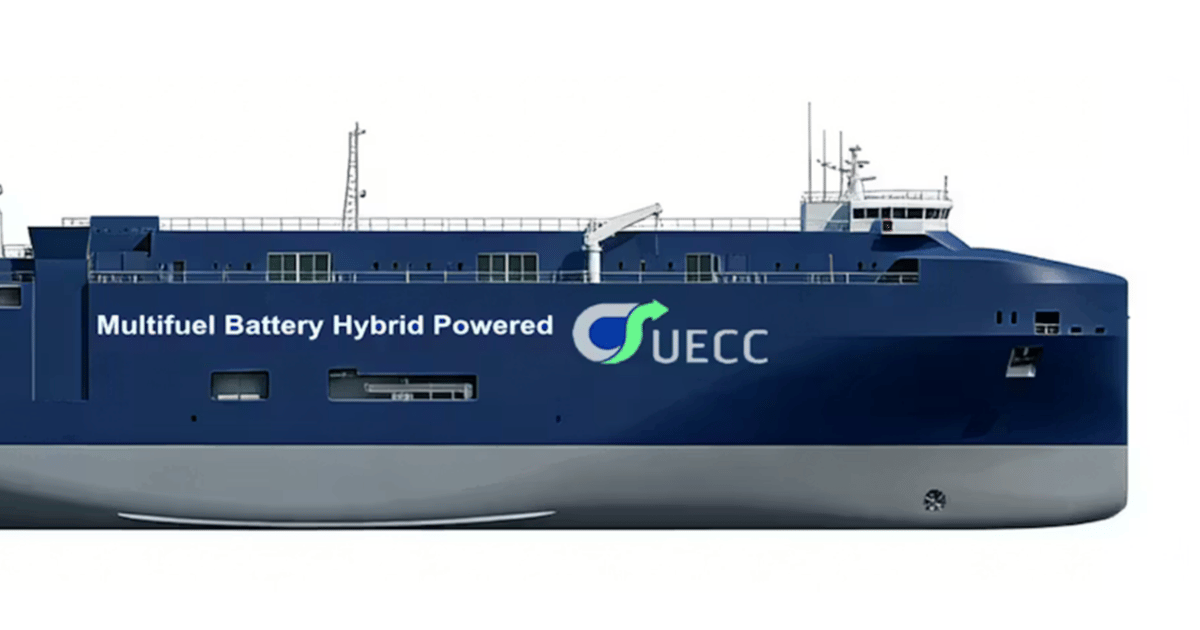
European vehicle carrier United European Car Carriers (UECC) has confirmed the order of two new multi-fuel battery-hybrid Pure Car and Truck Carriers (PCTCs), marking another step in the company’s long-term strategy to decarbonise maritime automotive transport.
The vessels, each with a capacity of 3,000 car equivalent units (CEU), will be built at China Merchants Jinling Shipyard. The order follows a previous contract for two larger 4,500-CEU vessels, which are scheduled for delivery in 2028.
According to UECC chief executive Glenn Edvardsen, the new ships represent an important milestone in the company’s sustainability roadmap.
“These newbuildings represent a significant step forward in safety, efficiency and environmental performance while redefining cargo-carrying capability in the PCTC segment,” Edvardsen said.
Advanced propulsion and hybrid technology
Developed in collaboration with the Shanghai Ship Research & Design Institute (SDARI), the vessels will feature LNG-powered multi-fuel engines combined with battery-hybrid propulsion systems.
The design incorporates several energy-efficiency technologies, including:
• hybrid battery propulsion systems
• multi-fuel LNG engines
• aerodynamically optimised hull design
• shore-power connectivity
• real-time emissions monitoring systems
The vessels will also feature a near ballast-free design, which further reduces fuel consumption and environmental impact.
Expanding a low-emission fleet
With the addition of these vessels, UECC will ultimately operate nine PCTCs capable of running on dual-fuel LNG or multi-fuel hybrid technology, delivered from 2016 onwards.
The ships are also designed to operate using liquefied biomethane, offering an additional pathway toward carbon-neutral operations.
Importantly, the new vessels have been engineered with future adaptability in mind, allowing them to integrate next-generation alternative fuels and propulsion technologies as they become commercially viable.