




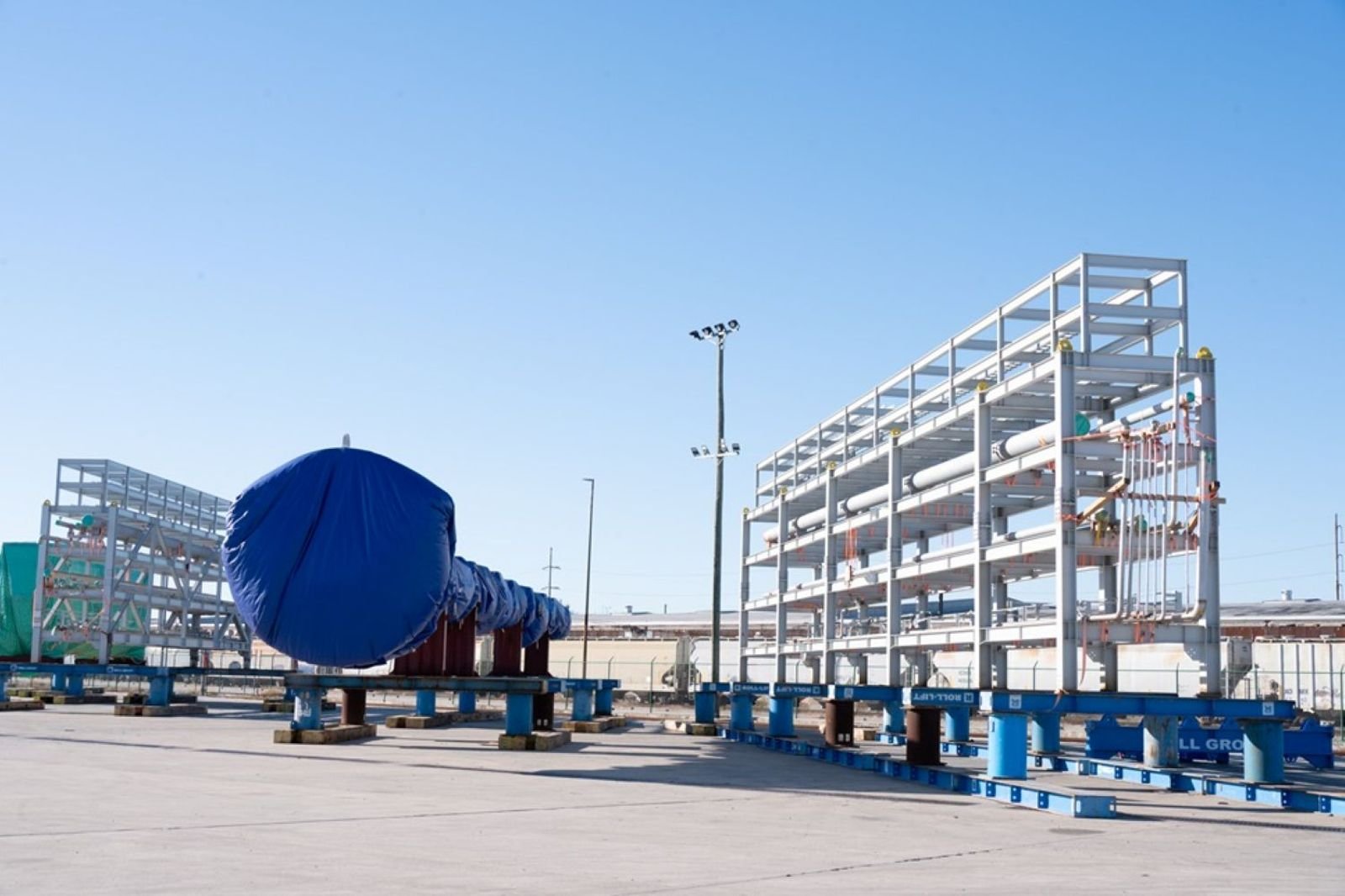
Breakbulk and project cargo activity is gaining momentum again across the US Gulf Coast, where major industrial and energy developments are generating fresh demand at two of the country’s leading gateways: the Port of New Orleans and Port Houston.
Both ports posted growth in project-related cargo over the past year, although steel imports remained under pressure. Port officials also expect those broader trends to continue.
At New Orleans, one of the latest catalysts is Shintech’s newly announced $3.4 billion expansion of its chemical manufacturing complex in southeastern Louisiana. Revealed on March 4, the project will be developed in phases, with the first phase scheduled for completion in 2030. Shintech is the world’s largest producer of polyvinyl chloride (PVC).
According to Janine Mansour, director of trade development at the Port of New Orleans, the announcement has reinforced confidence in the petrochemical sector, particularly at a time when disruptions in the Middle East are affecting competing production markets.
That optimism is already reflected in the numbers. Project cargo volumes at the Port of New Orleans climbed 31% in 2025 to 64,806 tons, following an even stronger 46% rise in 2024. The port said shipments came from a broad range of origins, including Italy, China, India, Thailand and South Korea.
Several major developments are feeding that pipeline, including Venture Global’s large-scale CP2 LNG export facility in southwest Louisiana, UBE Corporation’s EV battery chemical plant outside New Orleans, Meta’s 4-million-square-foot data center in northeast Louisiana, and Hyundai Steel’s planned $5.8 billion low-carbon steel mill in southeast Louisiana.
Still, the picture is mixed. Total breakbulk volumes at the Port of New Orleans fell 22% in 2025 to 958,152 tons, reflecting both tariff-related uncertainty and a shift of some steel and non-ferrous cargoes into containers.
Breakbulk steel volumes also dropped sharply, falling 29% to 524,749 short tons, with most shipments arriving from Japan, followed by South Korea and China. Mansour said steel imports have been hit hard by tariff increases designed to support domestic output.
At the same time, the port recorded a very different trend in industrial inputs. Bulk imports of ferro alloys and silico-alloys, both used in steel production, surged 80% year over year to 129,705 tons.
As breakbulk cargoes declined, multipurpose and heavy-lift vessel calls also eased, falling from 189 in 2024 to 163 in 2025.
Looking ahead, the ongoing conflict in the Middle East could tighten vessel availability worldwide for breakbulk and project cargo as route changes and port disruptions continue to absorb shipping capacity elsewhere. For now, however, New Orleans has not seen any major direct effects, and the Middle East is not a core trade lane for the port’s breakbulk business.
In Houston, the strategy is increasingly centered on cargo diversification. As tariffs continue to weigh on steel imports, Port Houston is relying on a broader cargo mix and Gulf Coast project development to support growth at the nation’s largest breakbulk and project cargo gateway.
General cargo volumes — a category that includes breakbulk, project cargo and other non-containerized freight — reached 564,346 tons in January, up 27% year over year.
Port Houston expects that momentum to continue, supported by a range of industrial and energy projects scheduled to move ahead between 2026 and 2028.
Steel, however, remains under pressure. Breakbulk steel imports at the port fell 35% year over year in January to 213,653 tons, a decline the port links to lower drilling activity and wider shifts in energy markets. For the full year 2025, breakbulk steel volumes were down 8% to just under 4.2 million tons.
Yet other cargo segments are expanding rapidly. Port Houston reported four-digit growth in machinery, triple-digit increases in grain, and double-digit gains in both pet coke and roll-on/roll-off cargo during February.
That broader cargo base is helping offset weakness in steel and stabilize overall activity, with further increases expected in the months ahead.