



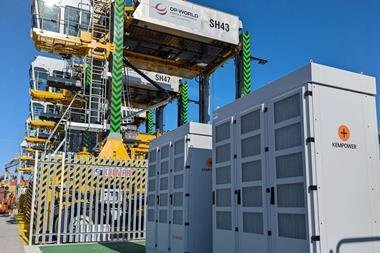
The Zero Emission Port Alliance (ZEPA) seeks to accelerate the electrification of container handling equipment by addressing a often underestimated issue: technological fragmentation. The alliance announces the launch of a “load profile” tool, a transition guide, and an update to its voluntary standards aimed at harmonizing batteries and charging systems to reduce adoption friction in terminals.
The heart of the matter is business: ZEPA indicates that, in most regions, the total cost of ownership of battery-electric equipment remains above that of diesel equivalents, but could become competitive within a horizon of one to five years, with segments already close to parity. The immediate challenge for operators is energy planning: the load profile tool aims to help terminals model the effect of charging choices on demand peaks, with ZEPA mentioning variations that could shift consumption peaks by several dozen megawatts.
For the market, this type of standardization is a trigger: without interoperability, each terminal ends up “reinventing” its charging architecture, which increases CAPEX/OPEX and slows down deployments. By clarifying standards, charging strategies, and cost trajectories, ZEPA aims to make electrification “financeable” more quickly, thereby transforming an ESG constraint into a rational economic decision.