



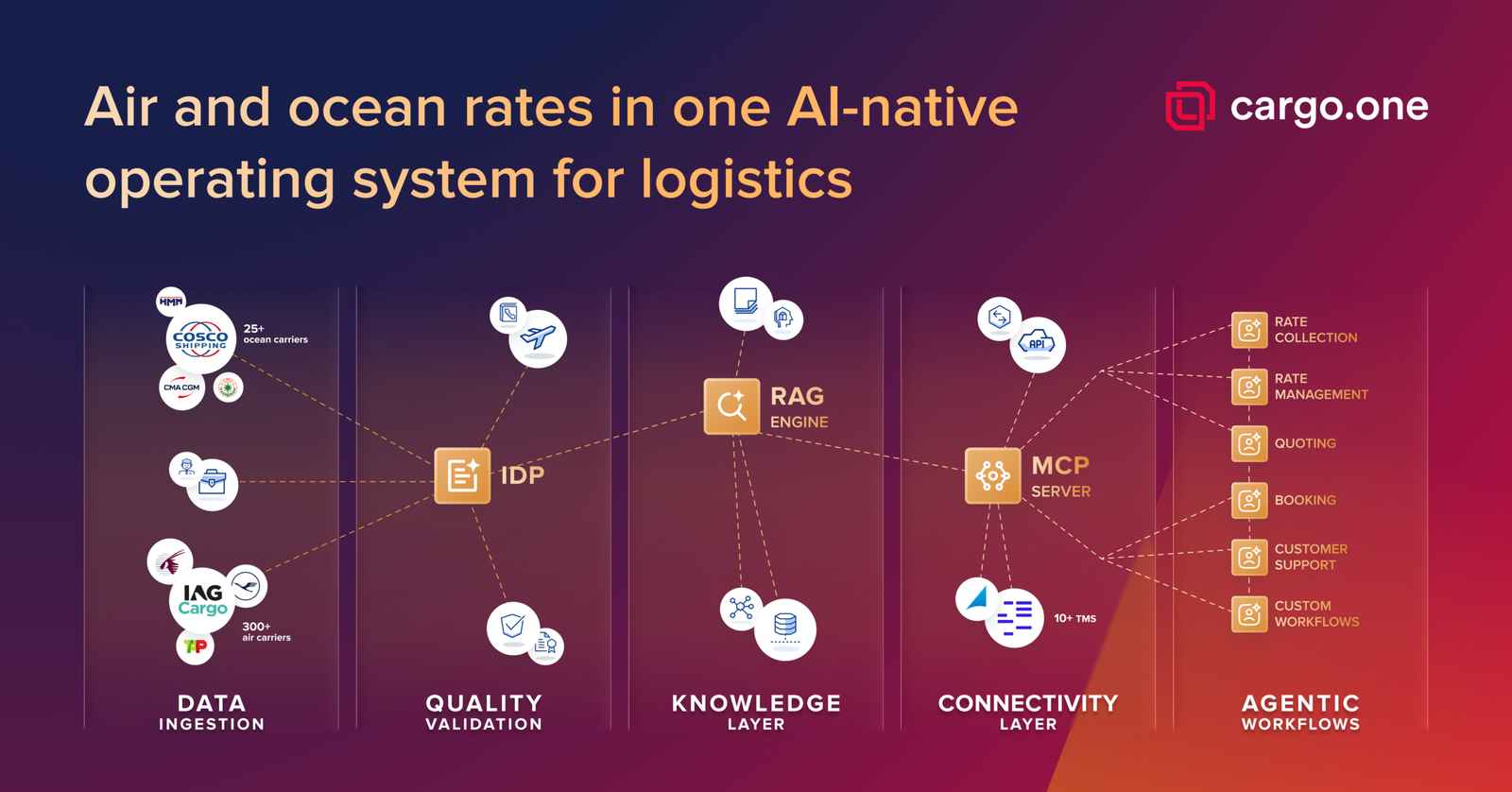
Air cargo booking platform cargo.one has announced the launch of what it describes as the industry’s first AI-native operating system designed specifically for multimodal freight operations.
The new system aims to unify air and ocean freight data within a single digital infrastructure, allowing logistics companies to deploy AI-driven workflows directly within their operational environment rather than relying on disconnected, bolt-on tools.
According to the company, the platform enables freight forwarders and carriers to run so-called “agentic workflows” across rate management, quoting, booking and customer support functions. Users can implement pre-built AI agents or develop customised solutions using open protocols such as MCP servers.
At the core of the system lies a multimodal data foundation that integrates structured rate information with retrieval-augmented generation (RAG) technology and supervision layers designed to monitor AI outputs for accuracy and reliability.
cargo.one argues that while many logistics companies are investing heavily in artificial intelligence, most initiatives struggle to move beyond pilot phases due to fragmented data ecosystems. AI applications often operate separately from the structured commercial data required for reliable automation.
“Most AI projects in logistics fail to deliver ROI because they lack access to robust, structured data,” said Moritz Claussen, founder and co-chief executive of cargo.one. “Real returns come from unified data infrastructure operating at enterprise scale.”
The company maintains that its system allows human operators and AI tools to work side by side using the same data environment, preserving transparency and operational control while automating repetitive processes.
To accelerate development, cargo.one recently secured $20 million in new funding from Bessemer Venture Partners and other technology investors. It also acquired ocean rate platform Cargofive, strengthening its ability to consolidate air and ocean pricing data within a single architecture.
Bob Goodman, partner at Bessemer Venture Partners, said logistics leaders evaluating AI partnerships should focus less on individual features and more on foundational data capabilities. “Features quickly become commoditised,” he noted. “What matters is having a partner with comprehensive data infrastructure and sector expertise that can evolve alongside your business.”
As digital transformation efforts intensify across freight markets, cargo.one’s move signals a broader shift toward embedded AI systems built directly into core logistics workflows rather than layered on top of legacy platforms.







