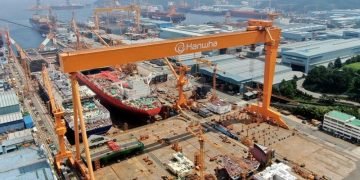




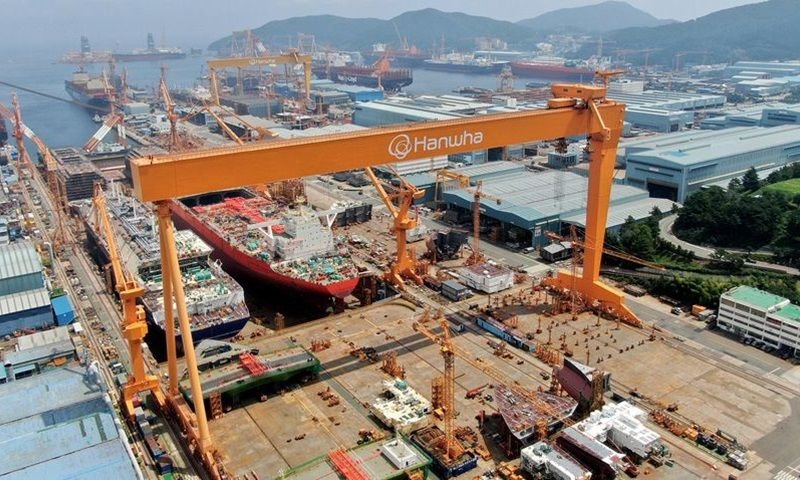
Hanwha Ocean is accelerating its push toward autonomous shipbuilding after selecting technology company NC AI to co-develop an AI-driven welding system that blends computer vision with collaborative robotics.
The South Korean shipbuilder aims to create a “physical AI” system capable of identifying welding zones, analysing working conditions and executing optimal welding operations in real time with minimal human intervention.
At the core of the initiative is one of shipbuilding’s most labour-intensive and technically demanding processes. The system under development is designed to allow robots to recognise weld lines, evaluate conditions on-site and automatically adjust key parameters such as torch angle and welding speed to ensure precision and consistency.
However, the project also targets a long-standing technical challenge in shipyard environments. Welding operations are typically affected by arc light, sparks, dust and lens contamination, all of which have historically limited the reliability of machine vision systems.
To overcome this, NC AI is developing shipbuilding-specific vision recognition technology using operational data from Hanwha Ocean alongside feedback from engineers. The goal is to enable accurate weld-line detection and real-time defect identification even under heavily degraded visual conditions.
The company also plans to integrate its next-generation vision-language model, VAETKI Vision, as the central engine of the system. This model combines visual inputs with textual instructions and is expected to evolve into a vision-language-action framework capable of converting human commands directly into robotic execution.
In practical terms, workers will be able to issue voice or text instructions, after which the system will interpret the welding task, analyse the environment and generate the appropriate control actions autonomously.
NC AI chief executive Lee Yeon-su said the objective is to build “robust vision recognition technology and autonomous control models that overcome dust and contamination on site.”
“We will create a physical AI model at the world’s highest level,” he added.
The project reflects a broader transformation across global shipyards, where artificial intelligence and robotics are increasingly being deployed to boost productivity, improve quality control and reduce reliance on manual labour at a time of persistent workforce shortages and rising demand for more advanced vessels.