



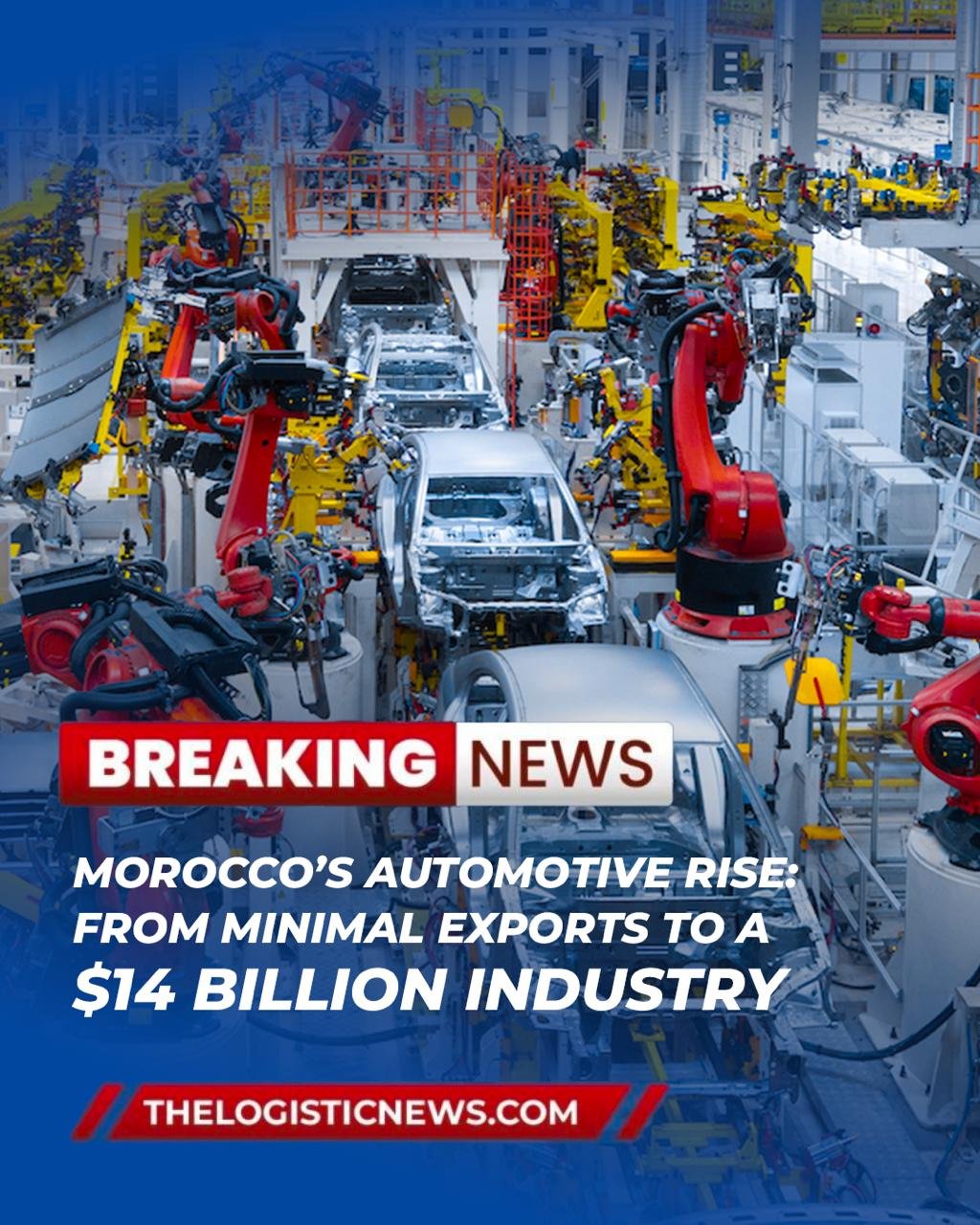
At the beginning of the 2000s, Morocco’s automotive sector was barely visible on the global export map. In 2005, the country exported virtually no vehicles abroad. Two decades later, the transformation is striking: by 2025, Morocco exported more than $14 billion worth of vehicles, making it Africa’s largest car exporter and placing the country among the top 20 automotive exporters worldwide.
Such a shift did not happen overnight. It is the outcome of a long-term industrial strategy carefully designed and implemented over many years. At the center of this transformation stands the development of Tanger Med Port, which has grown into the largest port in Africa and the Mediterranean. The port now serves as a critical logistics gateway connecting Morocco with European and global markets.
Alongside these infrastructure investments, Morocco succeeded in attracting major global automotive manufacturers. Two large assembly complexes were established through partnerships with Renault and Stellantis, laying the foundation for a powerful industrial ecosystem centered around vehicle production.
Around these manufacturing facilities, the Tanger Med free zone and its surrounding industrial cluster have evolved into a major economic engine. Today, more than 100,000 people are directly employed in automotive manufacturing in the region. When suppliers, logistics operators and related services are included, the industry’s broader supply chain impact extends across a significant part of Morocco’s economy.
Morocco’s industrial approach has been straightforward in concept but demanding in execution: position the country as Europe’s manufacturing neighbor. Its geographic proximity allows efficient just-in-time logistics for European markets, while competitive labor costs, political stability and continuous investment in infrastructure have strengthened the country’s appeal to international investors.
The strategy has delivered tangible results.
For many African economies seeking to develop higher value-added manufacturing, Morocco’s experience offers an important lesson. Success is not simply about being the lowest-cost location. Instead, it depends on reliable infrastructure, strong logistics connectivity and a stable environment capable of supporting long-term industrial investment.
Encouraged by the success of the automotive sector, Morocco is now applying a similar industrial model to other strategic industries, including aerospace, pharmaceuticals and renewable energy technologies. In many ways, the automotive boom has served as a proof of concept.
As global supply chains continue to evolve, Morocco’s trajectory demonstrates that Africa can become a competitive manufacturing base for international markets. In several respects, the country is already showing how that transformation can be achieved.