




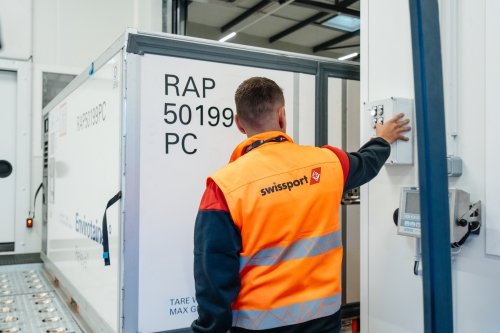
Swissport has reached a major operational milestone at EuroAirport Basel-Mulhouse-Freiburg, handling more than 1,000 temperature-controlled containers through its dedicated cool+connect facility.
The milestone reflects strong growth in pharmaceutical cargo volumes and reinforces Basel’s position as a strategic European gateway for life science airfreight.
Since launching the cool+connect infrastructure in February 2025, Swissport has processed more than 1,000 RKN-equivalent temperature-controlled containers at EuroAirport Basel. Monthly volumes have now risen to between 200 and 250 RKN-equivalent units.
This growth highlights increasing demand for reliable, airport-based cold chain solutions. It also places Swissport at the centre of pharmaceutical supply chains connecting Europe with key markets in Asia and beyond.
Swissport’s global pharma network includes 24 certified pharma centres and 65 pharma-capable warehouses worldwide, supporting its growing role in temperature-sensitive healthcare logistics.
The cool+connect facility is designed to optimise the handling of shipments requiring temperatures between +2°C and +8°C. By consolidating consignments directly at the airport before loading them into Active Cooltainers, Swissport maintains the cold chain throughout the process.
The model eliminates off-airport trucking loops, cuts handling times by around 70% and reduces CO₂ emissions, while protecting shipment integrity.
Andreas Behnke, Regional Head of Cargo for Switzerland, Italy and France at Swissport, said the milestone confirms the structural growth of temperature-controlled cargo. He added that demand from global pharmaceutical manufacturers and healthcare logistics providers continues to rise, particularly for airport-based solutions that reduce complexity and transit time.
Building on the success of cool+connect, Swissport is also strengthening resilience at Cargo Basel with newly tested thermal covers for transport dollies. Designed for extreme heat and cold, the reusable and washable covers can maintain stable temperatures for up to three hours during airside transport.
Specially adapted cargo dollies have been equipped with the system, allowing seamless integration into daily operations without adding handling complexity.
The investment further reduces weather-related risk and reinforces end-to-end temperature control for critical healthcare shipments.