



Ocado is reworking its US playbook.
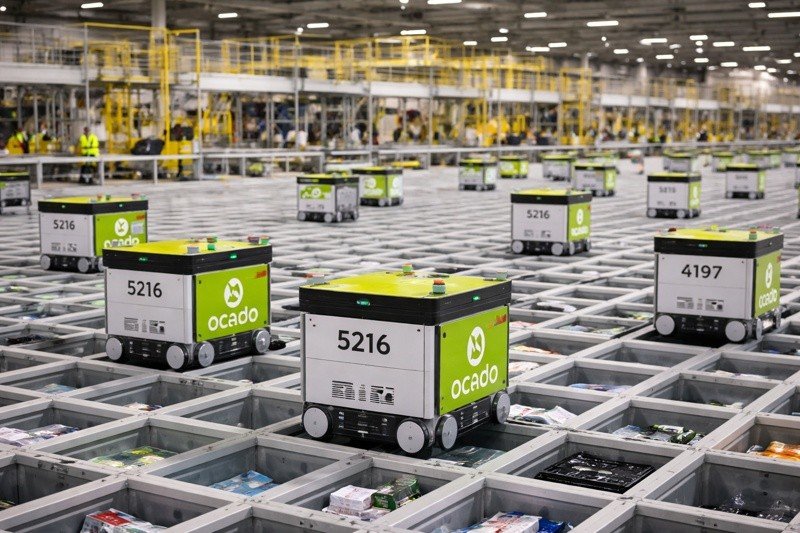
The British e-commerce technology company is turning its attention to store-based automated fulfillment after the end of its exclusive agreement with Kroger, a partnership that had once centered on large, highly automated customer fulfillment centers.
With that exclusivity agreement ending last year, Ocado is now in discussions with other American retailers about a more compact system designed to operate within or alongside stores. CEO Tim Steiner told Reuters that conversations with US grocers have been positive and that interest is centered more on the new smaller-format solution than on the company’s traditional large fulfillment centers.
Ocado hopes to test the technology at several US sites before expanding more broadly.
The store-based system, unveiled last year, is built to hold around 20,000 products within 4,000 to 5,000 square feet of space. It combines the company’s grid-based robotics technology with human labor and includes pickup points where drivers can collect orders for final delivery.
The move reflects a broader shift in grocery e-commerce. While Ocado built its reputation on massive next-day fulfillment centers, many grocers in the US and beyond are increasingly leaning on stores to fulfill online orders—partly for efficiency reasons and partly because of strong demand for same-day delivery.
That change places Ocado more directly in competition with companies developing micro-fulfillment centers and other forms of smaller-scale automation. Although those models have struggled to scale widely in the US grocery sector, there are signs of renewed momentum. Walmart acquired automation specialist Alert Innovation in 2022, and Amazon is currently testing a micro-fulfillment center inside a Whole Foods Market store in Pennsylvania.
Speaking during Ocado’s recent earnings call, Steiner argued that the company’s long experience in grocery fulfillment gives it an advantage. He said the smaller-format automation system starts to make commercial sense for stores generating at least $5 million in annual online sales.
In his view, stores doing only $2 million to $3 million in digital sales are not yet at a scale where store-based automation delivers a proper return. But for sites in the $5 million to $8 million range, and growing, the economics become much more compelling.
The pressure to adapt is real. In addition to Kroger closing three customer fulfillment centers and related facilities, Canadian retailer Sobeys announced in January that it would shut the Calgary fulfillment center it had developed with Ocado. More recently, the company also said it would cut around 5% of its workforce, roughly 1,000 jobs, according to the BBC.
For Ocado, the message is clear: the next phase of grocery automation may be smaller, closer to the store, and far more flexible than the warehouse-first model that once defined the company’s US ambitions.