




Africa’s air cargo market is showing renewed momentum, supported by strong perishables exports, shifting global supply chains and efforts to lower trade barriers across the continent.
According to IATA, African airlines recorded a 6% year-on-year increase in air cargo demand in 2025, while capacity rose by 7.8%. That performance was supported by airline network expansion, added lift, deeper integration into international supply chains and sustained demand for perishables exports.
The opening months of 2026 have been even stronger. African carriers posted demand growth of 18.2% in January, the highest of any region, with capacity up 6.5%. In February, demand rose by 21% while capacity increased by 17.3%.
That momentum is also visible in the region’s trade lanes. The Africa-Asia corridor, despite representing just 1.3% of global market share, expanded by 41.6% in January, marking its seventh straight month of growth.
Imports from Asia into Africa include semiconductors, machinery parts, automotive components and equipment linked to renewable energy and power infrastructure. On the export side, Africa continues to ship perishables such as fruit, vegetables, flowers and seafood, alongside industrial raw materials and precious metals.
Even with that strong start, the outlook presented by IATA during its World Cargo Symposium in Lima was more cautious, pointing to 2% growth for Africa in 2026. That figure is still broadly in line with the softer outlook for the wider market. Global air cargo demand grew by 3.4% in 2025 and is expected to moderate to 2.6% this year, although January still showed a 5.6% year-on-year increase worldwide.
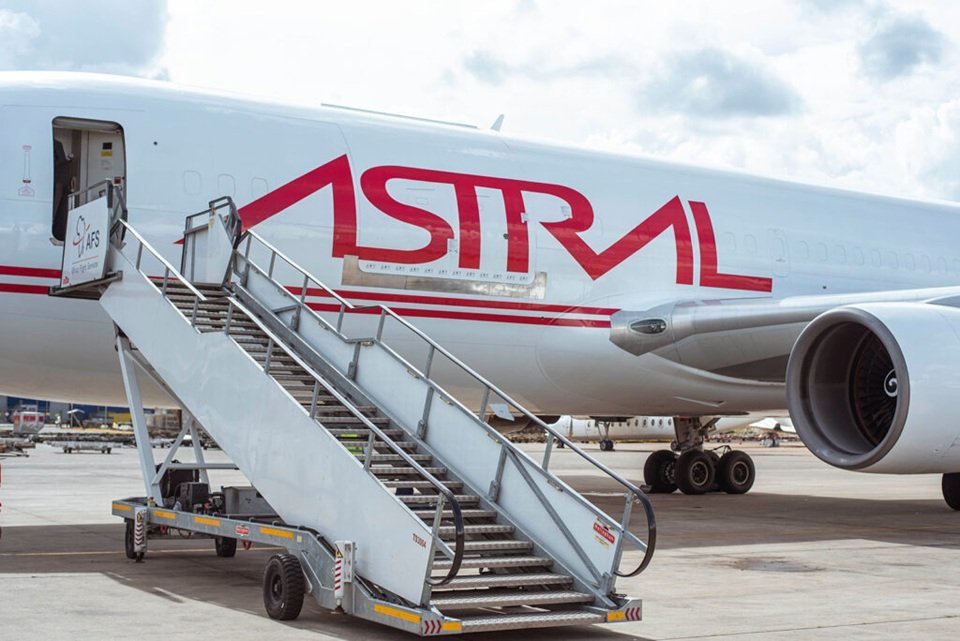
Among African operators, Astral Aviation remains optimistic. Chief executive Sanjeev Gadhia said the carrier expects stable to moderately positive growth this year despite geopolitical and economic uncertainty. He identified e-commerce, pharmaceuticals, perishables and energy-related cargo as the strongest performers, while noting that some general cargo segments may remain under pressure.
He also sees growing potential in intra-African demand as the African Continental Free Trade Area gains traction. According to Gadhia, stronger regional trade corridors, better connectivity and continued growth in perishables, pharma and e-commerce flows could make Africa one of the most promising air cargo growth regions globally.
Ground handlers are also benefiting from the rise in volumes. Swissport handled about 400,000 tonnes of cargo across Africa in 2025, accounting for roughly 8% of the group’s total global cargo volume of around 5m tonnes. Dirk Goovaerts, chief executive for Continental Europe, Middle East, Africa and India, and global cargo chair at Swissport, said that performance highlights the increasing importance of Africa within the company’s network.
Like Astral, Swissport sees perishables, pharmaceuticals and e-commerce as key growth drivers, alongside stronger regional trade supported by the AfCFTA. Goovaerts said the company expects steady market growth, with perishables still crucial in many African countries, e-commerce reshaping cargo flows through demand for faster processing and more flexible facilities, and healthcare logistics driving greater need for certified temperature-controlled handling.
Although e-commerce remains relatively small in Africa compared with other cargo segments, operators are positioning themselves for future growth. Astral is adjusting capacity selectively to capture global e-commerce flows passing through Africa, particularly from China and the Middle East into Johannesburg and Lagos via Nairobi.
Swissport is doing the same from the ground side. In South Africa, it has expanded its service offer to include dedicated e-commerce handling, freight forwarder services and flexible capacity solutions aimed at helping customers scale in a more volatile trade environment.
Supply chain shifts are also opening new doors. As the US ended the de minimis exemption and capacity moved from the transpacific to Asia-Europe, broader sourcing strategies such as China Plus One were already encouraging diversification in manufacturing and logistics patterns. Both Astral and Swissport believe Africa can benefit from this reconfiguration if it positions itself as a strategic logistics bridge between major global markets.
Goovaerts said cargo flows are increasingly moving towards emerging markets and alternative routes, including intra-African corridors. He also pointed to growing diversification in east and southern Africa, where exports traditionally destined for Europe are increasingly finding demand in the Middle East, especially from Gulf states, for products such as fresh meat, fruit and vegetables.
Algeria is another market Swissport sees as particularly promising. The country recorded a 10% rise in demand last year, helped by perishables exports, and is emerging as a gateway between Mediterranean and African markets. Goovaerts said Algeria is also expanding its pharmaceutical manufacturing base, creating new opportunities for temperature-controlled and specialist air cargo services.
Airlines themselves are also focused on fleet renewal. Africa has historically suffered from uneven capacity and a strong dependence on freighters because of limited passenger belly space. Astral has been replacing ageing narrowbody aircraft with more efficient widebody platforms and now operates one Boeing 737-400P2F, one 767-200P2F and one 767-300P2F. The airline plans further renewal, with interest in the 737-800F, 767-300F and potentially the 777F for long-haul work.
Astral had previously said it hoped to add two 777P2Fs, but those plans were slowed by the wait for Supplemental Type Certificate approvals. That landscape is now starting to change, with IAI holding approvals for its 777-300ERSF, Mammoth advancing its 777-200LRMF programme and Kansas Modification Center preparing to begin the STC process for its 777-300ERCF later this year.
Kenya Airways Cargo is also expanding. Its fleet currently includes two 737-300P2Fs, two 737-800P2Fs and a recently acquired 747F, which is supporting growth into the Middle East and Asia. Cargo director Fitsum Abadi Gebrehawaria said the airline ultimately wants three 777Fs by 2030, though it may temporarily rely on two 767-300Fs because of cost and availability constraints.
Kenya Airways is using its regional and long-haul network to target higher-value cargo flows in Africa, the Middle East and Asia. Perishables dominate widebody passenger services to Europe and North America, while inbound e-commerce from China is also moving on those routes. The airline sees further opportunity in the Asia-Pacific market, particularly Guangzhou and potentially Hong Kong, with perishables outbound and e-commerce inbound. It is also strengthening its network through interline agreements and partnerships with carriers such as Qatar Airways and Air Tanzania.
Yet despite the positive momentum, major obstacles remain. The conflict in the Middle East has caused airspace closures and driven up jet fuel prices. Although African airlines are not flying through the closed zones, they have historically relied on Gulf airspace for links to Europe and Asia.
At the same time, blocked airline funds remain a serious issue. IATA reported in December that $1.2bn in airline funds were being withheld from repatriation by governments as of the end of October 2025, with 93% of the total trapped in Africa and the Middle East. Gadhia said that challenge adds to already high operating costs, financing constraints, fragmented regulation, weak infrastructure, high taxes and the slow rollout of liberalisation frameworks such as the Single African Air Transport Market.
He said these issues continue to limit connectivity and raise costs, although industry bodies and airlines are working with governments to promote open skies, regulatory harmonisation and more efficient customs systems.
The AfCFTA is also starting to make a practical difference. Abadi said it is helping shorten lead times through streamlined customs processes, supporting just-in-time models for e-commerce, SMEs and manufacturers. Air cargo remains vital in that effort by helping shippers bypass weak road and rail systems, border delays and other logistics bottlenecks.
Even so, implementation of SAATM remains uneven despite 38 African countries signing up, as some governments remain cautious about the effect on national airlines. Abadi said broader adoption will require fair competition, strong safety and security compliance, and regulatory safeguards that protect both national and regional interests.
Africa’s air cargo story is therefore one of real opportunity, but also unfinished structural reform. The growth drivers are clear. The next step is ensuring the regulatory and infrastructure environment can keep pace.