



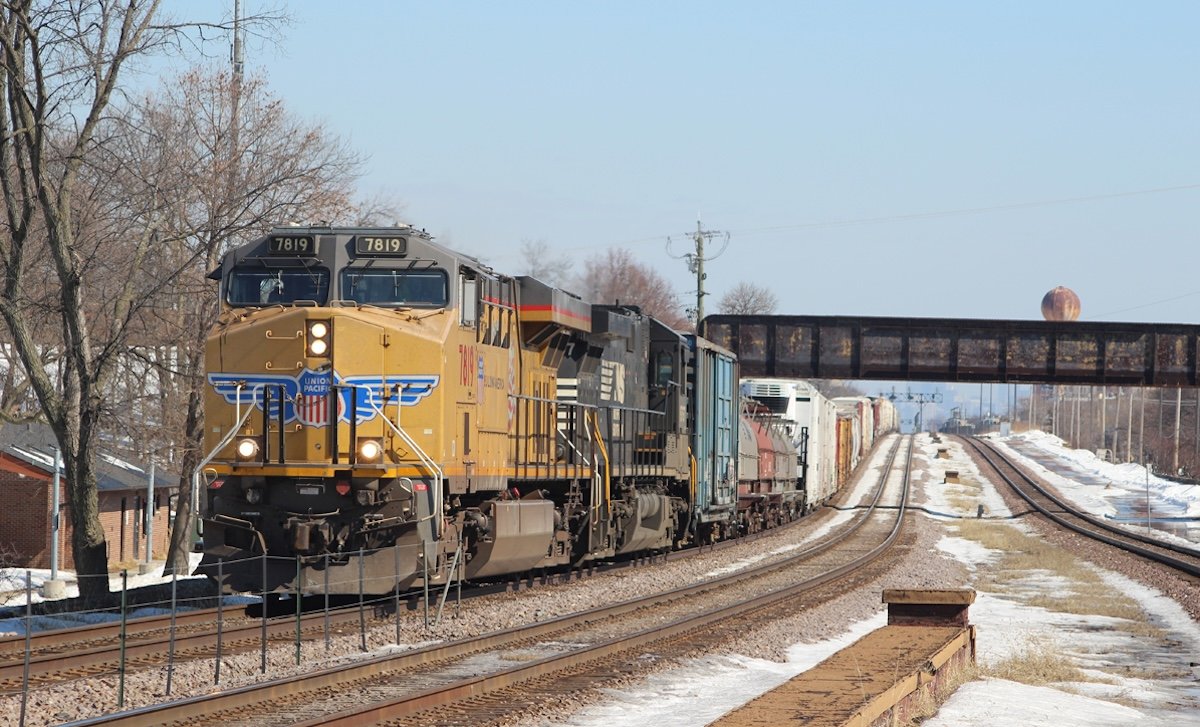
Norfolk Southern chief executive Mark George says the proposed transcontinental merger with Union Pacific could become the “one big thing” capable of addressing rail’s long-standing growth problem in the United States.
Speaking at the annual conference of the American Short Line and Regional Railroad Association in Minneapolis, George described the potential combination as a transformative opportunity for an industry that has struggled for decades to win back market share from trucking.
He said Norfolk Southern has come through a series of severe challenges in recent years, including the Covid pandemic, weaker shipper demand, a major hazardous materials derailment, labour tensions, executive turbulence and pressure from activist investors. Despite that, he said the company has been operating well for the past two years and the wider rail industry is now delivering more consistent service.
But for George, that improvement is not enough on its own. He pointed out that over the past two decades freight volumes at Norfolk Southern have declined by 11% and by 15% at Union Pacific, even as the broader economy continued to grow. Railroads responded by cutting costs and raising prices to protect earnings, but that did not reverse the structural loss of freight to trucks.
George said the industry must accept some responsibility for that outcome. In his view, shippers turned to trucking because rail service had too often been inconsistent and unreliable, forcing customers to hedge against uncertainty.
He contrasted the fragmented US rail map with the more integrated transcontinental systems operated by CN and CPKC in Canada. In the US, he said, east-west freight still depends on handoffs between separate railroads crossing the Mississippi watershed, creating service inconsistency, poor visibility and dwell time at interchange points.
That fragmentation, he argued, makes it harder for rail to scale with customers beyond regional footprints and represents a structural barrier to growth.
George said the Union Pacific–Norfolk Southern merger could help break through that limit by reducing handoffs and creating a more seamless end-to-end network. He linked the proposal to the period after deregulation in the 1980s, when rail mergers helped drive volume growth, improve productivity, lower rates and support profitability.
He acknowledged that merger integrations have caused pain in the past, but pointed to the Conrail split between CSX and Norfolk Southern as an example of a deal that ultimately led to seven straight years of volume growth, despite operational challenges along the way.
George also defended forecasts that the proposed merger could convert 1.3 million truckloads to rail. He said the partners expect to cut transit time by around 95 hours — roughly four days — on traffic moving from southern California to the southeastern United States, bringing service much closer to truck competitiveness.
At the same time, he admitted the process has faced setbacks. The companies will need to refile a 7,000-page application after their initial filing hit procedural problems, but he said the aim is to get the revised submission in by the end of April.
Once accepted, he expects the Surface Transportation Board review process to last at least a year.
George insisted that the companies are determined not to repeat the mistakes of earlier rail mergers. He described the combination as complex, but less challenging than integrating overlapping networks, and said the process would be handled in a careful and measured way.
For him, the logic is ultimately simple: if US rail is to return to sustained growth, it needs structural change — not just incremental improvement.